
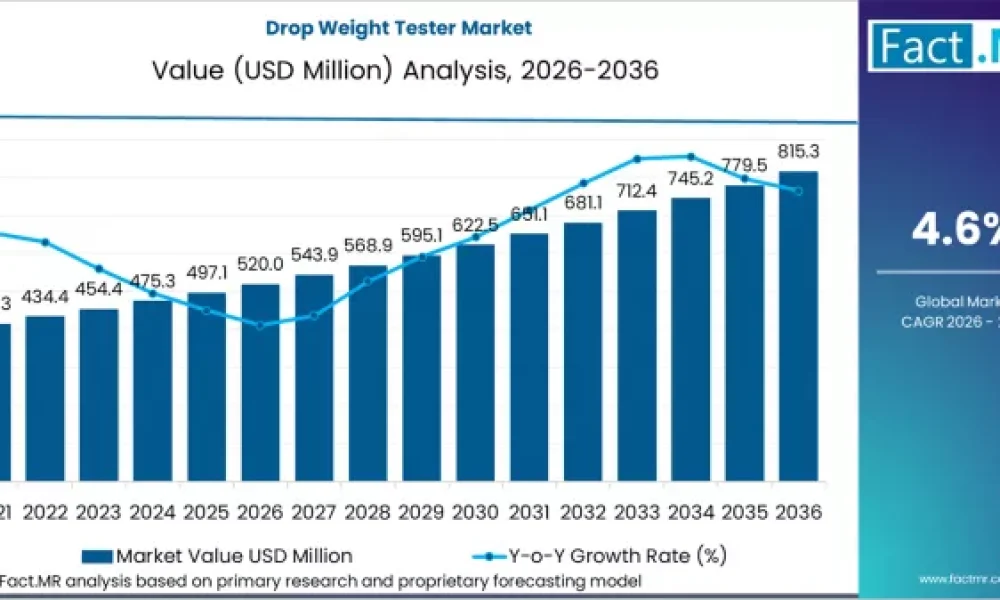
The global drop weight tester market is entering a pivotal era of expansion, fueled by a rigorous surge in industrial safety standards and the rapid development of high-performance materials. As of early 2026, industry analysts project a steady upward trajectory for the sector, with recent data suggesting a compound annual growth rate (CAGR) of approximately 9.9% through 2032. This growth is being steered by the automotive, aerospace, and energy sectors, which increasingly require precise impact resistance data to ensure the integrity of next-generation components.
Strategic Market Overview: The 5 Ws of Impact Testing
Who: Leading manufacturers such as ZwickRoell, Instron, and Testron Group are spearheading the market alongside emerging players in the Asia-Pacific region.
What: The market encompasses semi-automatic and fully automated dropping weight testing systems designed to evaluate the fracture toughness and energy absorption of polymers, metals, and composites.
When: The current growth phase, intensified in 2025, is expected to maintain momentum through the 2032 forecast period.
Where: While North America and Europe currently hold the largest market shares due to established aerospace and automotive infrastructures, the Asia-Pacific region (specifically China and India) is identified as the fastest-growing geographical segment.
Why: Escalating regulatory requirements (such as ASTM D2444 and UL 651) and the industry-wide shift toward lightweight materials have made drop weight testing a non-negotiable step in the quality assurance pipeline.
Request for Sample Report | Customize Report |purchase Full Report – https://www.factmr.com/connectus/sample?flag=S&rep_id=13890
Technological Integration: From Manual to Autonomous Systems
A primary driver of the market’s current valuation is the transition from traditional manual testing to fully automated and IoT-integrated solutions. Modern drop weight testers are no longer isolated hardware units; they are now sophisticated data hubs.
The integration of advanced sensors and cloud-based data management has improved testing accuracy by nearly 30%, notes a recent industry analysis. These innovations allow for real-time data export and seamless reporting, reducing human error—a critical factor for sectors like pipeline manufacturing and pharmaceutical packaging.
The demand for fully automated systems is particularly high in high-volume production environments. These machines offer increased throughput and enhanced precision, addressing the bottleneck effect often seen in legacy material testing labs.
Key Market Drivers and Sector Analysis
1. Automotive and Aerospace Resilience
The automotive industry remains a cornerstone of the market. With the expansion of Electric Vehicle (EV) platforms, manufacturers are utilizing drop weight testers to evaluate the impact performance of battery enclosures and lightweight structural composites. Similarly, the commercial aerospace sector, which has seen a revival in its order books, relies on these testers to validate the durability of carbon-fiber-reinforced polymers (CFRP) against bird strikes and runway debris.
2. Energy and Infrastructure Expansion
The global focus on energy security has catalyzed investments in pipeline infrastructure. Drop Weight Tear Testers (DWTT) are essential for assessing the fracture behavior of pipeline steels, ensuring they can withstand extreme environmental pressures. This segment alone is projected to account for a significant portion of the market revenue as new oil and gas reserves are tapped in North America and the Middle East.
3. Stringent Safety Regulations
Regulatory bodies are imposing tighter constraints on material performance. Compliance with international standards is no longer just a competitive advantage but a legal necessity. This has led to a winner-takes-all dynamic where companies investing in high-precision, standard-compliant testers are capturing the majority of the market share.
Regional Performance and Future Outlook
Geographically, the market displays a bifurcated growth model:
North America: Leads in innovation and high-end instrumented tester adoption, currently holding a 35.6% market share.
Asia-Pacific: Dominates in terms of volume and growth speed, driven by massive industrialization and infrastructure projects in China and India.
Despite high initial investment costs for automated systems, the long-term ROI—realized through 30% faster testing cycles and 100% compliance rates—is encouraging smaller enterprises to adopt modular, semi-automatic units.
Summary of Market Projections (2025–2032)
| Metric | Projection |
| Market Growth (CAGR) | 9.9% |
| Dominant Segment | Fully Automated Testers |
| Leading Application | Automotive & Pipeline Steel |
| Key Tech Trend | IoT and Digital Integration |
As the industry moves toward 2032, the focus will likely remain on miniaturization, portability for field testing, and sustainable manufacturing of the testing equipment itself.
About the Industry Report:
This press release is based on a synthesis of current market data, including insights from LP Information, Future Market Reports, and ReAnIn. It highlights the critical role of material testing in the modern industrial landscape.
Related Reports



