
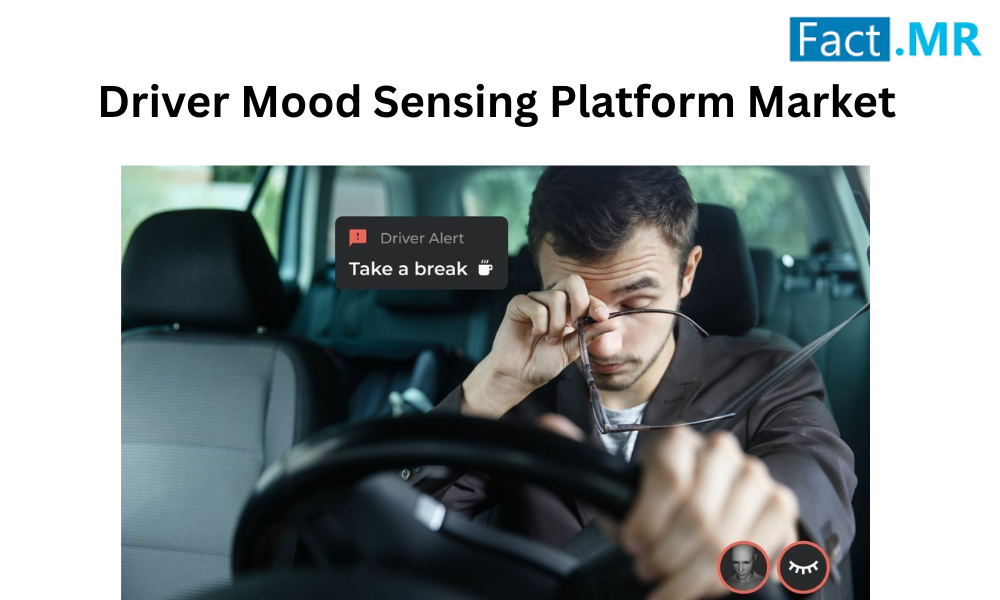
The global driver mood sensing platform market is set for substantial expansion, with its valuation projected to increase from USD 2,564 million in 2025 to USD 7,413 million by 2035. This growth reflects a robust compound annual growth rate (CAGR) of 11.2% over the forecast period from 2025 to 2035. The surge is primarily driven by advancements in automotive safety technologies, increasing regulatory emphasis on road safety, and the integration of AI-driven systems in vehicles. As road accidents due to driver fatigue, distraction, and emotional impairment continue to rise, mood sensing platforms are becoming essential for real-time monitoring and intervention, enhancing driver wellness and vehicle safety. This market evolution is further fueled by the rise of connected and autonomous vehicles, where these platforms personalize infotainment and support fleet management, positioning them as key components in modern automotive ecosystems.
Market Segmentation and Trends
The driver mood sensing platform market is segmented by component, detection parameter, vehicle type, application, end-use, and region, providing a detailed view of its dynamics. By component, hardware holds a leading share of 57% in 2025, driven by innovations in in-car cameras, infrared sensors, and biometric devices, while software and services are growing rapidly for AI integration. Detection parameters include facial expression recognition (CAGR 10.7%), eye movement and blink rate monitoring, voice tone and speech analysis (CAGR 12.1%), physiological signals, and driving pattern analysis, with facial recognition dominating for its non-intrusive accuracy.
By vehicle type, the market caters to passenger and commercial vehicles, with passenger cars leading due to consumer demand for safety features. Applications span safety and accident prevention, driver wellness, infotainment personalization, fleet management, and support for autonomous driving, where safety applications are the fastest-growing amid regulatory pressures. End-uses include OEM-installed systems, aftermarket solutions, and fleet operators, reflecting broad adoption.
Regionally, East Asia is a key growth area, with China at a 12.8% CAGR, followed by India at 12.6% and the U.S. at 11.7%. Trends highlight the use of AI and machine learning for precise emotion detection, the integration of multimodal sensors for comprehensive monitoring, and the development of privacy-focused systems to address data concerns, aligning with global safety standards.
Full Market Report Available for Delivery. For Purchase or Customization, Please Request Here: https://www.factmr.com/connectus/sample?flag=S&rep_id=10874
Driving Factors Behind Market Growth
The driver mood sensing platform market is propelled by stringent road safety regulations and increasing awareness of driver well-being. Governments in Europe, North America, and East Asia are implementing policies to reduce accidents caused by fatigue, distraction, or impaired driving, pushing OEMs to adopt advanced in-cabin sensing technologies. Technological innovations, including AI, computer vision, and biometric sensors, have improved detection accuracy and real-time interventions, further boosting market adoption.
The rise of connected and autonomous vehicles presents new opportunities, with mood-sensing platforms enhancing in-car experiences and fleet performance. The demand for personalized automotive features, such as adaptive infotainment based on driver mood, is also a key driver. Additionally, the focus on reducing insurance premiums through safer driving behaviors and the integration with ADAS systems are accelerating growth, as these platforms provide proactive alerts to prevent accidents.
Recent Developments and Key Players
The driver mood sensing platform market is competitive, with key players focusing on innovation, partnerships, and regulatory compliance to capture market share. Recent developments underscore the industry’s progress. In June 2024, Tobii introduced Glasses Explore, a cloud-based software for analyzing human awareness and behavior, enhancing mood detection capabilities. In January 2024, Paravision launched Paravision Liveness, a technology for passive face image verification, improving security in driver monitoring systems.
Key players include Valeo S.A., Denso Corporation, Robert Bosch GmbH, Seeing Machines Limited, Continental AG, Aptiv PLC, Magna International Inc., Visteon Corporation, Smart Eye AB, Lytx Inc., ZF Friedrichshafen AG, Veoneer Inc., Faurecia S.A., Panasonic Corporation, and Harman International Industries. Competitor analysis reveals a emphasis on AI integration and multimodal sensing. Companies are investing in R&D for accurate emotion recognition and forming alliances with automakers to embed systems in vehicles, ensuring scalability and compliance.
Regional Insights and Opportunities
North America and Western Europe lead in market adoption, supported by strict safety norms, high consumer awareness, and early development of driver monitoring systems. The U.S. benefits from advanced automotive tech ecosystems, while Europe emphasizes regulatory compliance for ADAS features.
East Asia, particularly China, Japan, and South Korea, is the fastest-growing region, driven by high automotive manufacturing rates, government safety initiatives, and advancements in electric and autonomous vehicles. South Asia, including India and ASEAN countries, shows strong potential due to rising middle-class demand and improved road safety policies. Latin America, Eastern Europe, the Middle East, and Africa are emerging, with fleet operators recognizing benefits for accident reduction and cost efficiency. Opportunities lie in aftermarket solutions for existing vehicles and OEM integrations in new models.
Challenges and Future Outlook
The driver mood sensing platform market faces challenges such as high implementation costs and system integration complexities. The need for active sensors, AI algorithms, and biometric tracking requires significant R&D investment, making the technology expensive for mid- and low-cost vehicles. Data privacy and cybersecurity concerns are also significant, with sensitive biometric data at risk.
However, the future outlook is optimistic, with opportunities in connected vehicles and fleet management. As regulations tighten and technology advances, the market is well-positioned for sustained growth, transforming road safety through intelligent mood sensing by 2035.
Check out More Related Studies Published by Fact.MR:
Driver Behavior Visualization Market: https://www.factmr.com/report/driver-behavior-visualization-market
Driver Attention Alert Systems Market: https://www.factmr.com/report/960/driver-attention-alert-systems-market
Contact:
US Sales Office
11140 Rockville Pike
Suite 400
Rockville, MD 20852
United States
Tel: +1 (628) 251-1583, +353-1-4434-232
Email: [email protected]
About Fact.MR
We are a trusted research partner of 80% of fortune 1000 companies across the globe. We are consistently growing in the field of market research with more than 1000 reports published every year. The dedicated team of 400-plus analysts and consultants is committed to achieving the utmost level of our client’s satisfaction.



