
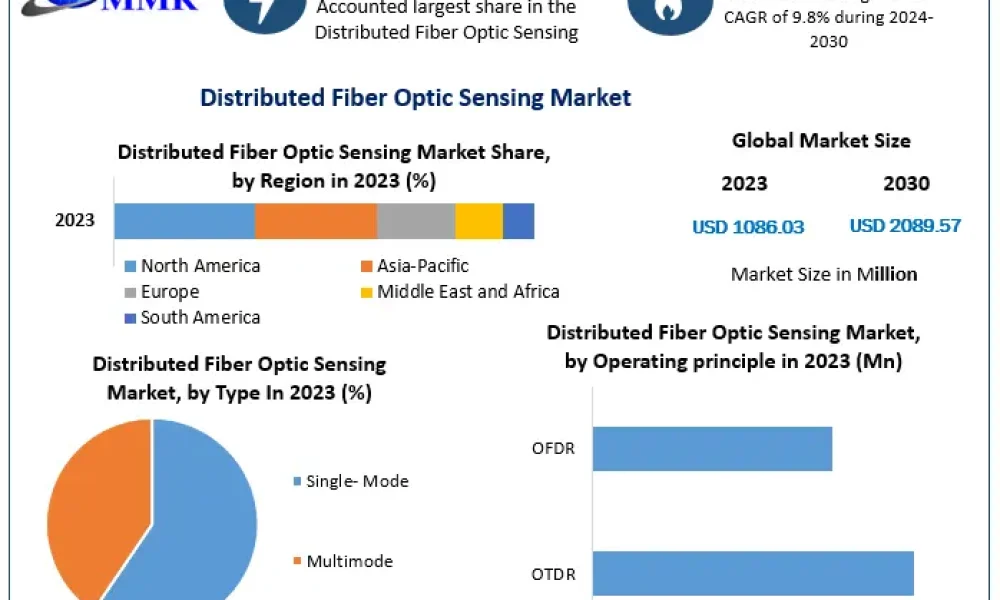
Distributed Fiber Optic Sensing Market Overview:
Distributed Fiber Optic Sensing Market has exhibited significant growth and is projected to expand from approximately USD 1.24 billion in 2024 to nearly USD 2.81 billion by 2030, representing a robust CAGR of around 11.4%. This surge is driven by increasing demand for continuous, real-time monitoring solutions across critical infrastructure sectors such as oil & gas, power & utilities, civil engineering, safety, and security.
Key Highlights & Insights
Market Size & Growth: Valued around USD 1.24 billion in 2024, the market is forecasted to reach USD 2.81 billion by 2030, growing at a CAGR of approximately 11.4%.
Dominating Region: North America leads the global DFOS market with a revenue share exceeding 30%, fueled by mature infrastructure, substantial oil & gas industry investments, and government focus on energy grid modernization and safety protocols.
Leading Segment: The multimode fiber segment holds the largest share owing to cost efficiency and flexibility in moderate distance sensing applications. Temperature sensing is the dominant application, comprising nearly 46% of the market.
Key Driver: The rising necessity for safety, operational efficiency, and environmental compliance in industrial sectors, combined with the increasing reliance on smart infrastructure and IoT-based asset monitoring, propels market demand.
► Get a sample of the report:https://www.maximizemarketresearch.com/request-sample/34649/
Recent Developments
2023-2025: Industry leaders including Baker Hughes, Schlumberger, Luna Innovations, and Northrop Grumman have invested heavily in R&D to enhance sensor sensitivity, range, and integration with AI-driven analytics platforms.
Rollout of pilot projects integrating DFOS with smart city infrastructures, energy grids, and border security amplifies the market’s scope.
Technological advancements such as Optical Time Domain Reflectometry (OTDR) and Optical Frequency Domain Reflectometry (OFDR) improve sensor accuracy and system reliability.
Collaborative ventures between government agencies and private players focus on deploying DFOS solutions in critical infrastructure monitoring and disaster management.
Market Dynamics
Growth Drivers:
Critical need for continuous monitoring of pipelines, borders, and infrastructure to prevent accidents and unauthorized activities.
Government regulations mandating enhanced safety and monitoring systems bolster adoption across oil & gas, power utilities, and transport sectors.
Advantages of distributed sensing over point sensors, delivering high spatial resolution for large-scale asset monitoring.
Integration with AI and machine learning enables predictive maintenance and real-time anomaly detection.
Challenges:
High deployment and maintenance costs may limit adoption in small-scale applications.
Requirement for specialized installation expertise and data interpretation skills.
Vulnerability to environmental factors and system complexity in harsh operating conditions.
Regional Analysis
North America: The largest and most advanced market characterized by extensive oil & gas infrastructure and smart grid investments. The U.S. spearheads regional demand supported by policy frameworks and technological capacity.
Asia Pacific: Fast-growing region with expanding urbanization, industrialization, and government initiatives in India, China, Japan, and South Korea driving demand.
Europe: Steady growth supported by smart city projects, renewable energy integration, and regulatory emphasis on critical infrastructure monitoring.
Latin America & Middle East/Africa: Emerging adoption with governments and private sector exploring critical infrastructure digitization to improve safety and operational efficiency.
Product Segmentation
By Fiber Type: Multimode (largest), Single-mode.
By Technology: Rayleigh Scattering (dominant), Brillouin, Raman, Fiber Bragg Grating.
By Application: Temperature sensing (largest), strain sensing, acoustic sensing.
By Vertical: Oil & Gas, Power and Utility, Safety and Security, Infrastructure, Industrial.
Key Trends
Increasing adoption of DFOS in smart city infrastructures and industrial IoT ecosystems.
Expansion of AI-powered analytics for advanced interpretation and predictive maintenance.
Development of hybrid sensing technologies combining multiple scattering effects.
Growing focus on cost-effective, scalable deployment solutions to enable broader market penetration.
Quote
“North America’s leadership in the Distributed Fiber Optic Sensing market is a reflection of its advanced industrial infrastructure and active investments in safety, sustainability, and smart technologies. As global demand for real-time monitoring intensifies, DFOS systems will be pivotal in safeguarding critical assets and enabling the next generation of resilient infrastructure.”
Contact Maximize Market Research:
3rd Floor, Navale IT Park, Phase 2
Pune Bangalore Highway, Narhe,
Pune, Maharashtra 411041, India
[email protected]
+91 96071 95908, +91 9607365656
About Maximize Market Research:
Maximize Market Research is a multifaceted market research and consulting company with professionals from several industries. Some of the industries we cover include medical devices, pharmaceutical manufacturers, science and engineering, electronic components, industrial equipment, technology and communication, cars and automobiles, chemical products and substances, general merchandise, beverages, personal care, and automated systems. To mention a few, we provide market-verified industry estimations, technical trend analysis, crucial market research, strategic advice, competition analysis, production and demand analysis, and client impact studies.




