
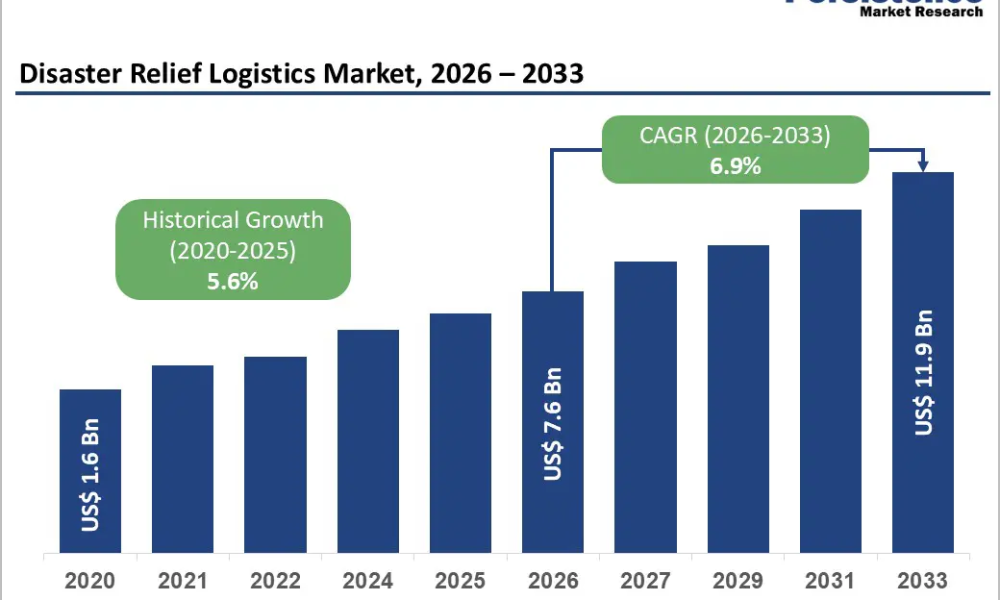
The global disaster relief logistics market is poised for steady growth as the frequency and intensity of natural and man-made disasters continue to rise worldwide. The market is projected to be valued at US$ 7.6 billion in 2026 and is expected to reach US$ 11.9 billion by 2033, registering a compound annual growth rate (CAGR) of 6.9% during the forecast period from 2026 to 2033.
Disaster relief logistics involves the planning, management, and execution of supply chain operations to deliver essential goods and services during emergencies. These include food, medical supplies, shelter equipment, and rescue resources. The growing occurrence of climate-related disasters such as floods, hurricanes, earthquakes, and wildfires is significantly driving demand for efficient and responsive logistics systems.
Additionally, increasing government investments in disaster preparedness and response infrastructure, along with the involvement of international humanitarian organizations, are contributing to market growth. The need for rapid deployment, real-time coordination, and efficient resource allocation is encouraging the adoption of advanced logistics solutions. Furthermore, the integration of digital technologies is transforming traditional disaster response mechanisms into more agile and data-driven systems.
Get Free Sample Now: https://www.persistencemarketresearch.com/samples/34148
Key Highlights from the Report
➤ Market Value: The disaster relief logistics market is projected to grow from US$ 7.6 billion in 2026 to US$ 11.9 billion by 2033, at a CAGR of 6.9%.
➤ Increasing frequency of natural disasters driving demand for efficient logistics solutions.
➤ Rising government and NGO investments in disaster preparedness and response.
➤ Growing adoption of advanced technologies for real-time coordination and tracking.
➤ Expansion of global humanitarian operations supporting market growth.
➤ Increasing focus on rapid response and efficient resource allocation.
Segmentation Analysis
By Type
The disaster relief logistics market is segmented into transportation, warehousing, inventory management, and distribution services. Among these, transportation services dominate the market due to their critical role in delivering relief supplies to affected areas. Efficient transportation networks, including air, land, and sea routes, are essential for timely response during emergencies. Warehousing and inventory management are also gaining importance, as pre-positioning of supplies enables faster deployment and reduces response times.
By Vehicle/Product/Service Type
Based on application, the market is categorized into food and water supply, medical aid, shelter materials, and rescue equipment. Food and water supply account for the largest share, as they are the most immediate needs during disaster situations. Medical aid is another critical segment, driven by the need for emergency healthcare services and supplies. Shelter materials and rescue equipment are also essential components, supporting long-term recovery and rehabilitation efforts.
By Propulsion/Technology/Channel
The market is influenced by advancements in logistics technologies and distribution channels. The integration of air transport, ground vehicles, drones, and maritime logistics is enabling more efficient and flexible disaster response operations. Technological advancements such as digital supply chain management systems, real-time tracking, and automated inventory management are enhancing operational efficiency. Both government agencies and private logistics providers are playing key roles in delivering disaster relief services.
Regional Insights
North America holds a significant share of the global disaster relief logistics market, driven by advanced infrastructure, strong government support, and the presence of leading logistics companies. The region’s proactive approach to disaster management and preparedness is contributing to market growth.
Europe also represents a key market, supported by well-established humanitarian organizations and strong regulatory frameworks. The region’s focus on sustainability and efficient resource management is influencing the adoption of advanced logistics solutions.
Asia-Pacific is expected to be the fastest-growing region, fueled by the high frequency of natural disasters and increasing investments in disaster management infrastructure. Countries such as India, China, and Japan are actively enhancing their disaster response capabilities, driving demand for efficient logistics solutions.
Request For Customization: https://www.persistencemarketresearch.com/request-customization/34148
Unique Features and Innovations in the Market
The disaster relief logistics market is undergoing significant transformation with the adoption of advanced technologies and innovative solutions. Modern logistics systems are designed to provide real-time visibility, efficient coordination, and rapid response capabilities.
Technologies such as AI, IoT, and 5G are playing a crucial role in enhancing disaster relief operations. AI-powered analytics enable predictive modeling and risk assessment, helping organizations prepare for potential disasters. IoT devices facilitate real-time tracking of supplies and equipment, ensuring efficient resource allocation. The adoption of 5G technology enables faster communication and data exchange, improving coordination among stakeholders.
Additionally, the use of drones and autonomous vehicles is revolutionizing last-mile delivery in disaster-affected areas. These technologies enable access to remote and hard-to-reach locations, ensuring timely delivery of critical supplies. Advanced data analytics and cloud-based platforms are further enhancing decision-making and operational efficiency.
Market Highlights
The adoption of disaster relief logistics solutions is driven by the need for rapid response, efficient resource management, and improved coordination during emergencies. Governments, NGOs, and private organizations are increasingly recognizing the importance of robust logistics systems in minimizing the impact of disasters.
Regulatory frameworks and international guidelines are playing a crucial role in shaping the market. Organizations are required to comply with standards related to safety, efficiency, and sustainability, encouraging the adoption of advanced logistics solutions.
Cost optimization and sustainability are also key considerations. Efficient logistics systems help reduce operational costs while ensuring timely delivery of supplies. The use of eco-friendly transportation methods and energy-efficient technologies is contributing to sustainable disaster management practices.
Key Players and Competitive Landscape
The global disaster relief logistics market is highly competitive, with several key players focusing on innovation, strategic partnerships, and expansion to strengthen their market position. Leading companies include:
✦ Deutsche Post DHL Group – A global logistics leader providing specialized disaster response services and humanitarian logistics solutions.
✦ FedEx Corporation – Offers rapid transportation and logistics support for disaster relief operations worldwide.
✦ United Parcel Service (UPS) – Focuses on efficient supply chain management and emergency response logistics.
✦ Kuehne + Nagel International AG – Provides integrated logistics solutions with a strong presence in humanitarian operations.
✦ DB Schenker – Specializes in global logistics services, including disaster relief and emergency response.
✦ Agility Public Warehousing Company – Known for its expertise in supply chain solutions and humanitarian logistics support.
These companies are leveraging advanced technologies, strategic collaborations, and global networks to enhance their disaster response capabilities. Partnerships with governments and humanitarian organizations are enabling them to expand their reach and improve service delivery.
Buy Now: https://www.persistencemarketresearch.com/checkout/34148
Recent Developments
- Deployment of drone-based delivery systems to improve last-mile logistics in disaster-affected areas.
- Expansion of digital logistics platforms for real-time tracking and coordination of relief operations.
Future Opportunities and Growth Prospects
The disaster relief logistics market presents significant growth opportunities, particularly in the context of increasing global disaster risks and technological advancements. The need for efficient and responsive logistics systems is expected to drive demand for innovative solutions in the coming years.
Technological advancements in AI, IoT, and data analytics will continue to play a crucial role in shaping the future of the market. These technologies will enable more accurate forecasting, efficient resource allocation, and improved coordination among stakeholders.
Evolving regulations and international standards will further influence market dynamics, encouraging the adoption of sustainable and efficient logistics practices. Companies that invest in advanced technologies, global expansion, and strategic partnerships are likely to gain a competitive advantage.
In conclusion, the global disaster relief logistics market is set for steady growth, driven by increasing disaster risks, technological advancements, and growing investments in disaster management infrastructure. As the market continues to evolve, innovation and collaboration will remain key to enhancing disaster response capabilities and minimizing the impact of emergencies worldwide.




