
The Direct-to-Shape (DTS) Inkjet Printer Market is gaining traction as industries increasingly adopt advanced digital printing technologies for packaging, branding, and product customization. Direct-to-shape inkjet printers enable high-quality printing directly on three-dimensional objects such as bottles, containers, cans, tubes, and other shaped surfaces without the need for labels or secondary processes. This technology reduces production time, improves printing precision, and enhances product aesthetics. Industries such as cosmetics, beverages, pharmaceuticals, and consumer goods are rapidly integrating DTS printing systems to achieve efficient and cost-effective packaging solutions.
Another key factor driving the adoption of DTS inkjet printers is the growing need for short production runs, customization, and sustainable packaging solutions. Manufacturers are increasingly focusing on flexible printing methods that minimize waste and eliminate the need for traditional labeling materials. As brands seek innovative ways to differentiate products on retail shelves, direct-to-shape printing offers a competitive advantage through vibrant designs and faster turnaround times. The leading product segment in the market is industrial DTS inkjet printers due to their high efficiency in large-scale manufacturing, while North America is expected to remain a leading regional market due to advanced printing technology adoption and strong packaging industries.
Download Your Free Sample & Explore Key Insights : https://www.persistencemarketresearch.com/samples/35552
Market Statistics and Growth Outlook
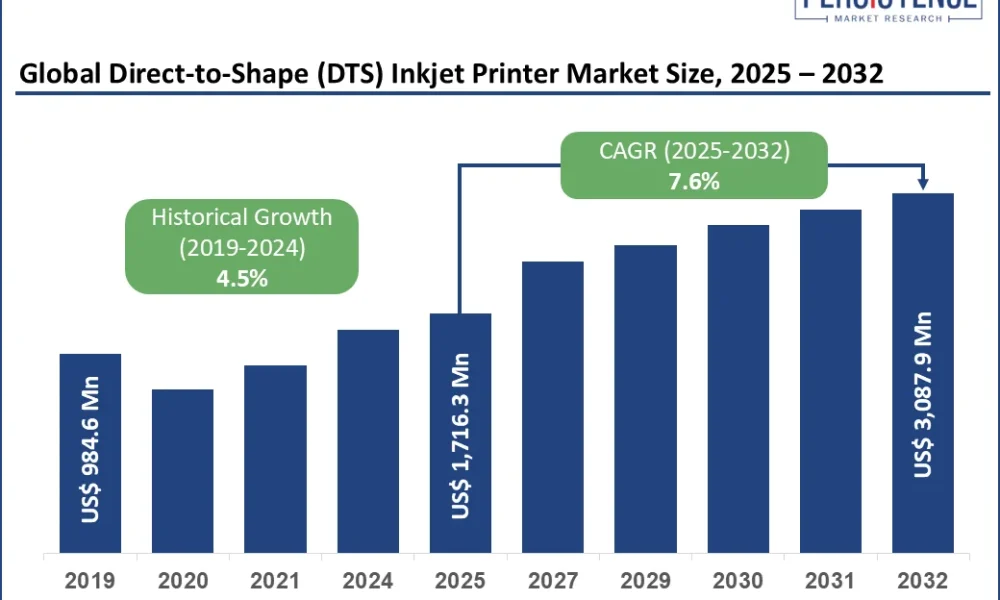
According to Persistence Market Research, the global Direct-to-Shape (DTS) Inkjet Printer market size is projected to rise from US$1,716.3 Mn in 2025 to US$3,087.9 Mn by 2032. The market is anticipated to witness a CAGR of 7.6% during the forecast period from 2025 to 2032. The increasing demand for efficient printing methods that reduce operational costs and improve production efficiency is one of the key factors contributing to this growth trajectory.
Furthermore, advancements in ink formulations, printing speed, and automation technologies are significantly improving the performance of DTS inkjet printers. Businesses are adopting these printers to achieve higher design flexibility and faster product launches. The expansion of industries such as beverages, cosmetics, and personal care products is also supporting the demand for direct-to-shape printing solutions. With companies prioritizing branding and product presentation, the adoption of DTS inkjet printing technology is expected to increase steadily across multiple manufacturing sectors.
Key Highlights from the Report
➤ The Direct-to-Shape (DTS) Inkjet Printer market is projected to expand from US$1,716.3 Mn in 2025 to US$3,087.9 Mn by 2032.
➤ The market is anticipated to register a CAGR of 7.6% during the forecast period 2025 to 2032.
➤ Increasing demand for high-speed and efficient digital printing technologies is supporting market expansion.
➤ Growing use of direct printing on bottles, containers, and packaging materials is driving adoption.
➤ Technological advancements in ink formulations and automated printing systems are improving efficiency.
➤ Expansion of packaging and consumer goods industries continues to boost demand for DTS printing solutions.
Market Segmentation
The Direct-to-Shape (DTS) Inkjet Printer Market can be segmented based on product type, application, and end-use industry. Product types typically include industrial DTS printers designed for high-volume manufacturing and specialized printers developed for customized printing applications. Industrial printers dominate the market due to their ability to deliver high-speed printing and consistent output for large-scale packaging operations. These printers are widely used in industries where product appearance and branding are critical for consumer engagement.
From an application perspective, the market serves several sectors including beverages, cosmetics, pharmaceuticals, food packaging, and household products. Among these, the beverage and cosmetics industries represent significant segments due to the increasing use of decorated bottles and containers. Direct-to-shape printing enables manufacturers to eliminate labels and print directly onto packaging materials, which reduces costs and improves production efficiency. As consumer demand for visually appealing packaging grows, these industries are expected to continue driving market demand.
Customize This Report for Your Exact Requirements : https://www.persistencemarketresearch.com/request-customization/35552
Regional Insights
North America holds a significant position in the Direct-to-Shape (DTS) Inkjet Printer Market, supported by strong technological advancements and widespread adoption of digital printing solutions. Companies in the region are continuously investing in innovative packaging technologies to improve efficiency and sustainability. The presence of leading packaging manufacturers and high demand for customized product packaging further contribute to the region’s market leadership.
Europe is another prominent market, driven by stringent sustainability regulations and the growing focus on eco-friendly packaging practices. Meanwhile, the Asia-Pacific region is experiencing rapid growth due to expanding manufacturing sectors and rising demand for consumer packaged goods. Countries such as China, Japan, and India are witnessing increased adoption of DTS printing technology as companies seek efficient and cost-effective production methods.
Market Drivers
One of the primary drivers of the Direct-to-Shape (DTS) Inkjet Printer Market is the increasing demand for innovative packaging and product differentiation. Companies across industries are focusing on visually appealing product packaging to attract consumers and enhance brand identity. Direct-to-shape printing allows manufacturers to produce vibrant designs directly on containers, enabling greater creativity and branding flexibility. This capability is particularly valuable in competitive markets where product presentation significantly influences consumer purchasing decisions.
Another major driver is the rising adoption of digital printing technologies in manufacturing processes. DTS inkjet printers eliminate the need for traditional labels and reduce multiple production steps, resulting in faster turnaround times and lower operational costs. The integration of automation and high-speed printing capabilities has further enhanced production efficiency. As companies seek to streamline manufacturing operations while maintaining high-quality output, DTS printing technology is becoming an increasingly attractive solution.
Market Restraints
Despite its promising growth prospects, the market faces certain challenges. One of the key restraints is the high initial investment cost associated with DTS inkjet printing systems. Small and medium-sized enterprises may find it difficult to adopt these advanced systems due to the significant capital expenditure required for equipment installation and integration into existing production lines. This factor can limit market adoption in price-sensitive regions.
Another challenge is the technical complexity associated with printing on irregular surfaces. Direct-to-shape printing requires precise calibration and specialized ink formulations to ensure consistent quality across various materials and shapes. Any inconsistencies in printing surfaces can affect output quality and production efficiency. As a result, companies must invest in skilled technicians and advanced equipment to ensure optimal performance, which may increase operational costs.
Market Opportunities
The growing focus on sustainable packaging solutions presents significant opportunities for the Direct-to-Shape (DTS) Inkjet Printer Market. By printing directly on containers, manufacturers can eliminate adhesive labels and reduce packaging waste. This aligns with global sustainability initiatives and regulatory frameworks aimed at minimizing environmental impact. Companies adopting eco-friendly packaging solutions are likely to drive the adoption of DTS printing technology.
Another major opportunity lies in the increasing demand for product customization and short-run printing. Modern consumers expect unique packaging designs and limited-edition products, which require flexible printing capabilities. DTS inkjet printers enable manufacturers to quickly modify designs and produce smaller batches without compromising efficiency. This flexibility makes the technology highly valuable for industries that frequently introduce new products or promotional packaging.
Unlock Complete Insights – Buy the Full Report : https://www.persistencemarketresearch.com/checkout/35552
Company Insights
Key players operating in the Direct-to-Shape (DTS) Inkjet Printer Market include:
- Xerox Corporation
- Xaar plc
- Velox Ltd.
- Roland DGA Corporation
- Seiko Epson Corporation
- Agfa-Gevaert Group
- INX International Ink Co.
- Engineered Printing Solutions
- Boston Industrial Solutions, Inc.
- Inkcups
Recent Developments
- February 2024: Inkcups introduced an advanced direct-to-shape inkjet printer designed to improve high-speed printing for cylindrical containers and packaging applications.
- October 2023: Engineered Printing Solutions expanded its direct-to-shape printing technology portfolio to enhance customization capabilities for packaging manufacturers.
Future Opportunities and Growth Prospects
The future of the Direct-to-Shape (DTS) Inkjet Printer Market appears promising as industries continue to adopt advanced digital printing solutions to improve efficiency and product differentiation. Technological advancements in inkjet printing systems, including faster printing speeds and improved compatibility with various materials, are expected to drive market growth in the coming years.
Moreover, increasing investments in packaging innovation and sustainable manufacturing practices are likely to accelerate the adoption of DTS printing technology. As global brands seek cost-effective and environmentally responsible solutions for product packaging, direct-to-shape inkjet printers will play a vital role in shaping the future of digital printing across multiple industries.




