
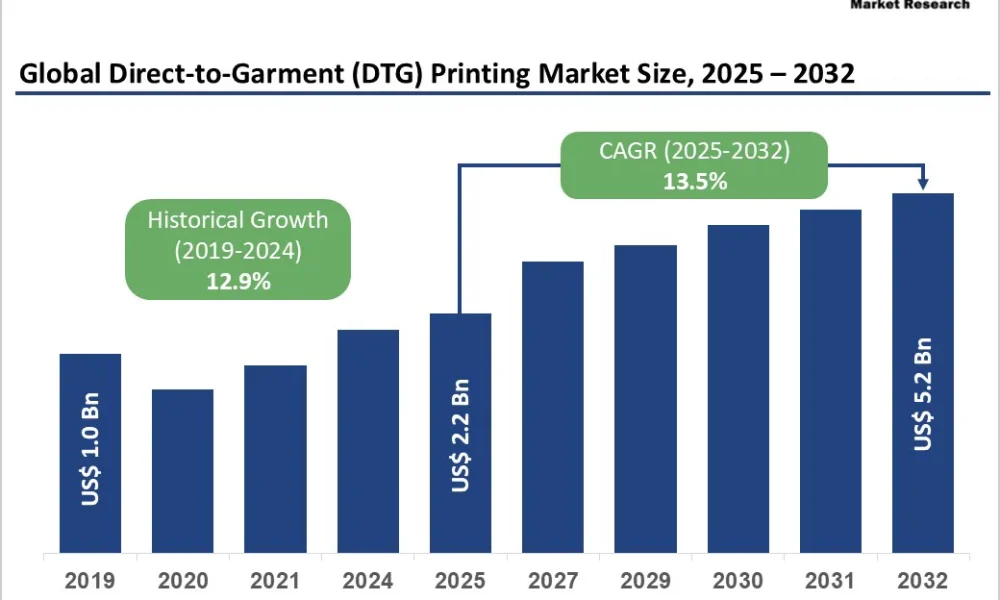
The direct-to-garment (DTG) printing market is undergoing a rapid transformation as digital textile technologies redefine how apparel is designed, produced, and delivered. Valued at US$ 2.2 billion in 2025, the global DTG printing market is projected to reach US$ 5.2 billion by 2032, expanding at a robust CAGR of 13.5% between 2025 and 2032. This strong growth trajectory reflects the industry’s evolution from a niche customization solution into a mainstream production technology supporting mass personalization and agile manufacturing.
DTG printing enables high-quality, full-color designs to be printed directly onto garments using digital inkjet technology. Unlike traditional screen printing, DTG eliminates the need for complex setup, making it ideal for short runs, on-demand production, and highly customized apparel. As consumer preferences shift toward individuality, sustainability, and fast delivery, DTG printing is increasingly positioned at the center of modern apparel manufacturing.
Market Overview and Growth Outlook
Over the past decade, DTG printing has progressed significantly in terms of print quality, speed, ink durability, and cost efficiency. Between 2019 and 2024, the market grew at a CAGR of 12.9%, indicating consistent adoption across both developed and emerging economies. The acceleration expected from 2025 onward underscores rising confidence in DTG as a scalable and commercially viable printing solution.
The growth of the direct-to-garment printing market is primarily driven by three structural shifts:
- Rising demand for personalized apparel, particularly among younger consumers
- Expansion of e-commerce and direct-to-consumer (DTC) business models
- Advancements in eco-friendly, water-based ink formulations
Together, these factors are reshaping apparel supply chains and lowering barriers for small brands, startups, and independent creators to enter the market.
Key Market Drivers
Growing Demand for Personalized and Custom Apparel
Personalization has emerged as a defining trend in the global fashion and apparel industry. Consumers increasingly prefer clothing that reflects individual identity, creativity, and exclusivity. DTG printing enables brands to offer custom designs, graphics, and text without incurring high setup costs, making one-off and limited-edition products commercially feasible.
Custom t-shirts, hoodies, sportswear, and merchandise for events, influencers, and online communities represent a significant share of DTG demand. The technology’s ability to print complex, multicolor designs with minimal waste further enhances its appeal among customization-focused brands.
Expansion of E-commerce and Print-on-Demand Platforms
The proliferation of e-commerce platforms and print-on-demand (POD) services has been a major catalyst for DTG market growth. Online storefronts integrated with DTG printing enable sellers to list products without holding inventory, printing items only after an order is placed.
This model reduces inventory risk, supports rapid design changes, and aligns with fast-changing fashion trends. The rise of global marketplaces, social commerce, and influencer-driven merchandise sales continues to fuel DTG printer adoption across small and medium-sized enterprises.
Sustainability and Regulatory Compliance
Sustainability has become a critical purchasing criterion for both consumers and regulators. DTG printing supports environmentally responsible manufacturing through reduced water usage, minimal ink waste, and compatibility with water-based, non-toxic inks.
With water-based inks holding approximately 42% market share, the industry is responding to stricter environmental regulations, particularly in Europe. DTG’s ability to support circular economy goals and low-waste production models is strengthening its position as a future-ready textile printing technology.
Technology Trends Shaping the DTG Printing Market
Dominance of Single-Pass Printing Technology
Single-pass printing technology accounts for nearly 55% of the DTG printing market, driven by its superior production speed and throughput efficiency. Unlike multi-pass systems, single-pass printers deposit ink in one continuous motion, making them suitable for high-volume apparel manufacturing.
This technology is increasingly adopted by large-scale apparel producers and fulfillment centers seeking to balance customization with industrial-level output. Continuous improvements in printhead reliability and ink consistency are further accelerating adoption.
Advancements in Print Quality and Fabric Compatibility
Modern DTG printers now support a wider range of fabric types, including cotton blends and treated synthetic textiles. Enhanced pre-treatment processes and improved ink adhesion have significantly improved color vibrancy, wash durability, and tactile feel.
These advancements are expanding DTG’s applicability beyond basic t-shirts into fashionwear, activewear, and premium merchandise, opening new revenue streams for apparel brands.
Elevate your business strategy with comprehensive market data. Request a sample report now: https://www.persistencemarketresearch.com/samples/35894
Application Analysis
Apparel Segment Leads Market Demand
The apparel segment dominates the DTG printing market with approximately 40% share, maintaining its position as the primary application area. Custom t-shirts, fashionwear, promotional clothing, and branded merchandise continue to account for the majority of DTG-printed products.
The flexibility of DTG printing allows apparel manufacturers to respond quickly to seasonal trends, limited-edition launches, and fast-fashion cycles without overproduction. This agility is particularly valuable in an era of demand-driven manufacturing.
Emerging Applications Beyond Apparel
Beyond clothing, DTG technology is increasingly used for textile-based home décor, accessories, and niche promotional items. While these segments currently represent a smaller share of the market, ongoing innovation in fabric compatibility is expected to broaden DTG’s application scope over the forecast period.
Regional Market Analysis
North America: Market Leader with Strong Infrastructure
North America holds approximately 32% of the global DTG printing market, driven by high consumer demand for personalized apparel and a mature digital printing ecosystem. The region benefits from widespread adoption of e-commerce, advanced fulfillment infrastructure, and a strong base of independent creators and small apparel brands.
The U.S., in particular, has seen strong uptake of DTG printers among print-on-demand service providers and online entrepreneurs.
Europe: Sustainability-Driven Growth
Europe accounts for nearly 28% of global DTG revenue, supported by stringent environmental regulations and strong emphasis on sustainable manufacturing practices. The region’s push toward circular economy models and eco-friendly textile production has accelerated the adoption of water-based inks and low-waste printing technologies.
Countries such as Germany, the UK, Italy, and France are at the forefront of DTG adoption, particularly in premium and ethically produced apparel.
Asia-Pacific: Fastest-Growing Regional Market
The Asia-Pacific region is the fastest-growing DTG market, fueled by China’s extensive textile manufacturing base, India’s rapidly expanding apparel sector, and Southeast Asia’s digital commerce boom. Rising disposable incomes, increasing fashion awareness, and strong growth in online retail are creating favorable conditions for DTG adoption.
Local manufacturers are increasingly investing in DTG technology to serve both domestic and export markets, positioning Asia-Pacific as a key growth engine over the forecast period.
Competitive Landscape and Industry Dynamics
The DTG printing market is moderately fragmented, with competition driven by technological innovation, print speed, ink efficiency, and after-sales support. Manufacturers are focusing on improving printer durability, reducing maintenance requirements, and enhancing software integration to improve overall user experience.
Strategic partnerships with e-commerce platforms, textile manufacturers, and ink suppliers are becoming increasingly common as companies seek to offer end-to-end printing solutions.
Challenges Facing the DTG Printing Market
Despite its strong growth prospects, the DTG printing market faces several challenges:
- High initial equipment costs, particularly for industrial-grade printers
- Fabric pre-treatment requirements, which can add operational complexity
- Competition from alternative digital printing methods, such as direct-to-film (DTF) printing
However, ongoing technological improvements and declining per-unit printing costs are expected to mitigate these challenges over time.
Future Outlook and Market Opportunities
Looking ahead, the direct-to-garment printing market is well-positioned for sustained growth through 2032. Continued innovation in printhead technology, ink chemistry, and automation will further enhance productivity and cost efficiency.
Emerging opportunities include:
- Integration of AI-driven design and workflow automation
- Expansion into sustainable fashion and ethical apparel brands
- Growth of localized, on-demand manufacturing hubs
As fashion moves toward personalization, sustainability, and digital-first business models, DTG printing is set to play a central role in the future of apparel production.
Conclusion
The global direct-to-garment (DTG) printing market is transitioning from a specialized customization tool into a core component of modern textile manufacturing. With market value expected to grow from US$ 2.2 billion in 2025 to US$ 5.2 billion by 2032, DTG printing represents one of the most dynamic segments within the digital printing industry.
Driven by personalized consumer demand, expanding e-commerce ecosystems, and sustainability-focused innovation, DTG technology is reshaping how apparel is produced and consumed worldwide. As adoption continues to rise across regions and applications, the DTG printing market is poised for long-term, resilient growth.
Related Reports:




