
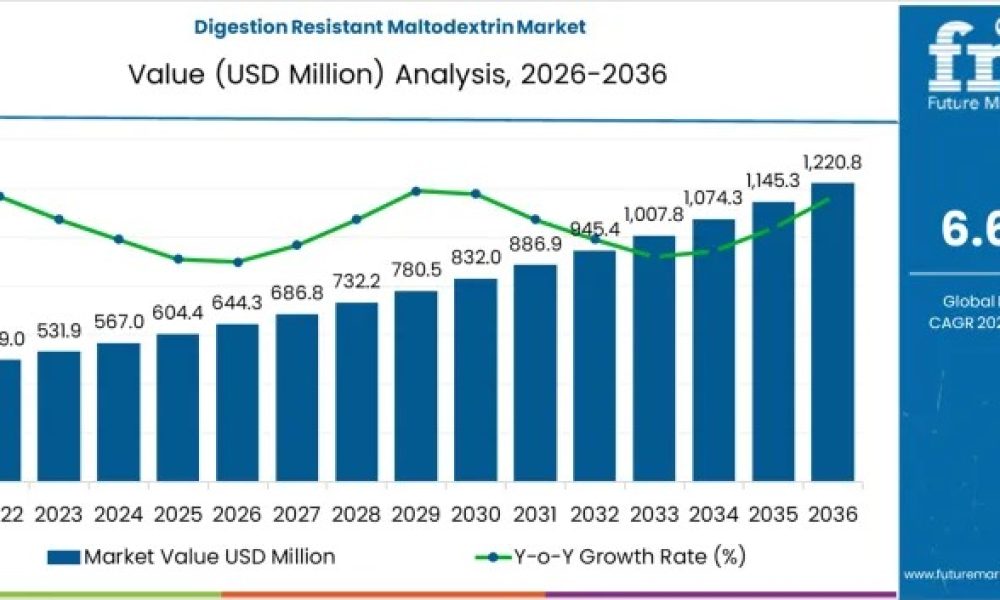
The global digestion resistant maltodextrin market is poised for robust growth, with a valuation of USD 644.3 million in 2026 expected to reach USD 1,220.2 million by 2036, registering a CAGR of 6.6%. Rising awareness of digestive health and demand for fiber-enriched functional foods are driving adoption across food, beverage, and dietary supplement sectors.
Explore trends before investing – request a sample report today!
Market Growth Overview
- Between 2026 and 2031, the market is projected to grow from USD 644.3 million to USD 832 million, adding USD 187.7 million. Volume expansion accounts for ~70% of growth, while premium product pricing contributes ~30%.
- From 2031 to 2036, the market is expected to rise from USD 832 million to USD 1,220.2 million. Volume remains dominant at 68%, with price growth representing 32% due to high-purity and specialty formulations.
Adoption is strongly influenced by functional food innovations, regulatory compliance, and consumer trends prioritizing gut health, fiber intake, and low-calorie formulations.
Leading Sources and Product Forms
Digestion resistant maltodextrin is produced from:
- Corn (leading source, ~25% of demand)
- Wheat
- Potato
- Cassava
- Mixed starches
Product forms include spray-dried powders and instantized/agglomerated variants, allowing versatility in formulation and application. Corn-based DRM leads due to its abundant supply, consistent starch content, and predictable functionality. It supports fiber enrichment, prebiotic effects, thermal stability, and maintains taste and texture across food and beverage products.
Application Trends
- Food Applications: Account for ~67% of total DRM demand. Used in baked goods, nutritional bars, dairy alternatives, and functional foods. Key benefits include fiber enrichment, calorie management, and texture enhancement.
- Beverages and Nutritional Products: Integration into shakes, meal replacements, and fortified beverages continues to rise.
- Dietary Supplements: Adoption driven by prebiotic functionality and digestive health claims.
DRM’s soluble nature allows seamless incorporation without affecting product consistency, color, or taste, meeting both regulatory and consumer expectations.
Regional Insights
- Japan: CAGR of 6.1%, driven by health-conscious consumers and functional food producers.
- China: CAGR of 6.0%, led by urban populations seeking fiber-enriched bakery, dairy, and beverages.
- India: CAGR of 4.8%, growing adoption in health-focused foods and bakery applications.
- USA: CAGR of 4.7%, steady use in functional foods and dietary supplements.
- UK: CAGR of 4.5%, supported by fiber labeling regulations and health-oriented products.
Competitive Landscape
Key players focus on product quality, formulation support, and supply chain reliability:
- Roquette Frères S.A.: Application-specific resistant maltodextrin solutions for fiber enrichment.
- Ingredion Incorporated: Customized resistant starch products for textural and nutritional optimization.
- Tate & Lyle PLC: Clean label fiber systems and application development support.
- ADM & Cargill: Broad portfolios and global logistics for large-scale manufacturers.
- Grain Processing Corporation: Consistent DRM functionality for beverages and nutritional products.
- Regional Players: Baolingbao Biology, Matsutani Chemical, Tereos Syral, and The AGRANA Group focus on local regulatory compliance and market-specific formulations.
Competitive advantage comes from combining consistent performance, tailored formulation guidance, and regulatory compliance with reliable supply chains.
Innovation and Collaboration Driving Growth
Trends emphasize:
- Tailored particle size and solubility for specific applications
- Pilot trials for performance validation
- Supplier-formulator collaboration for optimized functionality
- Regulatory and quality compliance for label accuracy
These efforts enable manufacturers to deliver fiber-enriched foods and beverages that meet taste, health, and sensory expectations.
To Access The Full Market Analysis, Strategic Recommendations, And Analyst Support, Purchase The Complete Report Here.
Challenges
Widespread adoption faces hurdles including:
- Ingredient sourcing consistency
- Impact on taste or texture in complex formulations
- Regional regulatory differences on fiber labeling and health claims
- Price sensitivity in certain markets
Consequently, usage is concentrated among manufacturers with technical expertise, stable supply chains, and compliance infrastructure.
By 2036, digestion resistant maltodextrin is expected to become a standard ingredient in functional foods, beverages, and dietary supplements, supporting both consumer health objectives and product innovation.
About Future Market Insights (FMI)
Future Market Insights, Inc. (FMI) is an ESOMAR-certified, ISO 9001:2015 market research and consulting organization, trusted by Fortune 500 clients and global enterprises. With operations in the U.S., UK, India, and Dubai, FMI provides data-backed insights and strategic intelligence across 30+ industries and 1200 markets worldwide.



