
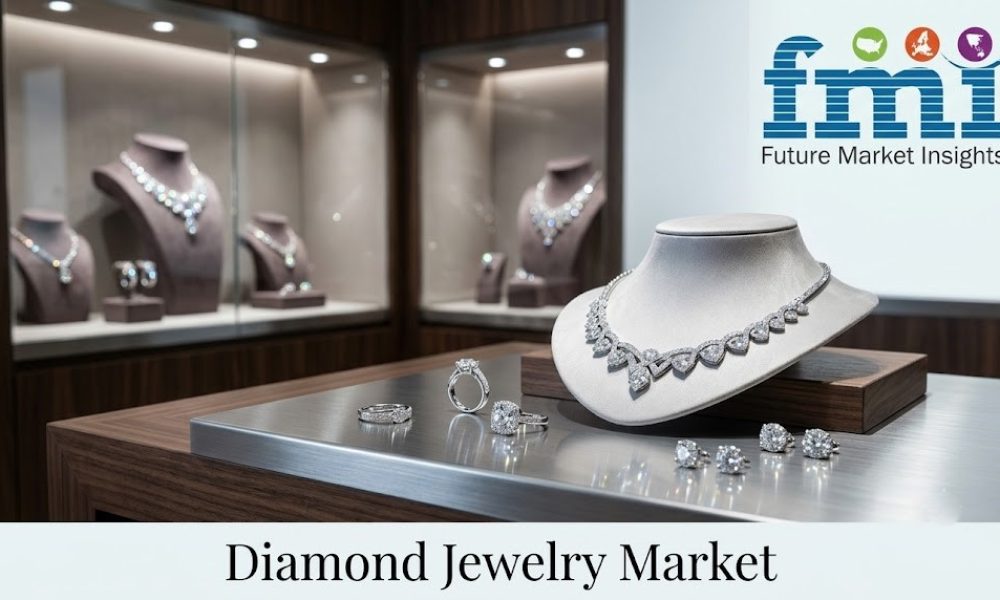
The global diamond jewelry market is entering a sustained period of expansion as bridal spending, gifting, self-purchase and branded retail development broaden demand beyond traditional wedding-led occasions. According to a new report by Future Market Insights (FMI), diamond jewelry market revenue is projected to increase from USD 408.2 billion in 2026 to USD 652.4 billion by 2036, registering a 4.8% CAGR during the forecast period.
The market is being shaped by changing purchase occasions, stronger organized retail networks and growing emphasis on sourcing transparency and product certification. As consumers increasingly consider diamond jewelry for gifting and personal purchases, brands and retailers are refining assortments to address a wider range of price points and usage occasions.
Earrings Anchor Product Demand
Earrings are projected to remain the leading product category, accounting for 45.0% of the diamond jewelry market in 2026. Their relatively accessible pricing compared with larger-ticket formats, styling flexibility and relevance across gifting and everyday purchases support their strong position.
For retailers, earrings also offer opportunities for broader assortment planning and faster sell-through across entry-level, mid-tier and premium collections. This makes the category important for brands seeking to balance volume generation with premium positioning.
Get detailed market forecasts, competitive benchmarking, and pricing trends: https://www.futuremarketinsights.com/reports/sample/rep-gb-16894
Jewelry Stores Retain Channel Leadership
Jewelry stores are expected to account for 37.6% of sales channel demand in 2026. High-value purchase decisions continue to benefit from assisted selling, physical product evaluation and trust associated with established retail environments.
Although digital commerce is expanding, store-based retail remains important for diamond jewelry because consumers often seek guidance regarding quality, certification, design and pricing. Retailers are also extending digital capabilities through product education, verified fulfillment and integrated online-to-store experiences.
Women Continue to Drive End-User Demand
Women are forecast to represent 60.5% of end-user demand in 2026, reinforcing their importance to assortment and merchandising strategies. Demand includes bridal purchases, gifting and self-purchase occasions, giving brands opportunities to develop collections that extend beyond traditional ceremonial buying.
This shift is encouraging retailers to build more structured portfolios, combining core collections with selective launches and differentiated designs. Tighter assortment architecture can also help companies manage inventory while reducing dependence on broad discounting.
Sourcing Transparency Becomes a Competitive Consideration
Supply-chain confidence is becoming increasingly important across the diamond jewelry value chain. Retail partners and consumers are placing greater emphasis on sourcing documentation, certification and compliance, creating opportunities for companies that can demonstrate consistent product provenance and supply reliability.
At the same time, competition is being influenced by the growing presence of lab-grown diamonds. Brands are increasingly required to manage natural and lab-grown diamond portfolios while maintaining clear value propositions and coherent brand positioning.
According to FMI, the market is also seeing greater emphasis on controlled distribution, disciplined pricing and product-tier differentiation. These factors are particularly relevant for companies operating across multiple markets where maintaining price integrity and consistent customer experience can influence long-term performance.
China and India Stand Out Among High-Growth Markets
Country-level growth reflects differences in retail infrastructure, premium spending and consumer purchasing behavior. China is forecast to expand at a 7.2% CAGR between 2026 and 2036, making it the fastest-growing country market covered in the report. Growth is supported by premium mix development, digital commerce and curated branded portfolios.
India is projected to grow at a 7.0% CAGR, supported by premiumization in occasion-led purchases, expansion of branded jewelry chains and wider access through modern retail formats.
The USA is forecast to grow at 5.6% CAGR, while the UK and Germany are projected to register CAGRs of 5.1% and 5.4%, respectively, supported by established retail networks and structured premium consumption.
Analyst Perspective
Rahul Pandita, Principal Consultant for Consumer Product and Travel and Tourism at Future Market Insights, said:
“Diamond jewelry demand is expected to favor brands with trusted sourcing systems and disciplined retail execution. Larger jewelry houses are likely to gain stronger buyer confidence as certified assortments and consistent service quality influence premium purchase decisions.”
Access the Complete Report in PDF Format: https://www.futuremarketinsights.com/reports/brochure/rep-gb-16894
Competitive Landscape
The competitive environment is centered on brand equity, sourcing credibility, retail execution and portfolio discipline. Key companies profiled in the report include Tiffany & Co., Bulgari S.p.A., Cartier, Signet Jewelers, De Beers plc, Pandora Jewellery, LLC, Chow Tai Fook Jewellery Group Limited, Swarovski AG, Petra Diamonds Limited, and Trans Hex Group.
Leading players are balancing evergreen collections with selective launches while strengthening digital commerce, fulfillment, returns management and supply-chain documentation.
Report Scope
The Diamond Jewelry Market report analyzes the industry by product type, sales channel, end user and region. Product types include earrings, necklaces, rings, bracelets, pendants and others. Sales channels cover jewelry stores, online, specialty stores, departmental stores and others. End users include women, men and unisex consumers.
The regional analysis covers North America, Latin America, Western Europe, Eastern Europe, East Asia, South Asia & Pacific, and the Middle East & Africa. The report comprises 333 pages and was authored by Rahul Pandita.
Business Impact
FMI helps organizations transform market complexity into strategic clarity, enabling leadership teams to identify growth opportunities faster, optimize resource allocation, strengthen competitive positioning, and make high-stakes business decisions with confidence.
To explore how FMI Custom Research can support your strategic priorities, please connect with our team at – [email protected]
About Future Market Insights (FMI)
Future Market Insights, Inc. (FMI) is an ESOMAR-certified, ISO 9001:2015 market research and consulting organization, trusted by Fortune 500 clients and global enterprises. With operations in the U.S., UK, India, and Dubai, FMI provides data-backed insights and strategic intelligence across 30+ industries and 1200 markets worldwide.



