
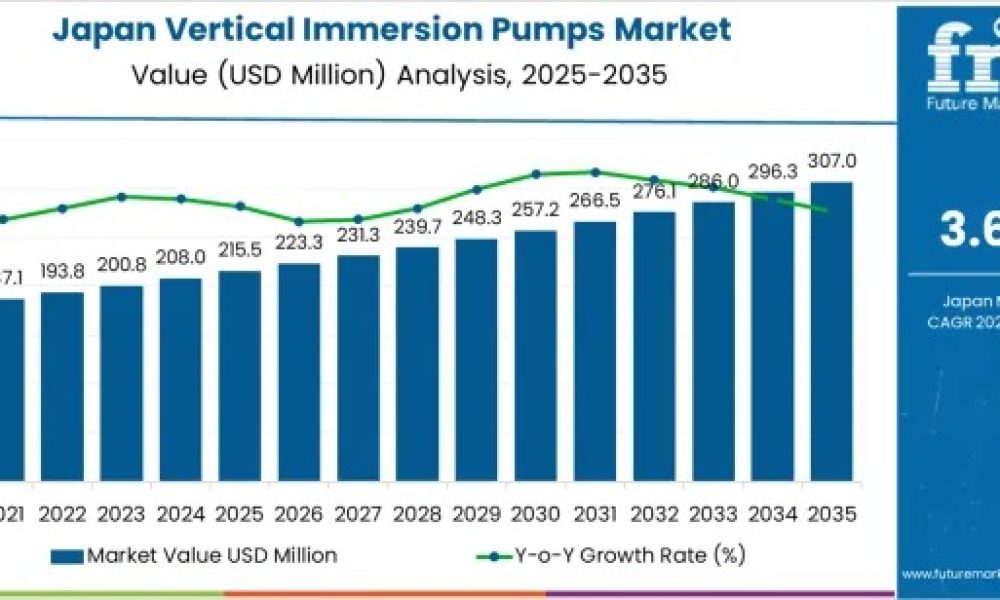
The Japan vertical immersion pumps market continues to demonstrate stable and engineering-driven growth, underpinned by the country’s mature industrial base, disciplined replacement cycles, and ongoing investments in efficiency-focused fluid-handling systems. Valued at USD 215.5 million in 2025, demand is projected to reach USD 307.0 million by 2035, expanding at a compound annual growth rate (CAGR) of 3.6% over the forecast period.
Unlike expansion-led markets, Japan’s vertical immersion pump demand is shaped primarily by operational reliability requirements, materials durability, and process stability across chemical processing, wastewater treatment, semiconductor fabrication, and metalworking applications. These pumps remain integral to fluid handling in deep tanks, corrosive environments, and space-constrained installations, where consistent performance and lifecycle efficiency outweigh short-term capital considerations.
Industrial Reliability Anchors Market Expansion
Vertical immersion pumps are widely adopted in Japan due to their ability to handle corrosive liquids, abrasive slurries, and high-temperature fluids while maintaining mechanical stability and ease of maintenance. The motor-above-liquid configuration allows safe operation in aggressive environments and supports rapid servicing without draining tanks, a critical advantage in continuous-duty industrial facilities.
Demand growth is reinforced by equipment modernisation programs, particularly in facilities replacing ageing pumping systems with energy-efficient models featuring corrosion-resistant alloys and improved shaft alignment. Japanese manufacturers continue to prioritise predictable performance, long service life, and low unplanned downtime, positioning vertical immersion pumps as a preferred solution in precision-driven operations.
Get access to comprehensive data tables and detailed market insights – request your sample report today!
Line Shaft Pumps Dominate Product Demand
By product type, line shaft pumps represent the leading segment, accounting for an estimated 57.0% of total demand. Their dominance reflects suitability for deep-tank installations, stable axial alignment, and high structural rigidity, making them ideal for chemical plants, utilities, and industrial facilities operating under continuous load conditions.
Line shaft designs provide efficient torque transmission and reduced vibration, supporting long vertical spans without compromising hydraulic stability. These attributes are particularly valuable in Japan’s industrial settings, where access limitations and compact layouts require robust, low-maintenance pumping solutions.
Cantilever pumps, holding the remaining 43.0% share, serve applications involving aggressive or particulate-laden fluids, where simplified mechanical arrangements and reduced submerged components enhance reliability. The coexistence of both product types highlights demand diversification based on installation depth, fluid characteristics, and maintenance strategy.
Mid-Capacity Pumps Anchor Market Volume
Capacity analysis shows that pumps in the 100–500 m³/hr range account for approximately 42.0% of total demand, making it the largest capacity segment in Japan. This range aligns with the flow requirements of municipal pumping stations, industrial cooling loops, and mid-scale irrigation networks, offering a balance between efficiency and throughput.
Smaller systems (up to 100 m³/hr) represent 26.0%, serving localized agricultural and potable water applications, while 500–1000 m³/hr units hold 21.0%, supporting high-output industrial and municipal operations. Capacities above 1000 m³/hr, primarily used in geothermal and large infrastructure projects, contribute 11.0% of demand. Overall, capacity distribution reflects Japan’s preference for precisely matched equipment rather than oversized installations.
Irrigation and Water Infrastructure Lead Applications
By application, irrigation accounts for the largest share at 33.0%, driven by continued use of vertical immersion pumps in paddy-field networks, greenhouse systems, and regional agricultural infrastructure. Potable water supply follows at 27.0%, supporting municipal wells and regional distribution systems requiring stable, long-duty operation.
Water cooling applications represent 19.0%, reflecting strong demand from industrial and energy-sector facilities, while dewatering contributes 13.0%, largely tied to construction and emergency water-removal needs. Geothermal wells, at 8.0%, remain a specialised but stable segment, particularly in regions leveraging geothermal energy resources.
Regional Demand Concentrated in Industrial Hubs
Regionally, demand remains concentrated in Japan’s established industrial corridors. Kyushu & Okinawa leads growth with a 4.5% CAGR, supported by diversified manufacturing clusters, chemical processing, electronics fabrication, and municipal wastewater infrastructure. Kanto, growing at 4.1%, benefits from dense industrial activity across Tokyo, Kanagawa, and Chiba, where immersion pumps are integral to machining, plating, and controlled fluid-transfer operations.
Kinki, with a 3.6% CAGR, maintains steady demand driven by metal processing, fabrication, and wastewater handling across Osaka and surrounding prefectures. Chubu follows at 3.2%, supported by automotive and machinery manufacturing, while Tohoku and the Rest of Japan grow at 2.8% and 2.7%, respectively, reflecting lower industrial density but consistent municipal and industrial requirements.
Tailor Your Solution: Request Customization for Your Unique Needs!
Competitive Landscape Focused on Engineering Excellence
The competitive environment in Japan’s vertical immersion pumps market is defined by a select group of global manufacturers with strong engineering credentials. Grundfos Holding A/S leads the market with an estimated 35.0% share, supported by its energy-efficient designs, corrosion-resistant materials, and strong integration with Japanese industrial OEMs.
KSB SE & Co. KGaA, Sulzer Ltd., and Flowserve Corporation follow, offering engineered immersion systems tailored for aggressive fluids, high-temperature environments, and precision process control. ITT Inc. maintains a solid presence in machine-tool coolant and general industrial circulation applications, emphasizing modular designs and dependable sealing arrangements.
Competition increasingly centers on material compatibility, hydraulic stability, energy efficiency, and lifecycle cost optimisation, rather than price-led differentiation.
Outlook: Stable Growth Driven by Precision and Reliability
The outlook for Japan’s vertical immersion pumps market remains steady and structurally resilient through 2035. Growth is driven not by rapid capacity expansion, but by precision manufacturing requirements, equipment replacement cycles, and incremental efficiency upgrades across industrial and municipal infrastructure.
As Japanese facilities continue to prioritise durability, compact system design, and predictable long-term performance, vertical immersion pumps will remain a core component of the country’s fluid-handling landscape. With demand projected to reach USD 307.0 million by 2035, the market reflects Japan’s broader industrial philosophy—measured growth, engineering excellence, and sustained operational continuity.
Why Choose FMI: Empowering Decisions that Drive Real-World Outcomes: https://www.futuremarketinsights.com/why-fmi
About Future Market Insights (FMI)
Future Market Insights, Inc. (FMI) is an ESOMAR-certified, ISO 9001:2015 market research and consulting organization, trusted by Fortune 500 clients and global enterprises. With operations in the U.S., UK, India, and Dubai, FMI provides data-backed insights and strategic intelligence across 30+ industries and 1200 markets worldwide.



