
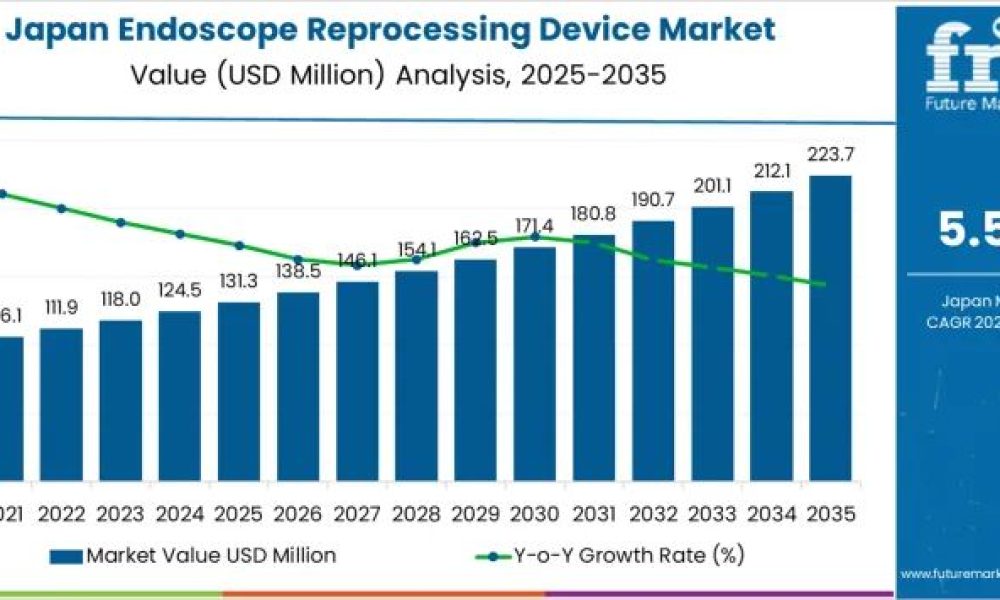
Future Market Insights (FMI), a leading provider of market intelligence and consulting services, today released its comprehensive analysis of the Demand for endoscope reprocessing device in Japan is valued at USD 131.3 million in 2025 and is projected to reach USD 223.7 million by 2035 at a CAGR of 5.5%. Automated endoscope reprocessors dominate deployment across large medical centers, supported by washer disinfectors, sterilizers, ultrasonic washers, and drying and storage cabinets across tiered facilities. Hospitals and central sterile services departments form the core demand base, while specialty clinics and academic institutions contribute steady procurement cycles. Kanto, Kinki, and Chubu remain the operational centers due to dense hospital networks and advanced endoscopy services. Global suppliers such as Olympus, Getinge, STERIS, Steelco, and ASP anchor system installations across public and private institutions.
The report, titled “Demand for Endoscope Reprocessing Device in Japan | Global Market Analysis Report – 2035,” emphasizes the critical role of rigorous infection control standards in fueling market demand. Japan’s healthcare system, renowned for its high-volume gastrointestinal screenings and early detection programs for gastric and colorectal cancers, continues to drive the need for reliable, efficient reprocessing solutions. As endoscopy procedures rise in gastroenterology, pulmonology, and urology—supported by an aging population and increasing awareness of antimicrobial resistance—healthcare facilities are shifting toward automated systems to ensure faster turnaround times, traceability, and reduced risk of healthcare-associated infections (HAIs).
“Japan stands at the forefront of endoscopic care excellence, where stringent national hygiene oversight and hospital accreditation requirements mandate validated, high-level disinfection cycles,” notes the FMI analysis. “This environment not only sustains demand for advanced reprocessing devices but also positions the market for resilient growth amid evolving clinical needs.”
Key market segments reveal clear leadership positions that align with operational realities in Japanese healthcare settings. Automated Endoscope Reprocessors command a dominant 51% market share, favored in large tertiary hospitals for their standardized cleaning, reduced manual errors, and integration with digital tracking systems. Complementary products, including washer disinfectors, sterilizers, ultrasonic washers, and drying and storage cabinets, support tiered facility needs across the country.
In terms of operation mode, semi-automatic systems hold a commanding 57% share, striking an optimal balance between efficiency and cost-effectiveness—particularly appealing to mid-sized facilities and regional hospitals managing high procedural volumes without the full capital outlay of fully automatic setups. Floor-standing and bench-top modalities remain prevalent due to space constraints in many urban and older hospital buildings, while mobile units gain traction in flexible outpatient settings.
Regional dynamics highlight concentrated demand in densely networked areas. The Kanto region, encompassing Tokyo’s tertiary centers, and Kansai (Kinki) drive core utilization through high procedure density and stable replacement cycles. Emerging growth hotspots include Kyushu & Okinawa, projected at a robust 6.8% CAGR, fueled by expanded colonoscopy programs and public hospital upgrades. Kanto follows closely at 6.3%, while Chubu registers 4.9%, reflecting moderate expansion in industrial-area shared facilities. Tohoku and other regions show steady progress tied to demographic aging and consolidation efforts.
Hospitals and centralized sterile services departments (CSSDs) form the primary end-user base, leveraging reprocessing devices to maintain throughput in high-volume environments. Specialty clinics and ambulatory surgical centers contribute incremental growth as outpatient endoscopy expands, aligning with Japan’s focus on efficient, patient-centered care.
Market drivers underscore structural strengths: routine screening initiatives, urban hospital demands for shorter reprocessing cycles, and rising emphasis on microbial reduction amid global infection concerns. Opportunities abound in digital integration—such as audit-ready documentation and remote monitoring—as well as replacement demand for aging units reaching end-of-life thresholds.
Challenges, including high upfront costs for automated systems, space limitations in legacy facilities, and reliance on imported components, are tempered by ongoing innovations from industry leaders. Prominent players shaping the landscape include Getinge AB, offering advanced washer disinfectors and drying cabinets; Olympus Corporation, integrating seamless workflows with its endoscope platforms; STERIS plc, delivering low-temperature sterilization solutions; ASP India Private Ltd., supplying specialized chemical sterilants; and Steelco S.p.A., providing compact automated systems tailored for surgical centers.
Subscribe for Year-Round Insights → Stay ahead with quarterly and annual data updates: https://www.futuremarketinsights.com/reports/brochure/rep-gb-29738
Request for Discount: https://www.futuremarketinsights.com/reports/sample/rep-gb-29738
Looking ahead, the report forecasts an intermediate milestone of USD 162.5 million by 2030—a USD 31.2 million increase from 2025—before accelerating to add USD 61.2 million in value from 2030 to 2035. This later-phase momentum stems from broader adoption in secondary hospitals, outpatient centers, and enhancements like chemical-compatible cycles and workload-reducing features.
As Japan continues to set global benchmarks in endoscopic hygiene and procedural efficiency, the endoscope reprocessing device market exemplifies a mature yet innovative sector committed to advancing patient outcomes. Healthcare decision-makers, from hospital administrators to policymakers, can leverage these insights to inform strategic investments in compliance-driven technologies that safeguard public health while optimizing operational performance.
About Future Market Insights (FMI)
Future Market Insights, Inc. (FMI) is an ESOMAR-certified, ISO 9001:2015 market research and consulting organization, trusted by Fortune 500 clients and global enterprises. With operations in the U.S., UK, India, and Dubai, FMI provides data-backed insights and strategic intelligence across 30+ industries and 1200 markets worldwide.
Why FMI: Decisions that Change Outcomes- https://www.futuremarketinsights.com/why-fmi
Contact Us:
Future Market Insights Inc.
Christiana Corporate, 200 Continental Drive,
Suite 401, Newark, Delaware – 19713, USA
T: +1-347-918-3531
Website: https://www.futuremarketinsights.com
LinkedIn| Twitter| Blogs | YouTube
Have a specific Requirements and Need Assistant on Report Pricing or Limited Budget please contact us – [email protected]



