
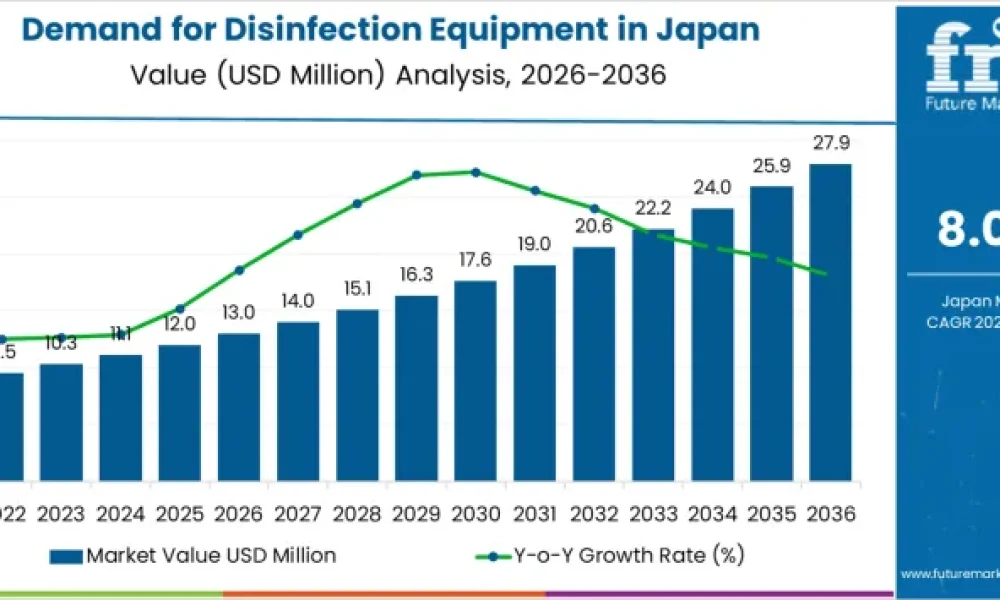
The demand for disinfection equipment in Japan is entering a sustained growth phase, supported by structured hygiene standards, long-term facility management practices, and continuous technology upgrades across healthcare, commercial, and industrial sectors. Valued at USD 13.0 million in 2026, the market is forecast to reach USD 27.9 million by 2036, registering a steady CAGR of 8.0% during the forecast period.
From early adoption in high-traffic environments to routine procurement cycles, Japan’s disinfection equipment industry reflects a shift from precautionary investments toward embedded hygiene infrastructure. Both established global manufacturers and emerging technology-focused suppliers are expanding their footprint by introducing compact designs, energy-efficient systems, and automated disinfection solutions tailored to Japanese facility layouts.
Gain access to detailed segment-wise analysis and forecast statistics – Download the Sample Report Today
Market Growth Outlook: 2026 to 2036
- Market value grows from USD 13.0 million (2026) to USD 17.6 million by 2031, driven by healthcare upgrades and outpatient facility expansion
- Accelerated growth phase from 2031 to 2036, reaching USD 27.9 million, supported by automation, infrastructure planning, and replacement cycles
- Commercial operators remain the largest buyers, while industrial users show predictable demand patterns
- Household adoption increases gradually through compact sprayers and online retail availability
Key Market Drivers Supporting Demand in Japan
- Rising infection control awareness across hospitals, clinics, transport hubs, and retail spaces
- Strong regulatory focus on indoor air quality and sanitation standards
- Expansion of smart buildings integrating disinfection with ventilation and monitoring systems
- Increased adoption of low-energy UV-C, electrostatic, and sensor-activated disinfection equipment
- Emphasis on lifecycle cost efficiency, safety compliance, and operational reliability
Key Segments of the Disinfection Equipment Market
By Equipment Type
- UV Disinfection (40% share)
- Preferred for predictable germicidal performance
- Low consumable requirements and stable operating costs
- Widely used in healthcare rooms, offices, and public service areas
- Electrostatic Sprayers
- Steady deployment for routine surface sanitation
- Popular in commercial and transport facilities
- Disinfection Sprayers
- Used across households and small facilities
- Growth supported by compact and portable designs
By End User
- Commercial (50.0%)
- Offices, retail, hospitality, transport hubs
- Regular sanitation cycles embedded in daily operations
- Industrial
- Food processing, manufacturing, pharmaceutical facilities
- Focus on controlled environments and equipment durability
- Household
- Gradual uptake through online channels
- Driven by compact and easy-to-use devices
By Distribution Channel
- Wholesalers and distributors dominate bulk procurement
- Online retailers support household and small business demand
- Independent small stores enable regional accessibility
Regional Demand Highlights
- Kyushu & Okinawa (11.4% CAGR) – Fastest growth, supported by healthcare modernization and hospitality adoption
- Kanto (10.5%) – Dense urban population, hospitals, offices, and transport infrastructure
- Kansai (9.2%) – Balanced growth across healthcare, foodservice, and commercial sectors
- Chubu (8.1%) – Manufacturing-related hygiene demand
- Tohoku (7.1%) & Rest of Japan (6.8%) – Gradual replacement-driven growth
Technology and Manufacturer Landscape
The disinfection equipment industry in Japan is shaped by both established multinational leaders and emerging innovators focused on compact design, automation, and energy efficiency. Companies are aligning product development with Japan’s space constraints, safety expectations, and workflow-driven hygiene routines.
- Xylem strengthens demand through UV and ozone-based water disinfection systems in municipal and industrial applications
- Sotera Health contributes validated sterilization solutions supporting healthcare compliance needs
- Shinva Medical Instrument expands its presence through imported sterilization and disinfection units used in medical and research facilities
- STERIS Corporation supports large hospitals with low-temperature sterilizers and washer-disinfectors
- Matachana serves surgical units, clinics, and laboratories through distributor-led market access
New and expanding manufacturers are increasingly investing in automation, sensor integration, and low-maintenance technologies, aiming to capture opportunities created by replacement cycles and long-term facility planning.
Future Market Outlook
From 2026 to 2036, Japan’s disinfection equipment market will continue to evolve as hygiene becomes a permanent operational requirement rather than a reactive measure. Growth will be shaped by technology upgrades, regulatory alignment, and steady procurement across healthcare, commercial, and industrial environments. Manufacturers that balance performance, compact design, and integration with smart facility systems are best positioned to expand their businesses and strengthen long-term market presence.
Have a specific Requirements and Need Assistant on Report Pricing or Limited Budget please contact us – [email protected]
About Future Market Insights (FMI)
Future Market Insights, Inc. (FMI) is an ESOMAR-certified, ISO 9001:2015 market research and consulting organization, trusted by Fortune 500 clients and global enterprises. With operations in the U.S., UK, India, and Dubai, FMI provides data-backed insights and strategic intelligence across 30+ industries and 1200 markets worldwide.



