
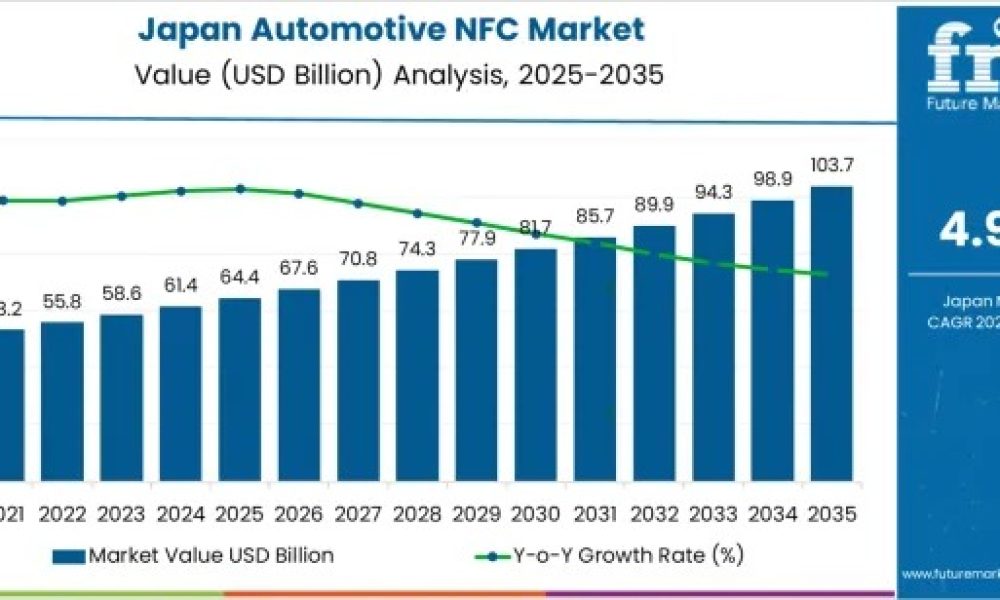
The demand for automotive near-field communication (NFC) technology in Japan is entering a decade of steady and structurally supported growth, reflecting the country’s rapid transition toward digitally enabled, connected, and user-centric vehicle platforms. Valued at USD 64.4 billion in 2025, the market is projected to reach USD 103.7 billion by 2035, expanding at a compound annual growth rate (CAGR) of 4.9%. This trajectory highlights the growing strategic role of NFC as a core enabler of secure access, personalization, and seamless interaction within modern vehicle ecosystems.
Automotive NFC technology supports a wide range of functions, including keyless entry, secure authentication, infotainment pairing, digital keys, and personalized in-car settings. As Japanese automakers accelerate the integration of digital interfaces across passenger and commercial vehicle platforms, NFC continues to gain traction due to its reliability, low power consumption, and ease of implementation. Its compatibility with smartphones and connected services further strengthens its position as a foundational technology within Japan’s evolving automotive architecture.
Get access to comprehensive data tables and detailed market insights – request your sample report today!
Predictable Growth Anchored in Connected Vehicle Evolution
The growth pattern for automotive NFC demand in Japan follows a consistent and upward trajectory. Market value progressed from USD 50.8 billion in earlier years to USD 64.4 billion in 2025, before entering a steady expansion phase toward USD 103.7 billion by 2035. Annual gains remain stable, with demand increasing from USD 67.6 billion in 2026 to USD 70.8 billion in 2027, followed by incremental growth across each subsequent year.
Between 2025 and 2030, demand is expected to rise to approximately USD 81.7 billion, driven primarily by broader NFC penetration across vehicle lineups. Beyond 2030, growth accelerates further as NFC systems evolve to support enhanced functionalities, including digital subscription services, expanded vehicle-to-device communication, and higher security standards. Over the full forecast horizon, the absolute increase of USD 39.3 billion underscores both rising vehicle volumes equipped with NFC and increasing per-vehicle system value.
Digital Convenience and Security Drive Adoption
The primary force behind rising automotive NFC demand in Japan is the growing consumer expectation for seamless, digital-first vehicle experiences. NFC-enabled smart keys allow drivers to unlock doors, start engines, and load personalized profiles using smartphones or wearable devices, reducing reliance on physical keys while enhancing security. These features align closely with Japanese consumer preferences for convenience, precision, and integrated technology.
The expansion of connected vehicle platforms further amplifies NFC adoption. As infotainment systems, telematics, and cloud-based services become standard, NFC provides a simple and secure interface for authentication and pairing. Additionally, Japan’s expanding electric vehicle (EV) ecosystem supports NFC growth, as the technology enables charging authentication, contactless payments at charging stations, and integration with broader smart mobility services.
424 Kbit/S NFC Leads by Type
By data transfer type, 424 Kbit/S NFC dominates the Japanese automotive NFC market, accounting for approximately 60% of total demand. This leadership reflects its suitability for high-reliability applications such as secure vehicle access, rapid device pairing, and in-vehicle personalization. Automakers favor this specification for its stable performance and compatibility with modern infotainment and electronic control architectures.
As vehicles increasingly adopt centralized electronic systems and connected service features, the 424 Kbit/S standard supports smooth and secure communication between mobile devices and vehicle platforms. Its resilience across varying environmental conditions and consistent authentication performance ensures continued preference as digital key ecosystems expand across mass-market and premium vehicles alike.
Passenger Cars Anchor Market Demand
By vehicle type, passenger cars account for approximately 70% of automotive NFC demand in Japan. This dominance reflects widespread consumer adoption of connectivity features in personal vehicles, where NFC simplifies entry, setup, and daily interaction. From compact models to premium sedans and SUVs, automakers are embedding NFC to support digital access, profile recognition, and media pairing.
Passenger vehicles also play a central role in Japan’s broader mobility ecosystem, integrating NFC to unify access, charging authorization, and in-car service interactions. As personal vehicles remain the cornerstone of transportation across urban and regional markets, passenger cars will continue to drive the majority of NFC system deployments.
Tailor Your Solution: Request Customization for Your Unique Needs!
Regional Momentum Highlights Industrial Hubs
Regionally, demand growth spans all parts of Japan, with notable acceleration in major automotive and technology centers. Kyushu & Okinawa lead with a 6.1% CAGR, supported by expanding automotive production and early adoption of secure digital access features. Kanto, including Tokyo, follows at 5.6% CAGR, reflecting strong integration of NFC into connected and smart mobility platforms.
Kinki records 4.9% CAGR, driven by steady adoption across established manufacturing bases, while Chubu, a core automotive production hub, grows at 4.3%. Tohoku and the rest of Japan post moderate but consistent growth, supported by gradual integration of NFC-enabled systems as connected vehicle infrastructure expands nationwide.
Competitive Landscape Shaped by Semiconductor and Systems Expertise
The automotive NFC ecosystem in Japan is shaped by leading semiconductor and electronics providers supplying NFC chips, secure elements, antenna modules, and system-level integration solutions. Key participants include Sony Corporation, NXP Semiconductors, Broadcom, Samsung Electronics, STMicroelectronics, and Panasonic Corporation. These companies support automakers with automotive-grade solutions designed to meet stringent reliability, safety, and security requirements.
Competition increasingly centers on integration capability, security performance, and compatibility with evolving digital key standards. As NFC becomes embedded deeper within vehicle architectures, suppliers with strong system-level expertise and long-term OEM partnerships are well positioned to capture sustained demand.
Outlook: NFC as a Cornerstone of Digital Mobility in Japan
As Japanese vehicles continue their transition toward fully connected, personalized, and software-enabled platforms, NFC technology is emerging as a cornerstone of digital vehicle access and interaction. While challenges such as system cost, interoperability, and regulatory certification remain, the long-term outlook remains firmly positive.
With demand projected to exceed USD 103 billion by 2035, automotive NFC represents a critical growth segment within Japan’s automotive technology landscape. The full market report delivers detailed forecasts, segment insights, competitive analysis, and regional intelligence for organizations seeking to understand and capitalize on the next phase of digital vehicle evolution in Japan.
Why Choose FMI: Empowering Decisions that Drive Real-World Outcomes: https://www.futuremarketinsights.com/why-fmi
About Future Market Insights (FMI)
Future Market Insights, Inc. (FMI) is an ESOMAR-certified, ISO 9001:2015 market research and consulting organization, trusted by Fortune 500 clients and global enterprises. With operations in the U.S., UK, India, and Dubai, FMI provides data-backed insights and strategic intelligence across 30+ industries and 1200 markets worldwide.



