
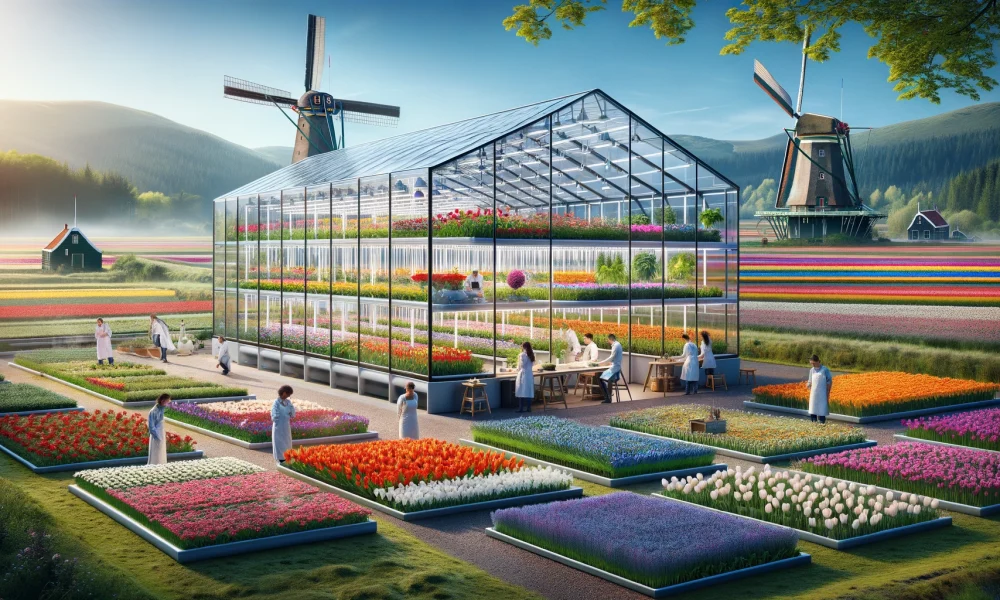
In the Netherlands, a new chapter in horticulture is being written with the emergence of Deliflor Hoogveld. This venture, born from the collaborative efforts of Deliflor and Kreling Chrysanten, represents a significant leap in the field of plant propagation. Officially opened on November 25, Deliflor Hoogveld stands as a testament to the fusion of cutting-edge technology and traditional gardening expertise.
Positioned strategically in the horticultural heartland of the country, this high-tech cuttings company is not just a facility; it’s a bold statement of innovation in an industry that is as ancient as civilization itself. With its capacity to produce a staggering 2.4 million cuttings each day, amounting to an impressive 500 million annually, Deliflor Hoogveld is poised to become a major player on the global horticultural stage.
The inauguration of Deliflor Hoogveld marks more than the opening of a new facility; it heralds a new period in sustainable and efficient plant production. The company’s state-of-the-art techniques and machinery promise to revolutionize the way we think about plant propagation, blending the art of horticulture with the precision of modern technology.
This venture is a clear reflection of the demands of the global market and the increasing need for sustainable agricultural practices. Its operational scale and technological prowess are not just a boon for the Dutch horticultural sector but also a beacon of inspiration for similar industries worldwide. So as Deliflor Hoogveld steps into the limelight, it carries with it the potential to reshape the plant cultivation, setting new benchmarks for productivity and sustainability in the process.
Innovative Approach to Cultivation
Deliflor Hoogveld’s operation is therefore a testament to modern agricultural advancements. At its sprawling 8.5-hectare facility, the company employs a unique three-layer cultivation system. This approach maximizes space efficiency and utilizes advanced climate control technologies to create the optimal conditions for plant growth. Notably, the two bottom layers operate without natural daylight, a striking example of how technology can replicate and even enhance natural growing conditions.
The Automated Heart of Production
Nonetheless, automation is at the core of Deliflor Hoogveld’s operation. Forty-two robots are tasked with handling and planting 4,000 cuttings every hour, filling 22,000 crates daily. These crates then embark on a journey through the greenhouse, positioned on 6,000 benches, with each bench hosting 45 crates.
The chrysanthemum cuttings undergo a 12-day rooting cycle, spending four days on each greenhouse level. This process is meticulously designed to expose the plants to varying light intensities and humidity levels, crucial for optimal rooting.
A Symphony of Machines and Human Expertise
But despite the heavy reliance on automation, human expertise is not overshadowed. A team of 35 employees orchestrates this complex system, ensuring smooth operation and efficiency. Interestingly, human contact with the plants is minimal, underscoring the precision and reliability of the automated processes.
Celebrating Innovation and Sustainability
The opening ceremony was a showcase of pride and achievement. Key figures such as Sjaak van der Tak, Peter Zaat, Wilma and Jan Kreling, and An and Margriet Beekenkamp were present to celebrate this milestone. The event highlighted not only the technical prowess of the facility but also its commitment to sustainability. The company also harnesses 750 MW of solar energy and operates 2 Combined Heat and Power (CHP) units, emphasizing a dedication to green practices.
Impact on the Regional and Global Stage
In addition, Deliflor Hoogveld’s impact extends beyond its immediate vicinity. While the majority of its cuttings are distributed within the regional cooperative network, its influence is felt globally through the flowers that eventually find their way across the world. This operation positions Kreling as a leading supplier of chrysanthemums, impacting both the local job market and the global floral industry.
Welcoming the Public
In a gesture of openness, the company welcomed visitors to witness this technological marvel. Guests were invited to a 1km tour of the facility, offering an up-close view of the cutting-edge processes and technologies in action. The event concluded with refreshments, allowing guests to reflect on the experience and the future of horticulture.
Analysis: A Model for Future Agricultural Ventures
In summary, Deliflor Hoogveld stands as a model for future agricultural ventures. Its embrace of automation and sustainable practices demonstrates a path forward for the industry. This venture illustrates how technology can be harmoniously integrated with natural processes to enhance efficiency and productivity. Furthermore, it underlines the importance of sustainable practices in an industry traditionally reliant on natural resources.
It is therefore not just a company; it’s a glimpse into the future of agriculture. Its opening marks a significant step forward in plant propagation technology, setting a new standard for efficiency, sustainability, and innovation in the horticultural sector. And so as the world grapples with the challenges of feeding a growing population and preserving natural resources, ventures like Deliflor Hoogveld offer hope and a blueprint for a greener, more efficient future in agriculture.