
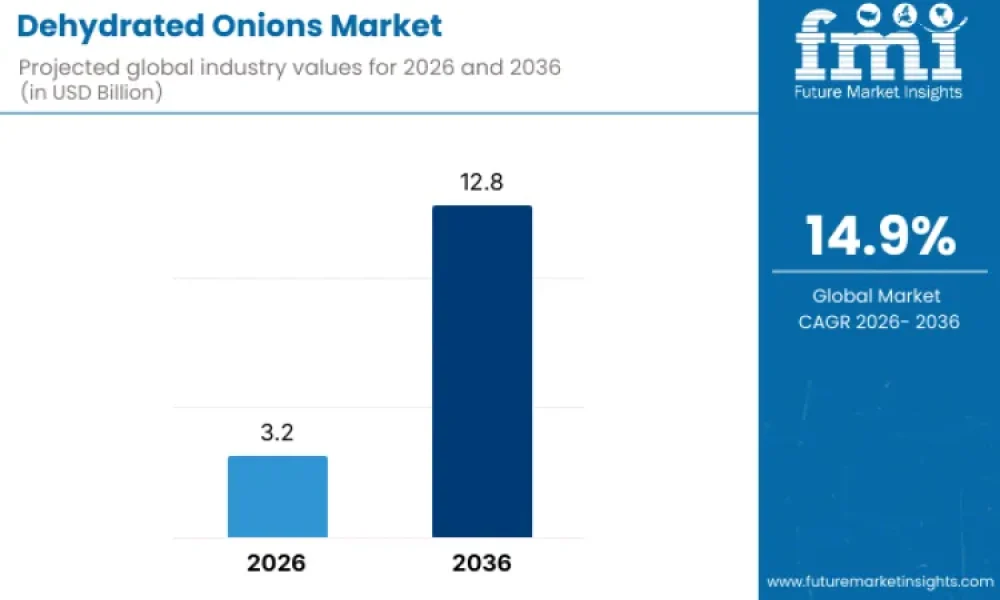
The global dehydrated onions market is entering a high-growth phase as food manufacturers and foodservice operators accelerate their shift toward shelf-stable, cost-efficient, and standardized flavoring solutions. Valued at USD 3.2 billion in 2026, the market is projected to reach USD 12.8 billion by 2036, expanding at a robust compound annual growth rate (CAGR) of 14.9% over the forecast period.
This rapid expansion reflects structural changes in global food production. Rising urbanization, growing consumption of convenience foods, and the need for resilient ingredient supply chains are pushing dehydrated onions from a supporting role into a core functional ingredient across industrial food systems.
Shelf Stability and Cost Efficiency Drive Market Adoption
Dehydrated onions offer food manufacturers a compelling value proposition. Compared with fresh onions, dehydrated formats deliver extended shelf life, reduced storage and transportation costs, and consistent flavor performance across geographies. These advantages are increasingly critical as global food supply chains adapt to volatility, labor constraints, and fluctuating agricultural yields.
Quick-service restaurants, packaged food producers, and large-scale processors rely on dehydrated onions to maintain uniform taste profiles while simplifying inventory management. As ready-to-eat meals, sauces, snacks, and seasoning blends continue to gain traction, demand for reliable, standardized onion ingredients is accelerating.
Request for Sample Report | Customize Report | Purchase Full Report – https://www.futuremarketinsights.com/reports/brochure/rep-gb-6694
Granules Dominate Form Demand Across Industrial Applications
By form, granules account for 44.2% of global demand, making them the most widely used dehydrated onion format. Granules are favored for their optimal rehydration properties, uniform particle size, and compatibility with automated dispensing and blending systems used in modern food manufacturing.
Powder formats maintain steady demand in seasoning blends requiring instant dissolution, while flakes serve applications where controlled rehydration and visible ingredient presence are preferred. The dominance of granules highlights the market’s orientation toward industrial efficiency and scalable food production workflows.
Food Processing Remains the Primary End-Use Segment
Food processing applications represent 69.1% of total market demand, underscoring the ingredient’s role in industrial food production rather than household consumption alone. Dehydrated onions integrate seamlessly into sauces, soups, meat products, bakery fillings, snacks, and prepared meals, supporting consistency across high-volume production lines.
Foodservice operators maintain significant demand, particularly in restaurant chains that prioritize speed, flavor uniformity, and waste reduction. Retail and household use continues to grow, driven by consumer interest in convenient cooking ingredients with extended shelf life.
Key Market Snapshot
- Market Value (2026): USD 3.2 billion
- Forecast Value (2036): USD 12.8 billion
- Forecast CAGR (2026–2036):9%
- Leading Form: Granules
- Leading End Use: Food processing
- High-Growth Regions: Asia Pacific, North America, Europe
Regional Growth Anchored in Processing Infrastructure Expansion
Asia Pacific emerges as a core growth engine, supported by expanding food processing capacity, rising urban populations, and government initiatives promoting agricultural value addition. India leads global growth with a CAGR of 16.8%, driven by large-scale deployment of dehydration technologies, export-oriented processing facilities, and strong policy support for food manufacturing modernization.
China follows with 15.2% CAGR, reflecting rapid urbanization, rising processed food consumption, and increasing reliance on standardized ingredients in large manufacturing clusters. The United States posts a 12.9% CAGR, supported by mature convenience food markets, quick-service restaurant expansion, and strong emphasis on ingredient standardization.
Brazil records 14.1% CAGR, aligned with agricultural modernization and export-focused food processing strategies, while Germany grows at 11.7% CAGR, driven by premium ingredient adoption and stringent quality standards within its advanced food manufacturing ecosystem.
Technology and Quality Standards Shape Market Dynamics
Advanced dehydration technologies—including air drying, freeze drying, vacuum drying, and spray drying—are improving flavor retention, texture control, and microbial safety. Food processors increasingly evaluate dehydration solutions based on moisture control accuracy, consistency validation, and regulatory compliance.
At the same time, cost considerations influence scalability. Capital investment in dehydration infrastructure, proximity to onion-growing regions, and energy efficiency requirements shape supplier strategies. Regulatory frameworks governing food safety, moisture thresholds, and labeling standards further influence long-term deployment decisions.
Competitive Landscape Focuses on Scale and Processing Excellence
Competition in the dehydrated onions market centers on processing capability, quality control, and supply reliability. Olam International leads with global sourcing strength and integrated supply chains serving high-volume food manufacturers. Jain Farm Fresh Foods and Daksh Foods leverage advanced dehydration platforms and food-grade processing systems to support industrial applications.
Natural Dehydrated Vegetables focuses on specialty ingredient solutions, while Harmony House Foods targets foodservice and retail segments with consistent, consumer-oriented product offerings. Across the competitive landscape, investment priorities include scalable production, automation compatibility, and strict adherence to food safety standards.
Outlook
From 2026 to 2036, the dehydrated onions market will remain one of the fastest-growing segments within processed food ingredients. As global food systems prioritize shelf stability, operational efficiency, and consistent flavor delivery, dehydrated onions are positioned as a strategic input rather than a commodity add-on. Strong growth across emerging and developed markets underscores the ingredient’s expanding role in modern food manufacturing and global supply chain optimization.
About Future Market Insights (FMI)
Future Market Insights, Inc. (FMI) is an ESOMAR-certified, ISO 9001:2015 market research and consulting organization, trusted by Fortune 500 clients and global enterprises. With operations in the U.S., UK, India, and Dubai, FMI provides data-backed insights and strategic intelligence across 30+ industries and 1,200 markets worldwide.
Contact Us:
Future Market Insights Inc.
Christiana Corporate, 200 Continental Drive,
Suite 401, Newark, Delaware – 19713, USA
T: +1-347-918-3531
For Sales Enquiries: [email protected]



