
The global deep fryer market is steadily expanding as fried food consumption continues to grow across both residential and commercial settings. Deep fryers have become essential kitchen appliances due to their ability to deliver quick, consistent, and flavorful cooking results. The rising demand for convenience foods, combined with evolving urban lifestyles, has significantly increased the adoption of deep fryers in households, restaurants, and cloud kitchens. With modern consumers prioritizing speed and taste, these appliances are becoming indispensable in contemporary cooking environments.
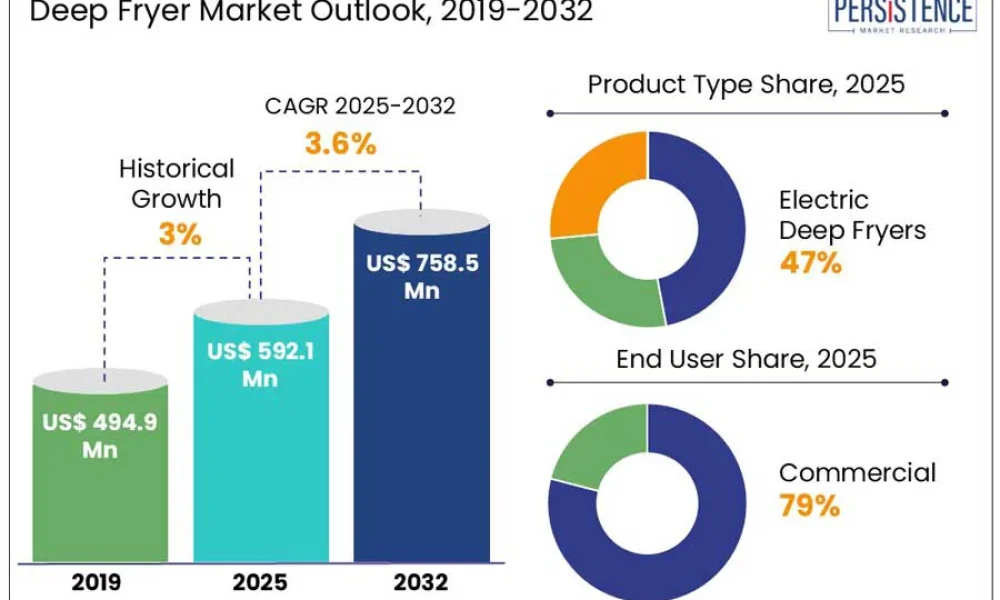
According to Persistence Market Research, the global deep fryer market size is anticipated to rise from US$ 592.1 Mn in 2025 to US$ 758.5 Mn by 2032, witnessing a CAGR of 3.6% during the forecast period. Market growth is largely driven by the surmounting rise of fried foods across cloud kitchens and fast-food chains. With over 300,000 fast food chain outlets globally, and more than 90% of major fast-food chains using deep fryers as core kitchen equipment for preparing fries, chicken, and nuggets, the demand for efficient frying solutions remains strong. The commercial segment leads the market, while North America dominates due to its well-established fast-food culture.
Download Your Free Sample & Explore Key Insights : https://www.persistencemarketresearch.com/samples/35368
Key Highlights from the Report
➤ The deep fryer market is projected to grow from US$ 592.1 Mn in 2025 to US$ 758.5 Mn by 2032 at a CAGR of 3.6%.
➤ Increasing reliance on deep fryers in fast-food chains and cloud kitchens is driving steady demand globally.
➤ More than 300,000 fast food outlets worldwide contribute significantly to equipment demand.
➤ Over 90% of major fast-food chains use deep fryers, making them essential kitchen equipment.
➤ Rising consumer preference for quick and convenient cooking solutions is supporting residential adoption.
➤ Technological advancements in energy-efficient and compact fryers are enhancing product appeal.
Market Segmentation
The deep fryer market is segmented based on product type, end-user, and capacity. Product types include electric deep fryers and gas deep fryers, with electric variants gaining popularity due to ease of use, safety features, and suitability for residential kitchens. Commercial-grade deep fryers, however, continue to dominate the market due to their high capacity and ability to handle large-scale food preparation. These are widely used in restaurants, hotels, and quick-service outlets where consistency and speed are crucial.
In terms of end-users, the market is divided into residential and commercial segments. The commercial segment holds a larger share due to the extensive use of deep fryers in fast-food chains and cloud kitchens. Meanwhile, the residential segment is growing steadily as consumers increasingly replicate restaurant-style cooking at home. The expansion of online food content and cooking tutorials is also encouraging home users to invest in advanced kitchen appliances such as deep fryers.
Customize This Report for Your Exact Requirements : https://www.persistencemarketresearch.com/request-customization/35368
Regional Insights
North America remains the leading region in the deep fryer market, supported by a strong fast-food culture and high consumption of fried food products. The presence of a large number of quick-service restaurants and established food chains has contributed significantly to the demand for commercial deep fryers. Consumers in the region also prefer convenient and quick meal preparation solutions, further driving residential demand.
The Asia-Pacific region is emerging as a high-growth market due to rapid urbanization, increasing disposable incomes, and the expansion of fast-food chains. Countries such as India and China are witnessing a surge in cloud kitchens and quick-service restaurants, boosting the demand for deep fryers. Additionally, changing dietary habits and growing exposure to global cuisines are encouraging the adoption of fried food preparation techniques in both commercial and residential settings.
Market Drivers
One of the primary drivers of the deep fryer market is the rapid expansion of fast-food chains and cloud kitchens globally. With over 300,000 fast food outlets operating worldwide, the demand for efficient cooking equipment has grown significantly. Deep fryers play a central role in preparing popular menu items such as fries, fried chicken, and nuggets, making them indispensable for foodservice operators. The increasing preference for quick-service dining and takeaway meals continues to strengthen this demand.
Another key growth factor is the rising consumer inclination toward convenience cooking. Modern lifestyles often leave limited time for elaborate meal preparation, leading consumers to adopt appliances that offer speed and efficiency. Deep fryers enable users to prepare crispy and flavorful dishes within minutes, making them a preferred choice in both households and commercial kitchens. Innovations such as temperature control, oil filtration, and compact designs further enhance their usability.
Market Restraints
Despite steady growth, the deep fryer market faces challenges related to health concerns associated with fried food consumption. Increasing awareness about obesity, cardiovascular diseases, and unhealthy eating habits has led some consumers to reduce their intake of fried foods. This shift in dietary preferences can impact the demand for deep fryers, particularly in health-conscious regions.
Another restraint is the availability of alternative cooking appliances such as air fryers and multi-functional cooking devices. These alternatives offer healthier cooking options by using minimal or no oil, attracting consumers who prioritize wellness. As a result, traditional deep fryer manufacturers face competition from innovative kitchen appliances that promote healthier cooking methods.
Market Opportunities
The deep fryer market presents promising opportunities through technological advancements and product innovation. Manufacturers are focusing on developing energy-efficient models with enhanced safety features and automated controls. These innovations not only improve user convenience but also address concerns related to energy consumption and operational efficiency, particularly in commercial settings.
Another significant opportunity lies in the expansion of emerging markets and cloud kitchen ecosystems. As urban populations grow and food delivery services gain popularity, the demand for reliable and high-capacity kitchen equipment is expected to rise. Deep fryer manufacturers can capitalize on this trend by offering customized solutions tailored to the needs of small-scale food businesses and large commercial operations.
Get Instant Access – Complete Your Purchase : https://www.persistencemarketresearch.com/checkout/35368
Company Insights
Key players operating in the deep fryer market include:
- T-fal
- Philips
- Cuisinart
- DeLonghi
- Hamilton Beach
- Breville
- Ninja Kitchen
- Pitco
- Henny Penny
- Frymaster
- Anets
- Avantco Equipment
- Bayou Classic
- Waring Commercial
- Adcraft
Recent Developments
- January 2024: Breville introduced a new range of smart deep fryers with advanced temperature control features.
- October 2023: Hamilton Beach expanded its commercial fryer portfolio to cater to growing demand from cloud kitchens.
Future Opportunities and Growth Prospects
The deep fryer market is expected to witness steady growth as global demand for fried foods continues to rise alongside the expansion of foodservice establishments. Manufacturers are likely to focus on innovation, including energy-efficient designs and enhanced safety features, to remain competitive. The integration of smart technologies and automation will further improve product functionality and appeal.
In addition, the rapid growth of cloud kitchens and online food delivery platforms will continue to drive demand for high-performance kitchen equipment. Emerging economies are expected to play a crucial role in market expansion, offering significant opportunities for manufacturers to strengthen their presence and tap into new customer segments.




