
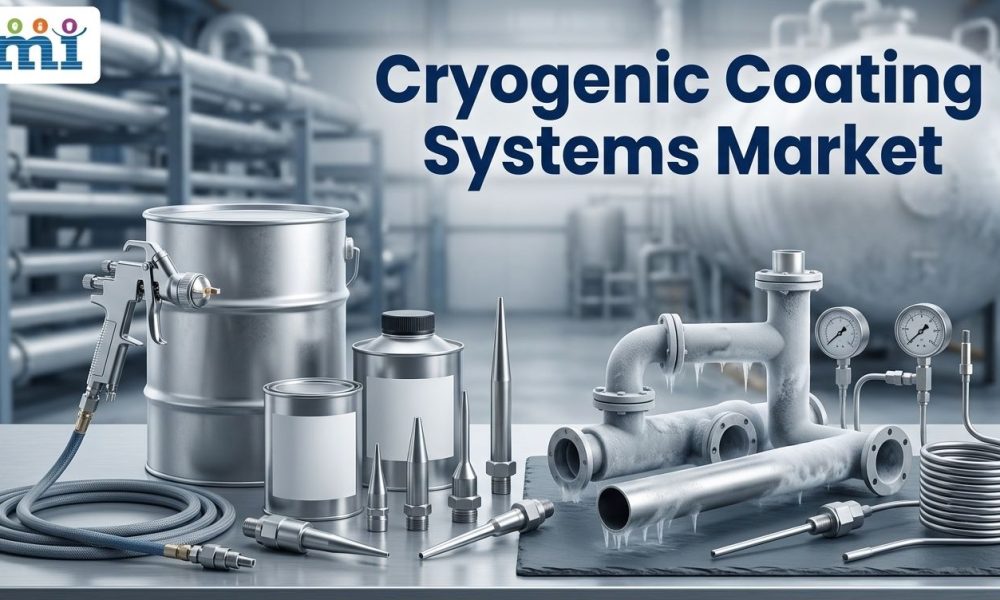
The global cryogenic coating systems market is projected to grow from USD 1,494.5 million in 2026 to USD 2,577.1 million by 2036, advancing at a 5.6% CAGR during the forecast period. Market demand is being supported by LNG infrastructure expansion, maintenance of existing facilities, and emerging hydrogen and ammonia projects requiring protection for steel structures operating under extreme temperature conditions.
As LNG facilities expand, coating systems are increasingly specified to protect carbon steel, process equipment, storage structures, and support systems against cryogenic spills, corrosion, and fire. Project teams evaluate coating performance before fabrication and installation, creating demand for systems with proven low-temperature performance, application compatibility, and field support.
Cryogenic Coating Systems Market: Key Growth Drivers
New LNG projects represent an important demand center because storage, transfer, loading, and processing facilities contain extensive steel surfaces exposed to cold-release and fire risks. Coating systems are incorporated into project specifications before shop work begins.
LNG terminals are expected to account for 35.0% of end-use demand, while carbon steel is projected to represent 41.0% of substrate demand, highlighting the importance of protective coatings across LNG infrastructure.
Get detailed market forecasts, competitive benchmarking, and pricing trends: https://www.futuremarketinsights.com/reports/sample/rep-gb-35504
Epoxy Cryogenic Coatings Lead Coating Type Demand
By coating type, epoxy cryogenic coatings are estimated to hold a 33.0% share in 2026. Their demand is supported by strong bonding properties and compatibility with thick coating layers used to protect steel under demanding operating conditions.
By application method, spray-applied systems are forecast to account for 43.0% of demand in 2026. Spray equipment enables crews to cover large steel surfaces efficiently while maintaining consistent film thickness during shop and project applications.
LNG Infrastructure Creates New Opportunities
LNG capacity additions are creating opportunities for coating suppliers offering systems designed for cold-spill protection, corrosion control, thermal performance, and fire resistance. New facilities add substantial steel surfaces requiring coating during module fabrication and site assembly.
Hydrogen and ammonia infrastructure also provides emerging opportunities. Storage vessels, process piping, and export facilities require coating systems matched to specific fluids, temperature ranges, and operating conditions. Suppliers with testing documentation, application expertise, local stock, and trained field crews can address requirements across new-build and maintenance projects.
Country Markets Show Different Growth Patterns
Canada is projected to record the highest CAGR among profiled countries at 6.8%, followed by South Korea at 6.5%, Australia at 6.1%, USA at 5.8%, Germany at 5.5%, France at 5.1%, and Japan at 4.8% through 2036.
Canada’s growth is linked to LNG infrastructure and expansion around Kitimat. South Korea benefits from LNG carrier and energy-module construction, while Australia combines LNG repair activity with hydrogen and ammonia projects. The USA is supported by LNG construction and maintenance, whereas Germany, France, and Japan have greater emphasis on existing infrastructure, upgrades, and planned repair work.
Access the Complete Report in PDF Format: https://www.futuremarketinsights.com/reports/brochure/rep-gb-35504
Competitive Landscape
The competitive landscape includes AkzoNobel, PPG, Sherwin-Williams, Hempel, Jotun, Carboline, Kansai Paint, Nippon Paint, Belzona, and Teknos.
Competition centers on cryogenic and severe-service qualification, corrosion protection, fire protection, application performance, field support, and geographic reach. AkzoNobel, PPG, Sherwin-Williams, Jotun, and Carboline participate in engineered fire and severe-service protection. Hempel, Kansai Paint, and Nippon Paint maintain broad marine and industrial protective coating portfolios, while Belzona and Teknos address repair and specialist coating requirements.
“Suppliers win cold-service coating work before site use because systems must pass project review and match the contractor’s plan. Local support matters when thick layers, checks, and shutdowns leave little room for errors.”
— Nikhil Kaitwade, Principal Consultant, Future Market Insights
Cryogenic Coating Systems Market: Report Scope
The report covers the market by coating type, substrate, end use, application method, sales channel, and region. Coating types include epoxy, polyurethane, insulation, anti-corrosion, and fire-protection coatings. Substrates include carbon steel, stainless steel, aluminum, concrete, and composite surfaces. End uses include LNG terminals, industrial gases, hydrogen infrastructure, marine LNG, and chemical plants.
The forecast period extends from 2026 to 2036, with the study evaluating demand based on cryogenic spill protection, corrosion resistance, fire protection, thermal performance, substrate compatibility, and application requirements.
Business Impact
FMI helps organizations transform market complexity into strategic clarity, enabling leadership teams to identify growth opportunities faster, optimize resource allocation, strengthen competitive positioning, and make high-stakes business decisions with confidence.
To explore how FMI Custom Research can support your strategic priorities, please connect with our team at – [email protected]
About Future Market Insights (FMI)
Future Market Insights, Inc. (FMI) is an ESOMAR-certified, ISO 9001:2015 market research and consulting organization, trusted by Fortune 500 clients and global enterprises. With operations in the U.S., UK, India, and Dubai, FMI provides data-backed insights and strategic intelligence across 30+ industries and 1200 markets worldwide.



