
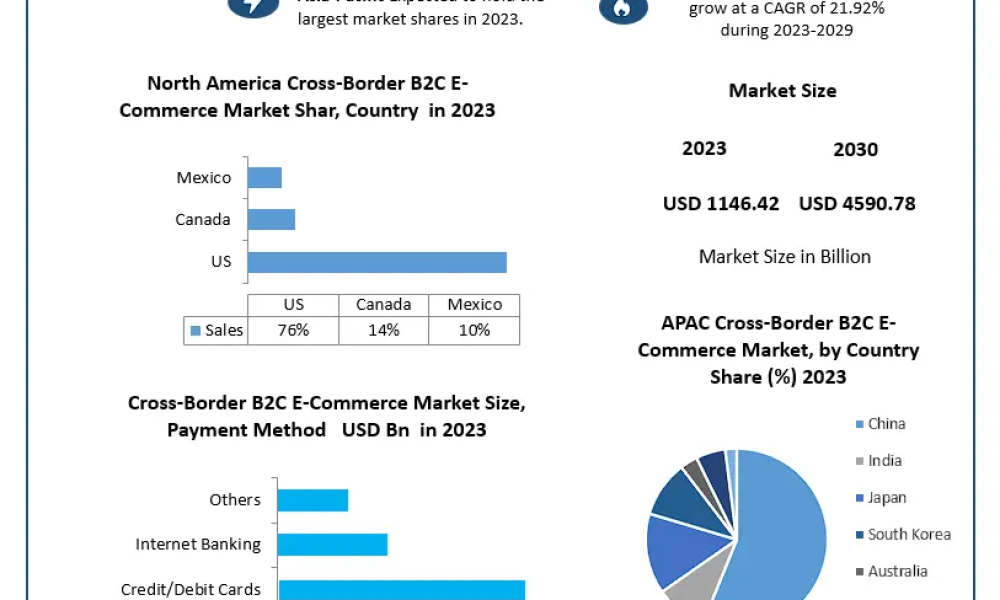
Cross-Border B2C E-Commerce Market Overview :
Cross-Border B2C e-Commerce Market was valued at approximately USD 1,122.08 billion in 2023 and is projected to surge at a CAGR of around 21.92%, reaching nearly USD 4,590.78 billion by 2030. Cross-border B2C e-commerce involves international online sales from businesses to consumers and has become a vital component of global retail, providing greater product variety, competitive pricing, and new growth avenues for small and medium enterprises (SMEs).
Key Market Insights and Dynamics
Dominating Region:
Asia Pacific leads the global cross-border B2C e-commerce market with over 46.25% market share in 2023, powered by rising international trade, enhanced free trade agreements, expanding digital infrastructure, and a large digitally connected population. North America is forecasted to grow at the highest CAGR of 22.45%, driven by demand for quality goods, efficient logistics, and a high price level index favoring international purchases.Market Segmentation:
By Offering: The assorted brands segment leads with roughly 70.32% market share due to expansive product variety catering to diverse consumer preferences.
By Category: Apparel & accessories dominate with nearly 29.77% global revenue share, reflecting consumers’ desire for global fashion trends and unique styles. Other major categories include consumer electronics, healthcare & nutrition, personal care & beauty, food & beverages, and entertainment & education.
By Payment Method: Credit/debit cards hold the largest share owing to global acceptance and ease of use. Digital wallets are the fastest growing payment mode due to convenience, security, and rising mobile commerce adoption.
Key Drivers:
Increasing internet penetration, smartphone usage, rising consumer confidence in online shopping, and well-established global logistics networks accelerate market growth. Social media influences shopping behavior and raises awareness regarding global products. SMEs benefit significantly through extended reach to international markets.Challenges:
Rising shipping costs, inflation, labor shortages, and managing cross-border returns sustainably challenge market operators. Price sensitivity and cultural preferences in some markets also require tailored marketing strategies.
Regional Analysis
Asia Pacific:
The region thrives on strengthened trade relations, such as free trade agreements between China and New Zealand, improving export processes, reducing tariffs, and broadening market access. Major markets include China, India, Japan, South Korea, and Southeast Asia.North America:
Growth is propelled by mature digital infrastructure, consumer preference for cross-border shopping, and significant investment in logistics and payment technologies.Europe:
Countries like Germany, France, and the UK contribute substantially, supported by high internet penetration and evolving e-commerce policies.Other Regions:
Latin America and Middle East & Africa show increasing adoption trends with opportunities for market expansion.
Competitive Landscape and Recent Developments
Global key players include Amazon.com Inc., Alibaba Group, eBay Inc., JD.com, Etsy Inc., Apple Inc., DHL Group, PayPal, and Zalando. Market players invest in expanding their logistics capability, adopting AI and blockchain technologies for secure payments, enhancing personalized shopping experiences, and forming partnerships to strengthen regional markets.
A notable recent development includes eBay’s 2023 acquisition of 3PM Shield to enhance monitoring against counterfeit and unsafe products.
Future Outlook and Trends
The cross-border B2C e-commerce market is poised for transformative growth fueled by continuous digital adoption, blockchain security, AI personalization, social commerce integration, and sustainable logistics. Expansion of digital wallet payment solutions and increasing demand for global products drive the sector’s dynamic evolution.
Quote
Asia Pacific’s dominance in cross-border B2C e-commerce reflects the region’s expanding internet population and global trading partnerships. Combined with North America’s technological infrastructure and consumer buying power, these markets are reshaping the retail landscape for global brands and SMEs alike across the next decade.
Overall, the cross-border B2C e-commerce market stands as a cornerstone of international trade and retail innovation—enabling businesses of all sizes to access global consumers and empowering shoppers with unparalleled choice and convenience worldwide.




