
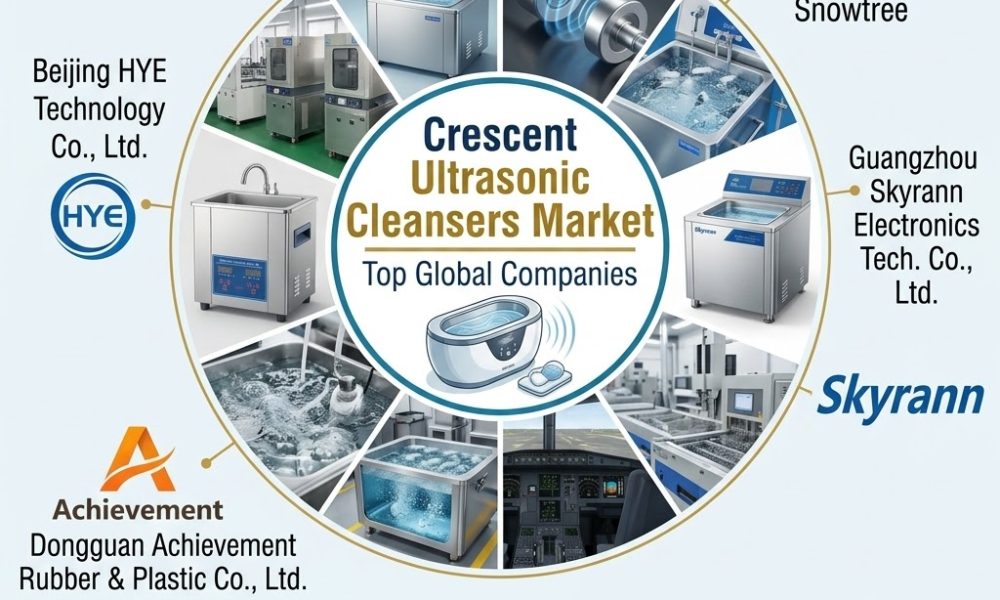
The global Crescent Ultrasonic Cleansers Market is projected to grow from USD 0.9 billion in 2026 to USD 2.1 billion by 2036, expanding at a compound annual growth rate (CAGR) of 8.8%, according to Fact.MR. Valued at approximately USD 0.8 billion in 2025, the market is expected to create an incremental growth opportunity of USD 1.2 billion between 2026 and 2036 as industrial manufacturing, healthcare reprocessing, electronics production, and automotive applications increase demand for controlled ultrasonic cleaning systems.
Get detailed market forecasts, competitive benchmarking, and pricing trends:
Market Size and Growth Forecasts
- 2025 Market Value: USD 0.8 billion
- 2026 Estimated Market Size: USD 0.9 billion
- 2036 Projected Market Value: USD 2.1 billion
- Forecast CAGR: 8.8% from 2026 to 2036
- Incremental Growth Opportunity: USD 1.2 billion
Demand is being supported by the need to remove machining residues, oils, polishing compounds, and particulate contamination from intricate components and reusable instruments. Manufacturers are increasingly evaluating ultrasonic cleaning as a controlled production step that influences inspection results, assembly quality, coating adhesion, and downstream process performance.
Key Market Segments
Industrial Equipment and Applications Lead Demand
- By Product: Industrial Ultrasonic Cleaners are projected to account for 64.1% of the market in 2026, supported by demand for larger tanks, durable transducers, and repeatable cleaning cycles.
- By Application: Industrial Cleaning Applications are expected to capture 41.8% of the market, reflecting recurring requirements for component degreasing, tooling maintenance, and residue removal.
- By End Use: Industrial Manufacturing is forecast to represent 57.3% of demand in 2026 as manufacturers integrate cleaning into inspection, assembly, bonding, and coating workflows.
- By Technology: Ultrasonic Cavitation Technology is expected to hold a 52.6% share, reflecting the importance of acoustic cavitation in removing contamination from immersed surfaces and complex geometries.
- By Formulation: Water Based Cleaning Systems are projected to account for 38.9% of the market, supported by formulation flexibility and compatibility with aqueous ultrasonic processes.
- By Distribution Channel: Direct Industrial Sales are expected to capture 66.4% of the market, reflecting the need for equipment sizing, application trials, installation, validation, and technical support.
Country-Level Growth Outlook Through 2036
Fact.MR projects the following country-level growth rates for the forecast period:
- Germany: 10.12% CAGR, supported by machinery, electronics, optical-product, and automotive manufacturing.
- Brazil: 9.24% CAGR, driven by industrial modernization and healthcare instrument-reprocessing requirements.
- United States: 8.36% CAGR, reflecting demand across manufacturing, electronics, and healthcare facilities.
- United Kingdom: 7.48% CAGR, supported by dental decontamination guidance and industrial cleaning applications.
- Japan: 6.6% CAGR, underpinned by precision manufacturing, electronic components, and production machinery.
Major Market Trends and Growth Drivers
Precision manufacturing and process control: Industrial buyers increasingly require consistent cleaning performance before assembly, coating, bonding, and inspection. Multi-frequency systems, temperature controls, filtration, and programmable cycles can help manufacturers manage different contamination levels and component sensitivities.
Healthcare reprocessing requirements: The U.S. Centers for Disease Control and Prevention recognizes ultrasonic cleaning among common mechanical cleaning methods. Regulatory expectations for validated reusable-device reprocessing instructions are increasing the importance of documented operating procedures, equipment maintenance, and cleaning verification.
Chemistry optimization and digital monitoring: Cleaning results depend on detergent chemistry, temperature, contact time, loading, and ultrasonic activity. Data logging, automated dosing, ultrasonic-activity monitoring, and fault detection are creating opportunities for suppliers to differentiate their systems through process traceability and consistent operating performance.
Capital costs, validation requirements, material compatibility, and maintenance discipline remain important adoption challenges. Suppliers that combine equipment design with application testing, chemistry guidance, and after-sales support can address these concerns more effectively.
Competitive Landscape
Competition centers on tank architecture, transducer reliability, frequency selection, heating, cycle programming, filtration, chemical compatibility, and technical service capabilities. Buyers increasingly assess whether suppliers can demonstrate repeatable performance and support documented cleaning procedures across production shifts and multiple facilities.
Key companies profiled include:
- Shenzhen Heng Xian Qiang Technology Co. Ltd.
- Snowtree Group Co. Ltd.
- Guangzhou Skyrann Electronics Tech. Co. Ltd.
- Dongguan Achievement Rubber & Plastic Co. Ltd.
- Beijing HYE Technology Co. Ltd.
Analyst Perspective
“Ultrasonic cleaning purchases are increasingly being judged as process-control decisions, not just equipment purchases. Buyers want repeatable cavitation, predictable chemistry performance, traceable cycles, and service support that keeps cleaning quality stable across shifts. Suppliers that can connect tank design, frequency, temperature, loading, and validation into one operating method will be better positioned in industrial and regulated applications.”
— Shambhu Nath Jha, Principal Consultant at Fact.MR
Strategic Implications for Industry Participants
Equipment manufacturers should demonstrate cleaning uniformity, document operating parameters, and offer application-specific testing. Healthcare-focused suppliers should prioritize validated procedures, performance checks, and compatibility with instrument-cleaning chemistries. Industrial suppliers can strengthen their position through integrated cleaning solutions that combine equipment, formulation selection, rinsing, drying, and cleanliness verification.
For procurement teams, evaluating total process performance rather than equipment price alone will remain important as quality requirements become more demanding.
Top Trending Reports:
On the go Food Packaging Market Valuation, ROI Potential & Long-Term Growth Prospects (2026–2036) https://www.openpr.com/news/4388443/on-the-go-food-packaging-market-valuation-roi-potential
About Fact.MR
Fact.MR is a market research and consulting firm providing market intelligence, industry analysis, and strategic insights to support business decisions across industries. Its research helps manufacturers, suppliers, investors, and other stakeholders evaluate market opportunities, competitive positioning, and emerging demand trends.



