
The global carbon felt and graphite felt market is projected to grow from USD 519.1 million in 2025 to USD 570.0 million in 2026, reaching USD 1,451.8 million by 2036, according to Fact.MR. The market is forecast to expand at a compound annual growth rate (CAGR) of 9.8% from 2026 to 2036, generating an incremental opportunity of USD 881.8 million. Growing investment in grid-scale energy storage, semiconductor manufacturing, photovoltaic production and energy-efficient industrial furnaces is increasing demand for specialized carbon-based materials.
Get detailed market forecasts, competitive benchmarking, and pricing trends : https://www.factmr.com/connectus/sample?flag=S&rep_id=4950
Carbon Felt and Graphite Felt Market: Size and Growth Forecast
- 2025 Market Value: USD 519.1 million
- 2026 Market Size: USD 570.0 million
- 2036 Forecast Value: USD 1,451.8 million
- Forecast CAGR: 9.8% from 2026 to 2036
- Incremental Growth Opportunity: USD 881.8 million
Carbon felt and graphite felt provide porous, electrically conductive structures for electrochemical applications and thermal insulation for high-temperature industrial processes. Their performance depends on properties such as density, porosity, electrical resistance, thermal conductivity, purity and dimensional stability.
Key Market Segments
PAN-Based Carbon Felt Leads Product Demand
Polyacrylonitrile (PAN)-based carbon felt is projected to account for 62.1% of the product segment in 2026. Its established precursor-processing route supports the production of controlled fibrous structures for both porous battery electrodes and high-temperature insulation. Suppliers can adapt thermal treatment, purification and surface properties to meet different industrial specifications.
Pitch-based and rayon-based carbon felt remain relevant for applications requiring specific thermal characteristics, purity levels or material economics.
Energy Storage Systems Lead Application Demand
Energy storage systems are expected to represent 38.4% of application demand in 2026. Carbon and graphite felt serve as porous electrodes in redox-flow batteries, allowing electrolyte to move through the material while supporting electrical conduction and electrochemical reactions.
Electrode compression, thickness and internal structure influence permeability, diffusion and electrical resistance. As battery developers move from laboratory testing to commercial stack qualification, consistent material specifications become increasingly important.
Energy and Power Industry Leads End Use
The energy and power industry is projected to account for 54.7% of end-use demand in 2026. Stationary energy storage and industrial thermal applications support procurement of felt materials with defined electrical, mechanical and thermal properties.
Carbonization technology is forecast to hold 47.9% of the technology segment, while high-density carbon felt formulations are expected to account for 66.8% of the formulation segment. Direct industrial sales are projected to represent 42.6% of distribution channels in 2026, reflecting the importance of customized dimensions, technical support and product qualification.
Country-Level Growth Outlook Through 2036
Fact.MR identifies the following country growth projections for the forecast period:
- Germany: 11.3% CAGR, supported by energy-storage development, specialty carbon materials and high-temperature industrial processing.
- Brazil: 10.3% CAGR, reflecting the development of battery-storage regulation and demand for flexible electricity systems.
- United States: 9.3% CAGR, supported by flow-battery research, manufacturing initiatives and grid-scale validation infrastructure.
- United Kingdom: 8.3% CAGR, with long-duration electricity-storage support creating opportunities for battery developers.
- Japan: 7.4% CAGR, supported by stationary storage initiatives, domestic carbon-felt capabilities and semiconductor-related thermal processing.
These projections highlight the importance of both energy-storage deployment and established industrial applications in shaping demand across national markets.
Major Market Trends and Growth Drivers
Grid-scale storage development: Redox-flow batteries offer a route to storing renewable electricity for later use. Research and testing programs at the Pacific Northwest National Laboratory (PNNL) support material evaluation, battery-stack assembly and performance testing. As projects progress toward commercial deployment, electrode consistency and qualification become important purchasing criteria.
High-temperature industrial processing: Semiconductor crystal growth, photovoltaic ingot production, sintering and heat treatment require insulation materials capable of operating under demanding thermal conditions. Suppliers such as SGL Carbon and Mersen serve applications where insulation performance influences temperature uniformity and energy consumption.
Application-specific material engineering: Battery developers must balance electrical contact with electrolyte transport, while furnace operators prioritize thermal conductivity, purity and dimensional stability. These requirements encourage suppliers to develop customized grades and provide detailed product specifications.
Investment in long-duration energy storage: Storage policies and project-development frameworks in Germany, the United States, the United Kingdom, Brazil and Japan are expanding opportunities for stationary battery technologies. The resulting demand for felt materials will depend on the battery chemistries and system designs selected for individual projects.
Competitive Landscape
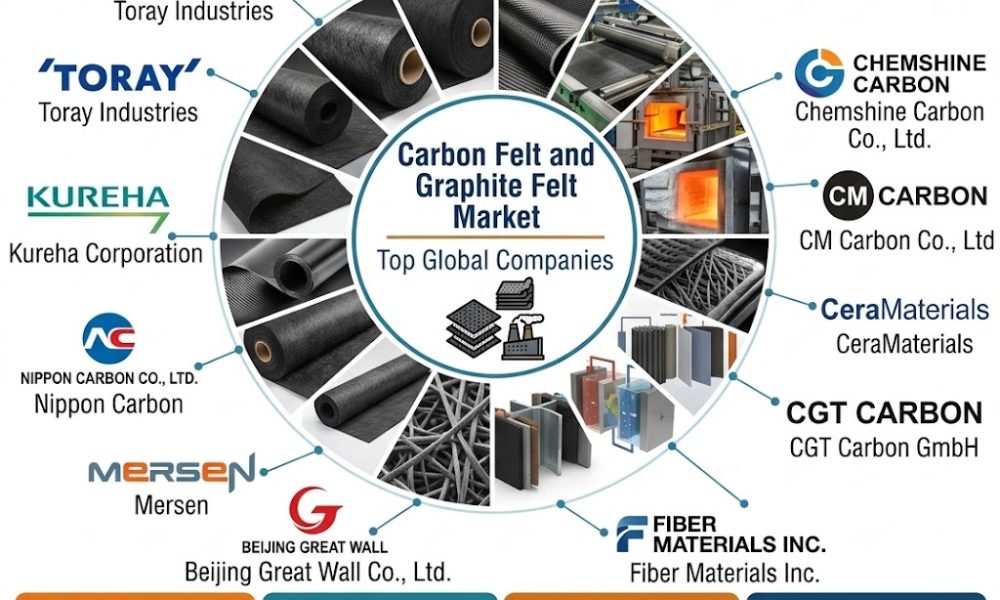
The carbon felt and graphite felt market includes established specialty-material manufacturers and suppliers serving battery, semiconductor and high-temperature industrial applications.
Key companies profiled include:
- SGL Carbon
- Toray Industries
- Kureha Corporation
- Nippon Carbon Co., Ltd.
- Mersen
- Beijing Great Wall Co., Ltd.
- Morgan Advanced Materials Plc
- Chemshine Carbon Co., Ltd.
- CM Carbon Co., Ltd.
- CeraMaterials
- CGT Carbon GmbH
- Fiber Materials Inc.
Competition centers on precursor selection, carbonization and graphitization capabilities, purification, dimensional control, surface treatment and the ability to maintain consistent material properties across production batches. Suppliers that support customer qualification and offer application-specific processing can strengthen their position in technically demanding markets.
Analyst Perspective
Shambhu Nath Jha, Principal Consultant at Fact.MR, states:
“Carbon felt and graphite felt purchasing is increasingly specification-led. Battery developers need a controlled balance between electrical contact and electrolyte transport, while furnace users focus on thermal conductivity, purity, outgassing and shape stability. Suppliers that can hold those variables consistent across production lots and support customer qualification will be better placed to capture repeat orders as flow-battery stacks and high-temperature processing capacity scale.”
Strategic Implications for Industry Participants
Manufacturers should prioritize repeatable quality, documented material properties and application-specific engineering support. Battery developers can benefit from qualifying electrode thickness and compression together, while furnace operators should assess thermal performance, impurity levels and replacement requirements.
Producers with carbonization and graphitization capabilities can address a wider range of specifications, supplying carbonized grades for suitable applications and more highly processed graphite felt where conductivity, purity or temperature requirements justify the additional processing.
Top Trending Reports:
About Fact.MR
Fact.MR is a market research and consulting firm providing market intelligence, industry analysis and strategic insights to businesses across sectors. Its research supports manufacturers, suppliers, investors and decision-makers in evaluating market opportunities, competitive conditions and emerging industry trends.



