
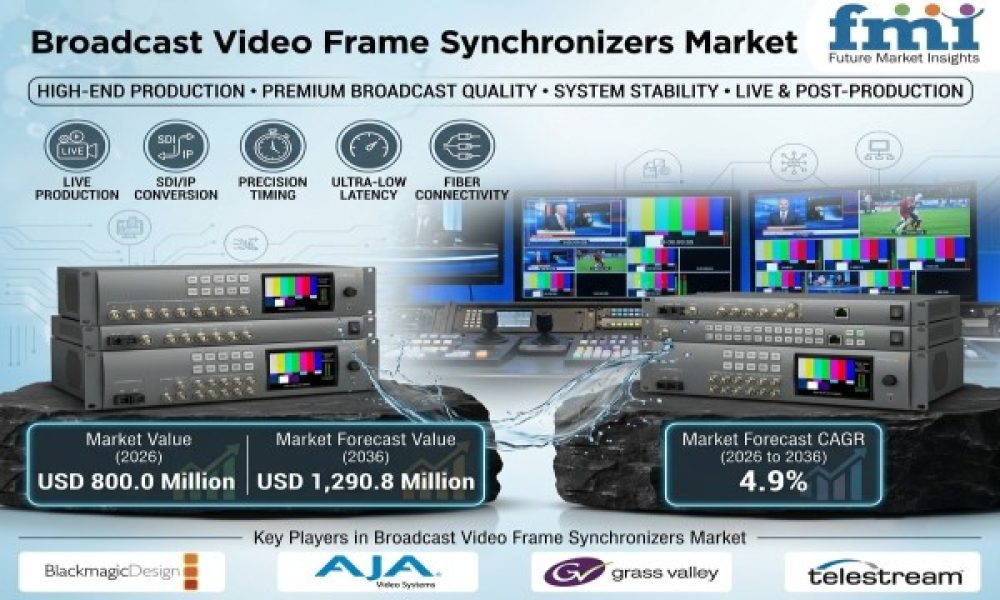
NEWARK, Del., October 14, 2026 — The global Broadcast Video Frame Synchronizers Market is projected to grow from USD 800.0 million in 2026 to USD 1,290.8 million by 2036. According to the latest market report published by Future Market Insights (FMI), the industry is anticipated to expand at a compound annual growth rate (CAGR) of 4.9% over the forecast period. Demand is being supported by broadcasters upgrading signal chains while continuing to operate legacy equipment alongside newer IP-based infrastructure.
View the Sample Study — Discover Market Trends Instantly!
https://www.futuremarketinsights.com/reports/sample/rep-gb-35494
KEY MARKET TAKEAWAYS
- Market Valuation: USD 800.0 million in 2026, projected to reach USD 1,290.8 million by 2036.
- Growth Rate: Expected to expand at a 4.9% CAGR from 2026 to 2036.
- Leading Product Segment: Modular card synchronizers are projected to account for 30.0% of the product type segment in 2026.
- Leading Signal Format: HD-SDI/3G-SDI is estimated to hold a 34.0% share in 2026.
- Fastest-Growing Country: The Netherlands is projected to record the highest country-level growth, at a 5.9% CAGR.
- Core Growth Driver: Broadcasters need to align incoming video feeds across hybrid SDI and IP production environments before switching, recording and playout.
INDUSTRY SHIFTS & MARKET DYNAMICS
Broadcast facilities increasingly need to connect signals from different sources, formats and timing systems. Frame synchronizers align incoming video feeds with a common reference, helping production teams maintain stable output. As broadcasters introduce IP workflows based on SMPTE ST 2110, synchronization equipment can help bridge existing SDI infrastructure and newer network-based systems. Modular card designs also appeal to facilities that want to add channels incrementally, replace individual cards and use existing rack space efficiently.
However, integration and testing can slow procurement. Legacy clock systems and Precision Time Protocol-based IP networks must work together reliably, and equipment needs to be tested under real operating conditions. Broadcasters also weigh compatibility, downtime risks and upgrade costs before replacing established systems. Suppliers that combine synchronization with format conversion and other signal-processing functions may appeal to facilities seeking to reduce equipment complexity while modernizing in stages.
COMPETITIVE LANDSCAPE
Competition centres on signal compatibility, channel capacity, rack efficiency, timing performance and integration with IP-based broadcast systems. Suppliers serve both facilities seeking compact, modular upgrades and larger operations modernizing interconnected production infrastructure. Buyers also consider service support, ease of replacement and the ability to expand system capacity without replacing an entire installation.
Key Companies Profiled Include: Evertz, Grass Valley, Ross Video, AJA Video Systems, Blackmagic Design, Imagine Communications, Lawo, FOR-A, Cobalt Digital and Decimator Design.
REGIONAL MARKET SUMMARY
- Netherlands — 5.9% CAGR: The fastest-growing country in the report’s forecast, supported by demand for timing control as media feeds move through shared and remote production systems.
- Mexico — 5.6% CAGR: Digital terrestrial television capacity and mixed generations of broadcast equipment create requirements for synchronization solutions that work with existing infrastructure.
- Canada — 5.3% CAGR: Broadcasters continue to assess equipment replacements carefully, creating interest in systems that combine multiple signal-processing functions.
- France — 5.0% CAGR: The transition toward IP-based broadcast networks increases the importance of dependable timing and signal coordination between regional facilities.
- United States — 4.6% CAGR: Staged infrastructure upgrades require equipment that supports existing SDI systems while accommodating newer production workflows.
Source: Future Market Insights, Broadcast Video Frame Synchronizers Market report.
ANALYST INSIGHTS
“Engineering teams will pay for frame timing that blends into the wider signal chain instead of adding another single-use box. The buy decision rests on proven timing plus a clear path from installed SDI gear to newer IP systems,” stated Sudip Saha, Principal Consultant at Future Market Insights.
FREQUENTLY ASKED QUESTIONS
Q: What is the projected size of the Broadcast Video Frame Synchronizers Market by 2036?
A: The market is projected to grow from USD 800.0 million in 2026 to USD 1,290.8 million by 2036, at a CAGR of 4.9%.
Q: Which product segment holds the leading share?
A: Modular card synchronizers are projected to account for 30.0% of the product type segment in 2026. Their modular design allows facilities to add channels and replace individual cards without changing an entire system.
Q: Which country is expected to record the highest growth rate?
A: The Netherlands is projected to lead the countries profiled, with a CAGR of 5.9% through 2036.
Explore More Related Reports –
Industrial IR Illuminator Market – https://www.futuremarketinsights.com/reports/industrial-ir-illuminator-market
Photonic Fabric Topology Optimization Software Market – https://www.futuremarketinsights.com/reports/photonic-fabric-topology-optimization-software-market
ABOUT FUTURE MARKET INSIGHTS
Future Market Insights, Inc. (FMI) is an ESOMAR-certified market research and consulting firm headquartered in Delaware, USA, with offices in the United Kingdom, the United Arab Emirates and India. FMI delivers syndicated and custom research across food and beverage, healthcare, chemicals, technology, packaging, consumer goods and industrial sectors. Its research supports business planning through market sizing, forecasts, competitive analysis and industry insights.
MEDIA CONTACT
Contact Person: Media Relations Team
Designation: Future Market Insights, Inc.
Email: [email protected]
Phone: +1-347-918-3531
Website: https://www.futuremarketinsights.com/



