
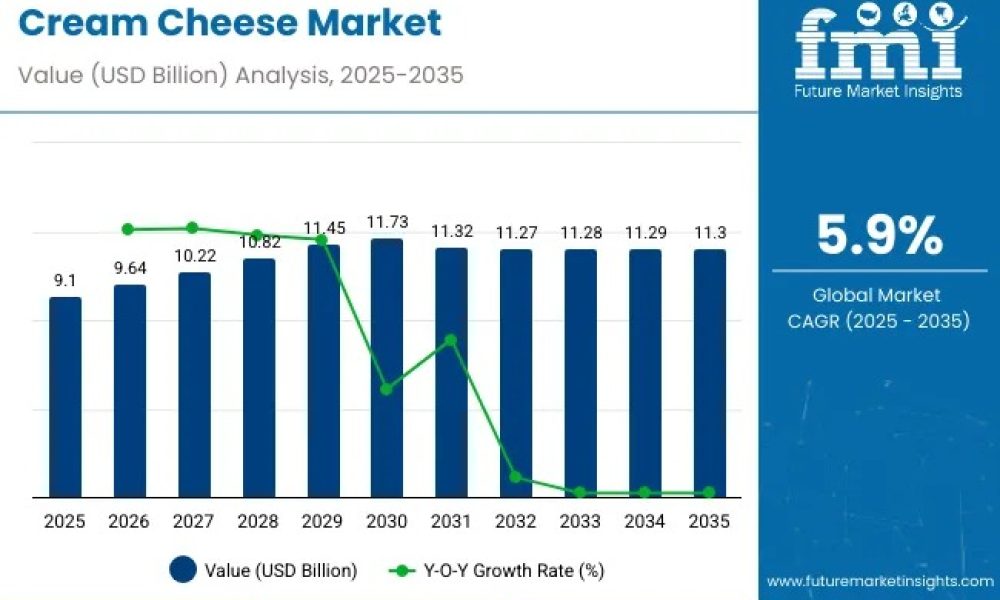
The global cream cheese market is projected to reach USD 11.3 billion by 2035 from its estimated USD 9.1 billion valuation in 2025, expanding at a robust 5.9% CAGR. Growth is fueled by rising consumer preference for dairy-based spreads, surging integration of cream cheese in bakery and foodservice menus, and increased innovation in premium and health-oriented cream cheese formulations.
To Explore Detailed Market Data, Segment-Wise Forecasts, and Competitive Insights, Request Sample Report! https://www.futuremarketinsights.com/reports/sample/rep-gb-5480
Premiumization, Health Shift, and Culinary Expansion Drive Market Momentum
Cream cheese continues to gain global traction as consumers experiment with recipes, breakfast spreads, quick snacks, and café-style desserts. Its widespread use in bagels, dips, sauces, frostings, cheesecakes, and fusion cuisine is expanding usage across retail households and commercial kitchens.
A growing shift toward organic, low-fat, lactose-free, probiotic, and plant-based dairy products is reinforcing market growth. Kraft Heinz’s 2024 launch of a plant-based cream cheese range exemplifies the rising demand for vegan and allergen-free formulations. At the same time, advancements in dairy processing and shelf-life enhancement technologies are enabling better product stability and convenience for retail and foodservice buyers.
Regional Growth Outlook Highlights Asia-Pacific’s Rising Adoption
North America and Europe remain the leading cream cheese markets due to strong bakery culture, high per-capita dairy consumption, and demand for flavored, whipped, and premium variants.
Meanwhile, Asia-Pacific is emerging as a high-growth region, driven by Western food adoption, café culture, higher disposable incomes, and the expansion of bakery and dessert chains in China, India, and Japan.
Key Market Indicators
- Market Size 2025: USD 9.1 Billion
- Projected Market Size 2035: USD 11.3 Billion
- CAGR (2025–2035): 5.9%
Rising Per Capita Consumption Boosts Global Market Depth
Per capita cream cheese consumption is increasing worldwide as home baking, café-style dining, and processed dairy availability surge. Western markets such as the U.S., Canada, Germany, and the UK maintain high consumption levels driven by mature culinary applications and product diversification.
Conversely, emerging economies—including India, China, Brazil, and South Africa—are witnessing rising demand as urban consumers adopt Western bakery products and explore international flavors. Growing exposure to global café chains and dessert formats is accelerating demand among younger demographics.
Global Trade Expansion Reinforces Supply and Distribution
Major exporting nations like the United States, Germany, France, and New Zealand benefit from advanced dairy infrastructure and extensive global supply chains. High import demand in Japan, South Korea, Saudi Arabia, the UAE, and increasingly China and India reflects widening usage in bakery, foodservice, and premium retail dairy categories.
Semi-Annual Demand Shifts Indicate Stable, Upward Trajectory
CAGR movements across H1 and H2 of 2024 and 2025 show stable growth with incremental improvements:
- H1 2024: 5.6%
- H2 2024: 5.8%
- H1 2025: 5.7%
- H2 2025: 5.9%
These improvements highlight steady demand expansion powered by clean-label trends, premium dairy consumption, flavored and organic cream cheese adoption, and growing relevance in bakery and foodservice operations.
Blueberry-Flavored Cream Cheese Leads Premium Segment
Blueberry-flavored cream cheese is set to command 58.6% market share in 2025, driven by demand for fruity, indulgent, and health-inspired varieties. Major brands—including Philadelphia and Kraft Heinz—continue expanding this segment with convenient, ready-to-use variants appealing to younger and experimental consumers.
Household End-Use Maintains Market Leadership
At 52% market share, households remain the largest end-use segment. Cream cheese’s versatility as a spread, ingredient, and dessert base makes it a kitchen staple globally. Its availability in multiple formats—brick, whipped, flavored, and organic—supports widespread consumption across age groups.
Key Industry Highlights
- Expanding bakery, café, and QSR operations are driving large-scale cream cheese usage in cheesecakes, pastries, sandwiches, and gourmet spreads.
- Health-conscious consumers are accelerating demand for organic, probiotic, low-fat, and clean-label cream cheese.
- Rise of plant-based dairy is reshaping innovation pipelines, with cashew, almond, and soy-based cream cheese gaining traction.
- E-commerce and DTC channels are boosting premium and specialty cream cheese accessibility, particularly among urban consumers.
Subscribe for Year-Round Insights → Stay ahead with quarterly and annual data updates. https://www.futuremarketinsights.com/reports/brochure/rep-gb-5480
Market Concentration and Competitive Landscape
Tier-1 players like Kraft Heinz (Philadelphia), Arla Foods, Fonterra, and Lactalis command 55% of global market share, driven by large-scale production, extensive distribution, and strong brand portfolios.
Tier-2 players—Müller Group, Bel Group, FrieslandCampina, Savencia—hold 30%, focusing on specialty, artisanal, and premium dairy offerings.
Tier-3 artisanal brands—including Vermont Creamery, Sierra Nevada Cheese Company, and Green Valley Creamery—collectively hold 15%, appealing to consumers seeking organic, grass-fed, local, and craft dairy experiences.
Country-Wise Market Outlook (2035 Forecast)
- United States: USD 5,875.2 Million
- Germany: USD 3,918.6 Million
- China: USD 3,128.4 Million
- India: USD 1,954.7 Million
Germany’s organic dairy preference, China’s Western bakery boom, and India’s expanding café culture are among the key growth drivers shaping regional demand.
About Future Market Insights (FMI)
Future Market Insights, Inc. (FMI) is an ESOMAR-certified, ISO 9001:2015 market research and consulting organization, trusted by Fortune 500 clients and global enterprises. With operations in the U.S., UK, India, and Dubai, FMI provides data-backed insights and strategic intelligence across 30+ industries and 1200 markets worldwide.



