
The need for industrial automation has grown as a result of the manufacturing sector’s increasing requirement to handle vast quantities of resources and goods effectively. Every industrial step has a conveyor system, which is a crucial component of the material handling process. Customization to satisfy the demands of varied end-users has led to the development of new conveyor systems with updated designs and automated functionalities. Additionally, the expansion of malls and airports in emerging economies has spurred a need for belt conveyors.
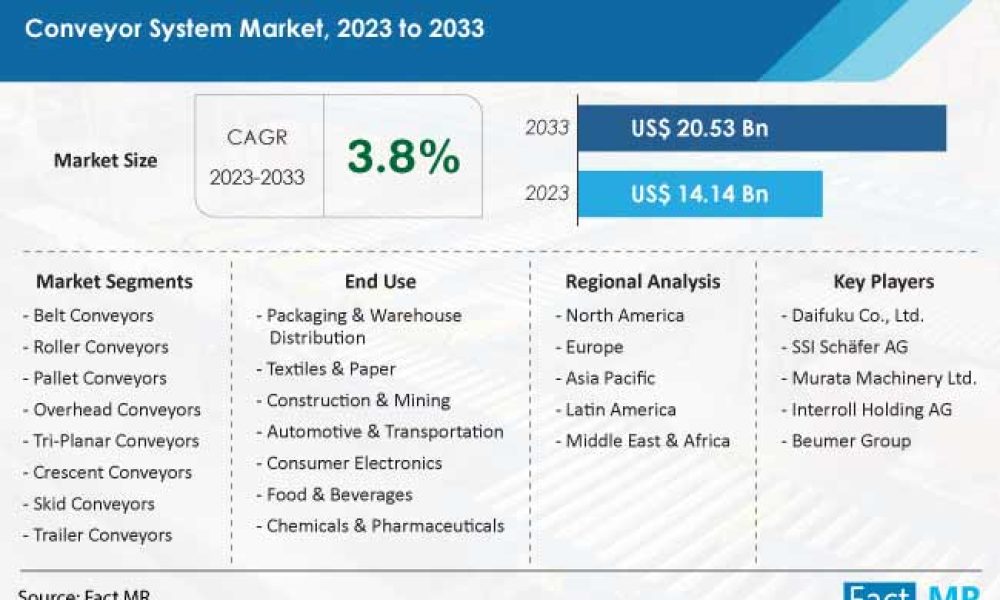
The global conveyor system market stands at a valuation of US$ 14.14 billion in 2023 and is forecasted to reach US$ 20.53 billion by the end of 2033. Worldwide demand for conveyor systems is set to increase at a CAGR of 3.8% from 2033 to 2033.
Download a Free Sample Copy of This Report: https://www.factmr.com/connectus/sample?flag=S&rep_id=4779?PJ
The Conveyor System Market research offers a thorough analysis of the business models, important market dynamics, including the drivers, restraints, trends, and opportunities, key business models, and respective market shares of some of the leading key players in the market. Along with an in-depth analysis of the major driving factors, the detailed research provides market data in terms of revenues, segment-specific data, regional data, and territorial data. Providing unique information about the market’s anticipated growth from 2023 to 2032 is the primary goal of the Conveyor System Market report.
Key Drivers of the Conveyor System Market:
- E-commerce and Retail Boom: The rapid growth of e-commerce and the expanding retail sector are significant drivers for the conveyor system market. Conveyor systems play a pivotal role in streamlining material flow, facilitating order fulfillment, and supporting the efficient movement of goods in distribution centers and warehouses.
- Automation in Manufacturing: The trend towards automation in manufacturing processes is a key driver for conveyor system adoption. Conveyor systems enable the automated movement of raw materials, components, and finished products within manufacturing facilities, leading to increased efficiency, reduced labor costs, and enhanced production throughput.
- Focus on Supply Chain Optimization: Companies across industries are increasingly focusing on optimizing their supply chains to improve operational efficiency and reduce costs. Conveyor systems contribute to supply chain optimization by providing a reliable and continuous flow of materials, reducing bottlenecks, and enhancing overall logistics performance.
- Technological Advancements: Ongoing technological advancements in conveyor system design and control systems contribute to their increased adoption. Innovations such as smart sensors, real-time monitoring, and advanced control software enhance the functionality and efficiency of conveyor systems, making them more adaptable to diverse applications.
Key Companies Profiled
- Daifuku Co., Ltd.
- SSI Schäfer AG
- Murata Machinery Ltd.
- Interroll Holding AG
- Beumer Group
- Honeywell International Inc.
- Siemens AG
- Dematic Company
- Fives
Challenges in the Conveyor System Market:
- High Initial Investment: The deployment of conveyor systems often involves a significant initial investment, which can be a challenge for some businesses, especially smaller enterprises. While the long-term benefits in terms of operational efficiency are evident, the upfront costs can influence the decision-making process.
- Integration Complexity: Integrating conveyor systems with existing manufacturing or warehouse operations can be complex. Compatibility with other automation systems, retrofitting challenges, and the need for system integration expertise pose hurdles for companies looking to implement or upgrade conveyor solutions.
- Maintenance and Downtime Concerns: Conveyor systems require regular maintenance to ensure smooth operation. Balancing maintenance schedules with production demands to minimize downtime is a challenge for businesses reliant on continuous material handling processes.
- Environmental Impact: The environmental impact of conveyor systems, particularly in terms of energy consumption and material usage, is a consideration. Companies are increasingly seeking sustainable solutions, and conveyor system manufacturers are under pressure to develop eco-friendly designs and energy-efficient components.
Key Highlights
- The study analyses the state of the latest worldwide Conveyor System market.
- The paper investigates the pandemic scenarios that are most likely to have a long-term impact on the sector.
- The paper examines in great detail how the world market for Conveyor System is changing.
- The research examines how the worldwide Conveyor System market is changing, the target markets with the greatest prospects, and emerging trends that could directly or indirectly affect your organization.
- The report identifies prospects as well as the main obstacles you may face in the near future.
The market for conveyor systems is expected to grow from its current value of US$ 14.14 billion in 2023 to US$ 20.53 billion by the end of 2033. The market for conveyor systems is anticipated to grow globally between 2033 and 2033 at a CAGR of 3.8%.
Recent Developments in the Conveyor System Market:
Several noteworthy developments were shaping the conveyor system market:
- Rise of Modular Conveyor Systems: Modular conveyor systems, consisting of easily configurable and reconfigurable components, have gained popularity. These systems offer flexibility, scalability, and easier integration with existing operations, allowing companies to adapt quickly to changing production requirements.
- Advancements in Conveyor Belt Technology: Conveyor belt technology has seen advancements, including the use of materials with enhanced durability and wear resistance. Innovations in belt designs and manufacturing processes contribute to longer service life, reduced maintenance needs, and improved overall conveyor system performance.
- Integration of Robotics: The integration of robotics with conveyor systems has become more prevalent. Collaborative robots (cobots) or robotic arms are often integrated with conveyors to perform tasks such as picking, packing, and quality control, further automating material handling processes.
- Focus on Energy Efficiency: Conveyor system manufacturers are placing a stronger emphasis on energy-efficient designs. This includes the use of energy-efficient motors, the incorporation of regenerative braking systems, and the integration of smart controls to optimize energy consumption based on real-time operational needs.
Key Segments of Conveyor System Industry Research
- By Product :
- Belt Conveyors
- Roller Conveyors
- Pallet Conveyors
- Overhead Conveyors
- Tri-Planar Conveyors
- Crescent Conveyors
- Skid Conveyors
- Trailer Conveyors
- Others
- By Operation :
- Manual
- Semi-Automatic
- Automatic
- By Capacity Type :
- Unit Handling
- Bulk Handling
- By End Use :
- Packaging & Warehouse Distribution
- Textile & Paper
- Construction & Mining
- Automotive & Transportation
- Consumer Electronics
- Food & Beverages
- Chemicals & Pharmaceuticals
- By Region :
- North America
- Europe
- Asia Pacific
- Latin America
- Middle East & Africa
Get Customization on this Report for Specific Research Solutions: https://www.factmr.com/connectus/sample?flag=RC&rep_id=4779?PJ
Potential Future Trends in the Conveyor System Market:
- Rise of Industry 4.0: The conveyor system market is likely to witness increased integration with Industry 4.0 principles. Smart conveyor systems equipped with sensors, data analytics, and connectivity features may become more prevalent, enabling real-time monitoring, predictive maintenance, and enhanced decision-making.
- Adoption of Artificial Intelligence (AI): Artificial Intelligence (AI) applications, including machine learning algorithms, may play a more significant role in conveyor systems. AI can optimize material flow, predict maintenance needs, and improve overall system efficiency by analyzing large datasets generated by conveyor operations.
- Customization and Scalability: The trend towards customization and scalability is expected to continue. Conveyor system manufacturers may focus on providing solutions that can be easily customized to fit specific industry requirements and scaled up or down based on changing production needs.
- Increased Use of 3D Printing: The adoption of 3D printing technology in conveyor system manufacturing could bring about more efficient and cost-effective production processes. This could lead to the creation of lightweight yet durable conveyor components with complex designs, contributing to overall system performance.
- Augmented Reality (AR) for Maintenance: Augmented Reality applications may find utility in conveyor system maintenance. Technicians could use AR devices to access real-time information, schematics, and instructions, enhancing the speed and accuracy of maintenance tasks.
Contact:
US Sales Office :
11140 Rockville Pike
Suite 400
Rockville, MD 20852
United States
Tel: +1 (628) 251-1583
E-Mail: [email protected]




