
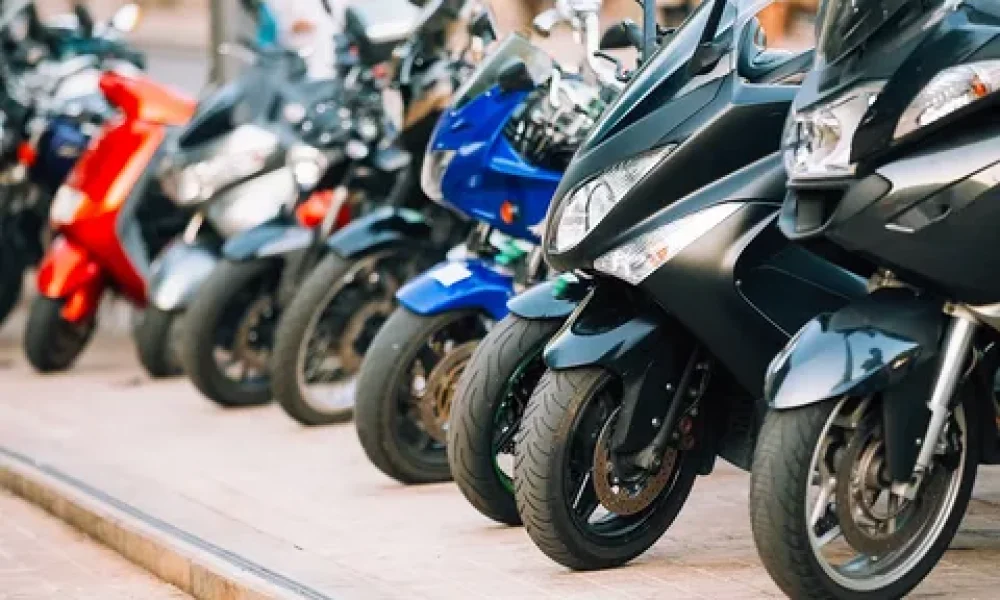
The global conventional motorcycles and scooters market is projected to reach a valuation of USD 1,99,138.0 million by 2033. The market is anticipated to grow at a CAGR of 3.8% between 2023 and 2033. The conventional motorcycles and scooters market is set to be valued at USD 1,37,145.2 million in 2023.
Increasing transportation charges and longer commuting times of public transportation are the key factors that are projected to fuel growth in the conventional motorcycles and scooters market. Growing traffic congestion is also predicted to increase the commute time, which can be a concern for the working-class population. Hence, motorcycles and scooters are projected to provide an effective solution to save time owing to their small and compact size, which in turn, is likely to accelerate growth in the global conventional motorcycles and scooters market.
The Conventional Motorcycles and Scooters Market continues to thrive globally, driven by rising urbanization, increasing fuel efficiency, and affordability. Despite the emergence of electric alternatives, conventional two-wheelers remain a dominant mode of personal and commercial transport in many regions, particularly across Asia-Pacific and Latin America.
Get Ahead with Our Report: Request Your Sample Now!
https://www.futuremarketinsights.com/report-sample#5245502d47422d34373532
Key Takeaways
Affordable pricing and ease of maintenance continue to favor conventional two-wheelers
Widespread use in daily commuting, delivery services, and rural mobility
Market remains strong in emerging economies where electric infrastructure is limited
Fuel-efficient engines and improved design boosting consumer preference
Shift in demand toward gearless scooters among urban riders and women
Top 3 Trends Pushing Sales of Conventional Motorcycles and Scooters
Growing Middle-class Population with Dual Income
The market for conventional motorcycles and scooters is mainly being driven by increasing urbanization in developing nations, rising employment rates, improvements in disposable income, and growing middle-class households with dual incomes. Other factors influencing growth in the conventional motorcycles and scooter market include affordable price ranges for the middle class and the freedom of movement that comes with it in congested metropolitan areas. Besides, low environmental effects and convenience of parking due to their compact size are projected to push the demand for conventional motorcycles and scooters in the assessment period.
Increasing Traffic Congestion Worldwide
Countries like India, China, France, and Italy have experienced severe traffic jams and smog development as a result of the rising number of heavy and four-wheeled automobiles on roads. Travel time has greatly increased due to growing traffic congestion, which is a major problem for the working-class population.
To address this issue, governments of the above-mentioned countries have enacted a wide range of measures such as lowering the top speed restriction for vehicles. Adoption of small and compact two-wheelers might be a practical answer to the issue of escalating traffic congestion. As a result, motorcycles and scooters are likely to position themselves as an efficient answer in the years to come, thereby driving the industry.
Incorporation of Advanced Features
Original equipment manufacturers (OEMs) have added multiple new features to conventional motorcycles and scooters such as automatic headlights on (AHO), disc brakes, and anti-lock braking systems (ABS), to gain an upper hand in the highly competitive market. These features are expected to help in increasing rider safety, reducing the chances of accidents, and maintaining the life of conventional motorcycles & scooters. Young riders belonging to the age group of 20 to 30 years often choose sports motorcycles owing to their rising preference for performance practicality that comes inbuilt with ABS systems and disc brakes to ensure maximum safety of riders.
Key Drivers
High fuel efficiency and low ownership costs compared to four-wheelers
Rising middle-class population and growing urbanization in developing countries
Expanding demand for last-mile delivery and gig-economy logistics
Robust dealership networks and easy availability of spare parts
Increasing youth interest in sports and commuter motorcycles
Growth Opportunities
Development of hybrid models to balance performance and emissions
Introduction of connected features like Bluetooth, navigation, and anti-theft systems
Opportunities in rural transport and underpenetrated markets in Africa and Southeast Asia
Collaboration with ride-sharing platforms for two-wheeler taxi services
Customization and personalization trends creating niche premium segments
Key Applications
Personal Commuting – Affordable daily travel option
Commercial Use – Logistics, food delivery, courier services
Recreational Use – Touring, sports biking
Utility Use – Transport in semi-urban and rural areas
Detailed Market Study: Full Report and Analysis
https://www.futuremarketinsights.com/reports/conventional-motorcycles-and-scooters-market
Key Players
Hero MotoCorp Ltd.
Honda Motor Co., Ltd.
Yamaha Motor Co., Ltd.
Bajaj Auto Ltd.
TVS Motor Company
Suzuki Motor Corporation
Kawasaki Heavy Industries, Ltd.
Royal Enfield (Eicher Motors)
Piaggio & C. SpA
Harley-Davidson, Inc.
Key Segmentations
By Vehicle Type – Motorcycles, Scooters, Mopeds
By Engine Capacity – Below 125cc, 126–250cc, 251–500cc, Above 500cc
By Transmission Type – Manual, Automatic/Continuously Variable Transmission (CVT)
By End Use – Personal, Commercial
By Region – Asia-Pacific, Latin America, North America, Europe, Middle East & Africa
About Future Market Insights (FMI)
Future Market Insights, Inc. (ESOMAR certified, recipient of the Stevie Award, and a member of the Greater New York Chamber of Commerce) offers profound insights into the driving factors that are boosting demand in the market. FMI stands as the leading global provider of market intelligence, advisory services, consulting, and events for the Packaging, Food and Beverage, Consumer Technology, Healthcare, Industrial, and Chemicals markets. With a vast team of 400 analysts worldwide, FMI provides global, regional, and local expertise on diverse domains and industry trends across more than 110 countries.




