
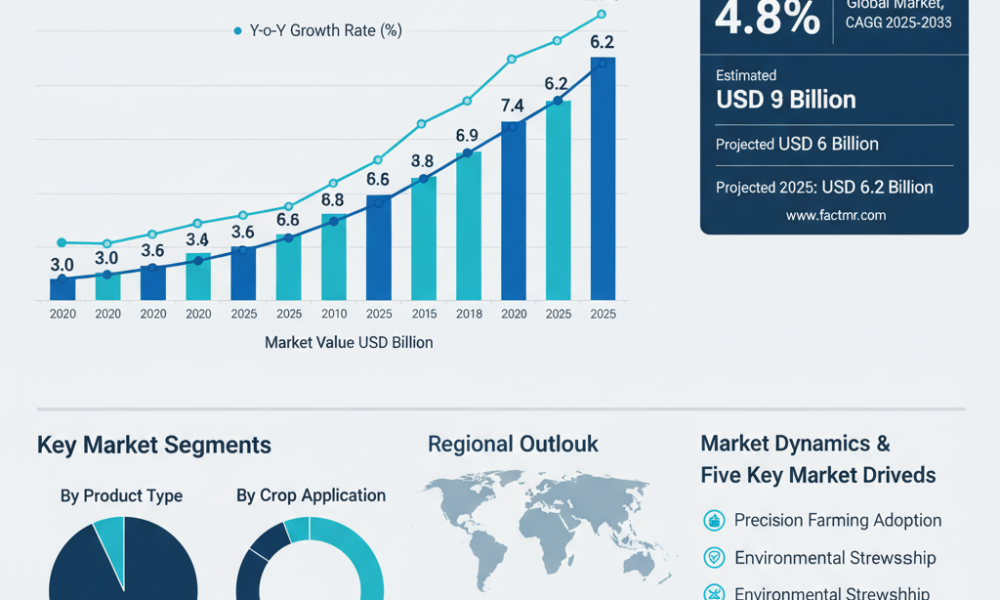
The global controlled release fertilizer (CRF) market is set to expand significantly over the next decade, driven by sustainable farming practices, precision agriculture, and evolving nutrient management technologies. According to Fact.MR’s latest analysis, the market is projected to rise from USD 3.9 billion in 2025 to USD 6.2 billion by 2035, growing at a compound annual growth rate (CAGR) of 4.8%.
Controlled release fertilizers—engineered to deliver nutrients gradually and in sync with plant uptake—are rapidly becoming an essential tool for improving fertilizer efficiency, reducing application frequency, and minimizing environmental runoff. Their use is expanding across high-value crops, horticulture, and large-scale agricultural systems.
Sustainability and Precision Agriculture Propel Market Growth
The accelerating global transition toward sustainable farming and smarter input management is driving demand for CRF technologies. With governments and farmers focusing on soil health and optimized nutrient use, controlled release fertilizers are becoming a preferred choice for both commercial and smallholder operations.
“Controlled release fertilizers are no longer viewed as a premium niche—they are central to the next generation of precision agriculture,” said a senior research analyst at Fact.MR. “Growers adopting CRFs are achieving measurable gains in yield, resource efficiency, and environmental compliance.”
The report highlights that between 2025 and 2030, the market will expand by approximately USD 1.0 billion, followed by an additional USD 1.3 billion from 2030 to 2035 as adoption deepens across emerging economies.
To access the complete data tables and in-depth insights, request a Discount on Report: https://www.factmr.com/connectus/sample?flag=S&rep_id=4565
Key Market Metrics at a Glance
| Metric | Estimate |
| Market Value (2025) | USD 3.9 Billion |
| Forecast Value (2035) | USD 6.2 Billion |
| CAGR (2025–2035) | 4.8% |
| Leading Product Type | Polymer/Sulfur-Coated Urea (~51% share) |
| Leading Crop Application | Fruits & Vegetables (~38% share) |
Market Segmentation Overview
By Product Type:
Polymer and sulfur-coated urea remains the dominant product category, accounting for over half of global revenue in 2025. These formulations offer extended nutrient release profiles and reduced leaching, making them ideal for crops requiring long-term nutrient supply. NPK-coated blends follow with about one-third market share, while other controlled-release formulations cater to specialty and customized agricultural applications.
By Crop Application:
The fruits and vegetables segment leads the global market, representing roughly 38% of total demand. High-value crops demand precision nutrient delivery for improved quality and yield consistency. Turf, ornamental, and landscape applications collectively account for around 34%, followed by cereals and oilseeds at 28%.
By Release Mechanism:
Time-release fertilizers dominate with approximately 62% share, driven by their simplicity, reliability, and proven agronomic outcomes. Moisture- and temperature-controlled systems are gaining ground, particularly in regions with variable climatic conditions.
Regional Insights: Global Adoption Accelerates
- North America remains the largest market, benefiting from precision farming adoption, strong regulatory support for nutrient efficiency, and advanced agricultural infrastructure.
- Europe continues to lead in sustainable fertilizer innovation, with Germany, the Netherlands, and France at the forefront of adopting CRF solutions for both agriculture and turf management.
- Asia-Pacific emerges as the fastest-growing region, supported by large-scale agricultural modernization, population growth, and increasing awareness of environmental sustainability.
- Latin America and the Middle East & Africa are witnessing gradual uptake driven by export-oriented fruit and vegetable production and regional policy support for efficient fertilizer use.
Five Core Forces Driving the Market
- Precision Farming Adoption: CRFs align with the digitalization of agriculture, enabling synchronized nutrient supply and precision application.
- Environmental Stewardship: Stricter nutrient management regulations and growing awareness of soil and water conservation are fueling demand for low-runoff fertilizers.
- Labour Efficiency: Reduced frequency of application lowers overall labor costs and time investment for large-scale farms.
- Yield Optimization: Controlled nutrient availability enhances root health, crop productivity, and overall quality—key to meeting global food security goals.
- Technological Innovation: Advances in polymer coating, nanomaterials, and biodegradable encapsulation are improving cost-efficiency and scalability.
Challenges and Market Constraints
Despite clear advantages, CRF adoption faces several challenges:
- Higher Upfront Costs: The advanced manufacturing process makes CRFs more expensive than conventional fertilizers, limiting accessibility for smallholder farmers.
- Knowledge Gaps: Effective use requires understanding of crop cycles and release profiles, calling for agronomic training and field education.
- Production Scale: Manufacturers continue to balance cost control with performance, particularly in emerging markets where price sensitivity is high.
Competitive Landscape
The global controlled release fertilizer market is moderately consolidated, with a mix of large multinational companies and regional players. Key market participants include:
- ICL Group
- Nutrien Ltd.
- Yara International ASA
- Koch Fertilizer, LLC
- Haifa Group
- AgroLiquid
- Compo Expert GmbH
- Kingenta Ecological Engineering Group Co., Ltd.
Leading manufacturers are investing in R&D for biodegradable coatings, environmentally friendly polymer systems, and strategic partnerships with precision agriculture platforms. Mergers and acquisitions continue to shape competitive positioning, particularly in Asia-Pacific and North America.
Purchase the Full Report: https://www.factmr.com/checkout/4565
Future Outlook: Toward Smart, Sustainable Fertilization
Over the next decade, controlled release fertilizers will evolve from performance-enhancing inputs to essential components of integrated farm management systems. The convergence of IoT, AI, and satellite-based precision agriculture will allow farmers to tailor nutrient delivery more precisely than ever before.
“Controlled release fertilizers represent the intersection of agronomy, technology, and sustainability,” the Fact.MR analyst added. “Their widespread adoption will redefine productivity benchmarks while reducing agriculture’s environmental footprint.”
Why This Report Matters
Fact.MR’s latest market intelligence study offers strategic insights across product types, crop segments, release mechanisms, and regions. It provides actionable guidance for fertilizer producers, agritech firms, and investors seeking to understand market opportunities, competitive positioning, and long-term growth potential.
Explore Related Reports:
Controlled Pore Metal Oxide Market
About Fact.MR
Fact.MR is a leading market research and consulting agency providing data-driven insights across over 5,000 industries. Its forward-looking reports and analytical intelligence enable businesses to anticipate market shifts, identify emerging opportunities, and implement evidence-based growth strategies.



