
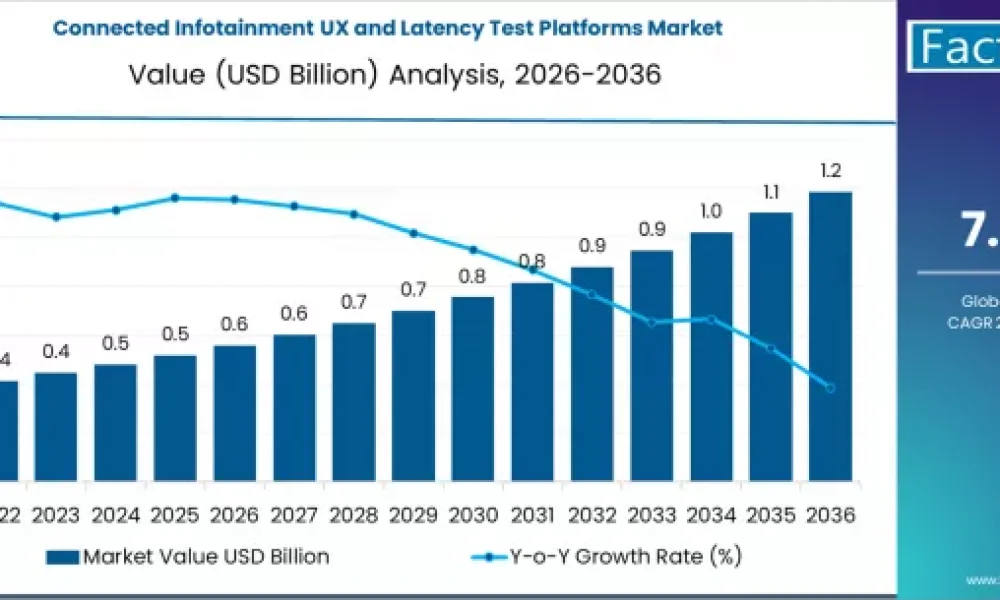
The global connected infotainment UX and latency test platforms market is set to witness strong growth over the next decade, fueled by the rapid evolution of software-defined vehicles (SDVs), increasing consumer expectations for seamless in-vehicle digital experiences, and rising complexity in automotive connectivity ecosystems. According to a new study by Fact.MR, the market is projected to expand from USD 0.56 billion in 2026 to USD 1.19 billion by 2036, registering a total growth of 112.5% over the forecast period.
This growth trajectory reflects a healthy compound annual growth rate (CAGR) of 7.8% between 2026 and 2036, highlighting the growing importance of real-time UX validation, latency benchmarking, and network performance assurance in modern connected vehicles.
The increasing deployment of 5G, V2X communication, cloud-based infotainment, and OTA updates is significantly accelerating the adoption of advanced infotainment UX and latency test platforms worldwide.
To access the complete data tables and in-depth insights, request a Discount On The Report here: https://www.factmr.com/connectus/sample?flag=S&rep_id=13140
Strategic Market Drivers
Software-Defined Vehicles and Digital Cockpits Accelerate Adoption
The automotive industry’s transition toward software-defined and connected vehicles is transforming infotainment systems into highly complex digital platforms. Automakers and Tier-1 suppliers are increasingly relying on UX and latency test platforms to ensure:
- Seamless human–machine interaction (HMI)
- Low-latency content delivery
- Reliable multi-screen synchronization
- Consistent performance across regions and network conditions
As digital cockpits integrate navigation, streaming, voice assistants, and vehicle controls, comprehensive testing has become mission-critical.
Rising Importance of Network Latency and QoS Validation
With infotainment systems now dependent on cloud services, mobile networks, and edge computing, validating network latency and Quality of Service (QoS) is essential. The network latency and QoS testing segment is expected to account for 30.0% of the market in 2026, reflecting its central role in ensuring uninterrupted connectivity and superior user experience.
These platforms enable OEMs to simulate real-world network conditions and identify performance bottlenecks before deployment.
Growth in Connected and Autonomous Vehicle Ecosystems
The rapid expansion of connected, semi-autonomous, and autonomous vehicles is driving demand for advanced testing solutions that can validate infotainment responsiveness alongside ADAS and telematics systems.
Real-time testing of data flow, latency, and user experience is becoming a core requirement for next-generation mobility platforms.
Advancements in 5G, V2X, and Cloud-Based Infotainment
The rollout of 5G networks and increasing adoption of V2X communication are raising performance expectations for in-vehicle infotainment. Testing platforms that support multi-network environments, edge-cloud integration, and real-time analytics are gaining widespread traction across the automotive value chain.
Regional Growth Highlights
North America: Innovation in Connected and Autonomous Vehicles
North America remains a prominent market, driven by strong R&D investments in connected mobility, early adoption of autonomous driving technologies, and the presence of leading automotive OEMs and software vendors. The U.S. continues to lead in infotainment UX innovation and advanced validation platforms.
Europe: Regulatory Compliance and Premium Vehicle Demand
Europe’s focus on vehicle safety, data integrity, and digital quality standards, combined with high demand for premium connected vehicles, is driving adoption. Germany, France, and the U.K. are key markets, supported by strong automotive engineering capabilities.
East Asia: Automotive Electronics and 5G Leadership
China, Japan, and South Korea are witnessing rapid growth due to their dominance in automotive electronics manufacturing, aggressive 5G deployment, and expanding connected vehicle fleets. Local OEMs are increasingly investing in in-house infotainment testing and validation tools.
Emerging Markets: Growing Connected Mobility Infrastructure
Markets such as India, Southeast Asia, and Latin America are experiencing rising demand driven by:
- Expansion of connected car offerings
- Increasing smartphone-to-vehicle integration
- Growing middle-class demand for smart infotainment features
Market Segmentation Insights
By Test Type
- Network Latency & QoS Testing – Leading segment with strong adoption across OEMs and telecom-integrated platforms
- UX Performance & Responsiveness Testing – Rapid growth driven by consumer experience expectations
- System Integration & Interoperability Testing
By Deployment Mode
- On-Premise Platforms – Preferred by OEMs for secure, in-house testing
- Cloud-Based Platforms – Gaining traction due to scalability and real-time analytics
By End User
- Automotive OEMs
- Tier-1 Suppliers
- Infotainment Software Developers
- Telecom & Connectivity Solution Providers
Challenges Impacting Market Growth
High Platform and Integration Costs
Advanced test platforms require significant investment in software, simulation tools, and skilled personnel, posing challenges for smaller manufacturers.
Rapid Technology Evolution
Frequent updates in infotainment software, network protocols, and connectivity standards demand continuous platform upgrades.
Complexity of Multi-Network Testing
Validating infotainment performance across different geographies, carriers, and network conditions adds to operational complexity.
Competitive Landscape
The connected infotainment UX and latency test platforms market is moderately fragmented, with companies focusing on:
- AI-driven UX analytics
- Real-time latency simulation
- Cloud-native testing environments
- Integration with CI/CD automotive software pipelines
Key Players Focus On
- Automated testing frameworks
- 5G and V2X-ready platforms
- Scalable cloud-based validation tools
- Data-driven user experience optimization
Recent Developments
- 2024: Introduction of AI-powered UX testing platforms enabling predictive performance analysis
- 2023: Increased adoption of cloud-based infotainment testing tools by global OEMs
- 2022: Expansion of latency and QoS validation solutions aligned with 5G automotive rollouts
Future Outlook: Defining the Next Generation of In-Vehicle Digital Experience
Over the next decade, the connected infotainment UX and latency test platforms market will be shaped by:
- Proliferation of software-defined vehicles
- Expansion of 5G and V2X ecosystems
- Increasing complexity of digital cockpits
- Rising consumer demand for seamless, low-latency infotainment
- Integration of AI and real-time analytics into testing workflows
As vehicles evolve into fully connected digital environments, robust UX and latency validation platforms will become indispensable, positioning the market for sustained, long-term growth through 2036.
Have a specific Requirements and Need Assistant on Report Pricing or Limited Budget please contact us – [email protected]
About Fact.MR
Fact.MR is a global market research and consulting firm, trusted by Fortune 500 companies and emerging businesses for reliable insights and strategic intelligence. With a presence across the U.S., UK, India, and Dubai, we deliver data-driven research and tailored consulting solutions across 30+ industries and 1,000+ markets. Backed by deep expertise and advanced analytics, Fact.MR helps organizations uncover opportunities, reduce risks, and make informed decisions for sustainable growth



