
Definition
The Global Computer Screen Market encompasses the design, manufacture, and distribution of display devices used for visual output across personal, professional, and industrial applications. Computer screens—commonly referred to as monitors—serve as the primary interface between users and digital systems, translating complex data into interactive, visual information. These displays are essential in diverse settings such as offices, homes, educational institutions, gaming environments, design studios, and healthcare facilities.
Computer screens have evolved dramatically over the past two decades, shifting from bulky cathode-ray tube (CRT) monitors to sleek, energy-efficient flat-panel displays such as LCD, LED, OLED, and Quantum Dot technologies. The modern monitor market is characterized by innovations in resolution (HD to 8K UHD), refresh rate, color accuracy, and ergonomic design, addressing the needs of both everyday consumers and specialized professionals.
In essence, the computer screen is not merely a display device—it is a central productivity and interaction tool in an increasingly digital world. As cloud computing, artificial intelligence (AI), and virtual collaboration continue to expand, the demand for screens capable of supporting immersive, high-performance visual experiences continues to grow.
Read Full Report: https://semiconductorinsight.com/report/computer-screen-market/
Computer screens today are engineered to support specific use cases:
- Corporate and professional applications, such as financial analytics, CAD/CAM design, programming, and video conferencing, prioritize color fidelity, multi-monitor setups, and flicker-free viewing.
- Gaming and entertainment, a rapidly growing segment, demands ultra-fast refresh rates (120Hz–360Hz), low latency, HDR support, and adaptive sync technologies like NVIDIA G-SYNC and AMD FreeSync.
- Medical imaging, graphic design, and media production require professional-grade monitors with superior calibration and wide color gamut coverage (AdobeRGB, DCI-P3).
- Home and education sectors emphasize affordability, portability, and eye-comfort technologies such as blue light filters and anti-glare coatings.
Furthermore, the global shift toward remote and hybrid work models has amplified the importance of display quality, connectivity, and ergonomics. Organizations worldwide are investing in multi-screen configurations, ultrawide monitors, and curved displays to enhance employee comfort and productivity.
As technology continues to advance, the market is witnessing the integration of AI-driven brightness adjustments, energy-efficient backlighting, and USB-C/Thunderbolt connectivity, reinforcing the role of computer screens as intelligent, adaptive peripherals. The rising demand for flexible displays and sustainability-driven manufacturing practices—such as recyclable panels and reduced energy consumption—further indicates a future where innovation, efficiency, and user experience converge seamlessly.
In summary, the Computer Screen Market represents the intersection of functionality, design, and technology—fueling the next generation of digital workspaces and entertainment environments worldwide.
Download FREE Sample Report:
Computer Screen Market – View in Detailed Research Report
Market Size
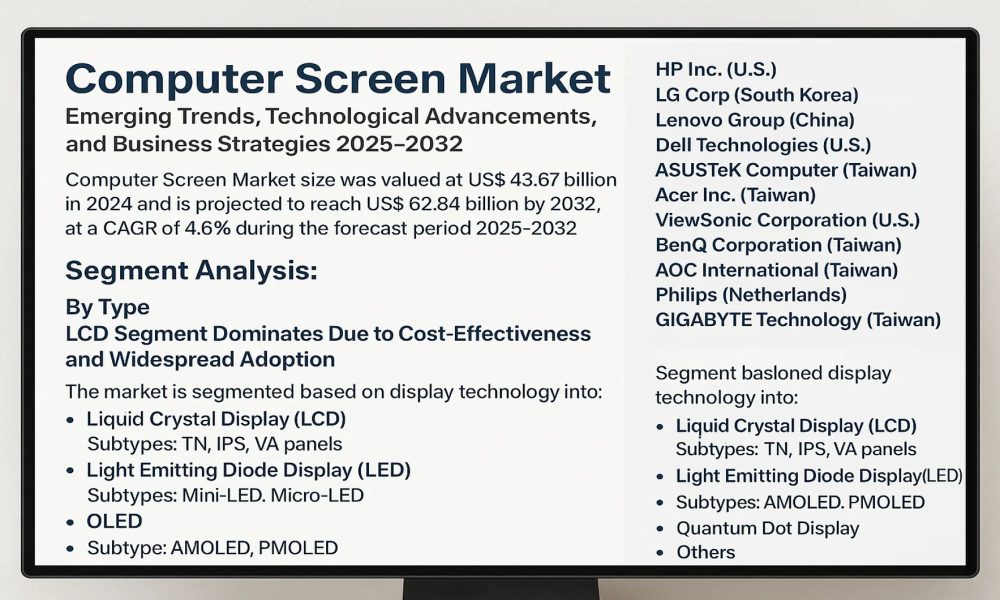
The Global Computer Screen Market was valued at US$ 43.67 billion in 2024 and is projected to reach US$ 62.84 billion by 2032, expanding at a compound annual growth rate (CAGR) of 4.6% between 2025 and 2032. This consistent growth reflects the deepening integration of display technologies into both personal and professional ecosystems, driven by hybrid work models, gaming culture, and digital transformation across industries.
Historically, the computer screen market experienced steady growth due to the rise of personal computing and the digitalization of office workflows. However, the post-2020 period marked a new era of demand acceleration, driven by the global adoption of remote and hybrid work. The pandemic highlighted the importance of high-quality displays for productivity and communication, leading to a surge in sales of high-resolution and dual-screen setups among professionals.
As of 2025, the corporate sector accounts for approximately 40% of total screen demand, emphasizing its crucial role in business productivity. Meanwhile, the gaming and entertainment segment represents one of the fastest-growing areas, bolstered by the booming global eSports market and the proliferation of gaming consoles and PCs capable of ultra-high refresh rates and 4K/8K output.
The commercial and educational markets are also witnessing strong adoption, particularly as digital classrooms and e-learning platforms become mainstream. Schools, universities, and training centers are upgrading to large-format interactive displays and high-definition monitors to enhance the teaching and learning experience.
Technological advancement remains a core market driver. Manufacturers are focusing on OLED and Quantum Dot displays, which deliver higher brightness, energy efficiency, and color accuracy compared to traditional LCD and LED screens. At the same time, mini-LED and micro-LED innovations are emerging as the next frontier, promising thinner designs, better contrast ratios, and extended product lifespans.
In addition to performance, sustainability and design aesthetics are shaping purchasing trends. The global market has seen a sharp rise in demand for eco-friendly, energy-efficient monitors, aligning with corporate ESG commitments and consumer preferences for low-power devices. Many brands, such as Dell, HP, and Philips, have launched monitors made from recycled materials and integrated power-saving technologies to reduce carbon emissions.
Regionally, Asia-Pacific dominates the market, accounting for over 50% of global screen production and consumption. This dominance is driven by manufacturing hubs in China, South Korea, and Taiwan, coupled with rising consumer electronics adoption across India and Southeast Asia. North America and Europe follow as mature markets, characterized by strong replacement demand and innovation in premium segments.
Overall, the market outlook remains optimistic, supported by consistent technological progress, widespread digital adoption, and the expanding role of visual interfaces in all sectors—from gaming and design to healthcare and finance.
Global Computer Screen Market: Market Segmentation Analysis
This report provides a deep insight into the global Computer Screen Market, covering all its essential aspects. This ranges from a macro overview of the market to micro details of the market size, competitive landscape, development trend, niche market, key market drivers and challenges, SWOT analysis, value chain analysis, etc.
The analysis helps the reader to shape the competition within the industries and strategies for the competitive environment to enhance the potential profit. Furthermore, it provides a simple framework for evaluating and assessing the position of the business organization. The report structure also focuses on the competitive landscape of the Global Computer Screen Market. This report introduces in detail the market share, market performance, product situation, operation situation, etc., of the main players, which helps the readers in the industry to identify the main competitors and deeply understand the competition pattern of the market.
In a word, this report is a must-read for industry players, investors, researchers, consultants, business strategists, and all those who have any kind of stake or are planning to foray into the Computer Screen Market in any manner.
Market Segmentation (by Application)
- Home
- Commercial
- Gaming
- Professional
- Others
Market Segmentation (by Type)
- Liquid Crystal Display (LCD)
- Light Emitting Diode Display (LED)
- OLED
- Quantum Dot Display
- Others
Download FREE Sample Report:
Computer Screen Market – View in Detailed Research Report
Key Company
- Samsung Electronics (South Korea)
- LG Corp (South Korea)
- Dell Technologies (U.S.)
- HP Inc. (U.S.)
- Lenovo Group (China)
- TPV Technology (China)
- Acer Inc. (Taiwan)
- ASUSTeK Computer (Taiwan)
- ViewSonic Corporation (U.S.)
- BenQ Corporation (Taiwan)
- Apple Inc. (U.S.)
- Philips (Netherlands)
- AOC International (Taiwan)
- GIGABYTE Technology (Taiwan)
Geographic Segmentation
- North America
- Europe
- Asia-Pacific
- Latin America
- Middle East & Africa
Regional Analysis
The Asia-Pacific region holds the largest share of the global computer screen market, accounting for over 50% of total production and consumption. This dominance is anchored by the presence of major display manufacturers such as Samsung, LG, AUO, and BOE Technology, as well as large-scale OEM production hubs across China, Taiwan, South Korea, and Japan. The rapid digitalization of economies, rising disposable incomes, and growing gaming and entertainment markets further contribute to regional growth.
China remains the largest producer and exporter of LCD and LED screens, benefiting from vast manufacturing capacity, government incentives, and domestic demand from its thriving consumer electronics sector. South Korea continues to lead in OLED and Quantum Dot innovations, while Taiwan serves as a critical supplier of mid- to high-range panels for global brands like Dell, Acer, and ASUS.
In North America, the market is driven by strong enterprise demand and gaming adoption. The U.S. in particular is witnessing steady growth in professional-grade monitors and ergonomic displays designed for hybrid work environments. The European market is similarly mature, characterized by sustainability-led purchasing and high replacement cycles among corporate users. Regions like Germany, the U.K., and France are focusing on energy-efficient monitors aligned with EU environmental standards.
Emerging markets in Latin America, the Middle East, and Africa are experiencing increased adoption, driven by expanding internet penetration, remote learning programs, and e-commerce growth. As multinational manufacturers establish local distribution networks and regional assembly units, these areas are expected to witness rapid market expansion through 2032.
Competitor Analysis (in brief)
The computer screen industry is highly competitive and technology-driven, with leading players emphasizing innovation, product differentiation, and global distribution networks.
- Samsung Electronics and LG Corp dominate through technological leadership in OLED and QLED displays.
- Dell, HP, and Lenovo maintain strong brand recognition in business and consumer segments, leveraging diversified product portfolios and after-sales services.
- Acer, ASUS, and BenQ cater primarily to gaming and mid-tier consumer markets, focusing on high-refresh-rate and performance-oriented monitors.
- Apple Inc. differentiates itself through premium design, Retina displays, and seamless integration within its ecosystem.
- TPV Technology and AOC serve as major OEM suppliers to various brands, ensuring scalability and affordability.
The competitive landscape is further defined by continuous R&D investments, strategic mergers, and sustainability-driven initiatives. Companies are also integrating AI-based calibration, color optimization, and smart connectivity features to enhance user experience and differentiate their products in a crowded market.
Download FREE Sample Report:
Computer Screen Market – View in Detailed Research Report
FAQ
- What is the current market size of the Computer Screen Market?
The global market is valued at US$ 43.67 billion in 2024 and is projected to reach US$ 62.84 billion by 2032, expanding at a CAGR of 4.6% during the forecast period. - Which are the key companies operating in the Computer Screen Market?
Key companies include Samsung Electronics, LG Corp, Dell Technologies, HP Inc., Lenovo Group, TPV Technology, Acer Inc., ASUSTeK Computer, Apple Inc., and Philips. - What are the key growth drivers in the Computer Screen Market?
Major drivers include hybrid work adoption, gaming industry expansion, digital transformation across sectors, and advancements in OLED and Quantum Dot technologies. - Which regions dominate the Computer Screen Market?
The Asia-Pacific region dominates, accounting for over 50% of global production and consumption, led by manufacturing hubs in China, South Korea, and Taiwan. - What are the emerging trends in the Computer Screen Market?
Emerging trends include the adoption of eco-friendly and energy-efficient designs, AI-enhanced display calibration, ultrawide and curved monitors, and advancements in mini-LED and micro-LED technologies.




