
The global coffee creamer market is witnessing steady expansion as consumer preferences continue to evolve toward convenient and customizable coffee experiences. Coffee creamers are widely used to enhance the taste, texture, and richness of coffee beverages. With the rising popularity of specialty coffee drinks and the increasing number of coffee consumers worldwide, creamers have become an essential addition to daily coffee routines. Modern consumers are seeking options that offer flavor diversity, longer shelf life, and compatibility with dietary preferences such as vegan or lactose-free diets.
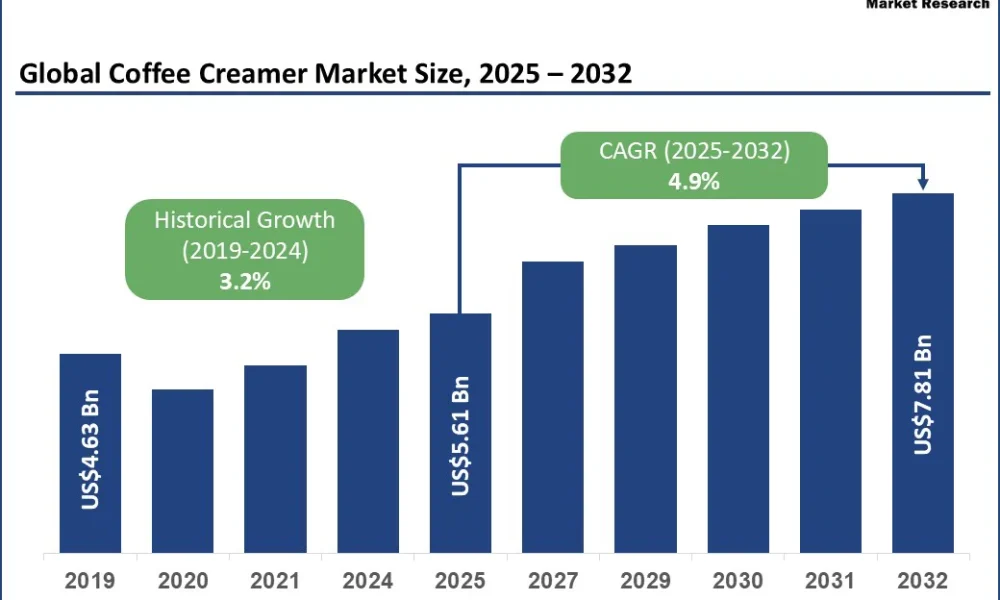
According to Persistence Market Research, the global coffee creamer market size is likely to be valued at US$5.61 Bn in 2025 and is expected to reach US$7.81 Bn by 2032, growing at a CAGR of 4.9% during the forecast period from 2025 to 2032. This growth is primarily driven by the shift of consumer preferences toward convenient, dairy-free, and plant-based alternatives that enhance the coffee-drinking experience. North America remains a leading regional market due to strong coffee consumption culture, while plant-based creamers are emerging as a leading product category due to health awareness and vegan lifestyle trends.
Download Your Free Sample & Explore Key Insights : https://www.persistencemarketresearch.com/samples/35659
Key Highlights from the Report
➤ The global coffee creamer market is projected to grow from US$5.61 Bn in 2025 to US$7.81 Bn by 2032.
➤ Increasing demand for plant-based and dairy-free creamers is shaping product innovation across the industry.
➤ Rapid growth of specialty coffee culture and café chains is supporting creamer consumption globally.
➤ Product innovations in flavored creamers and low-calorie options are attracting health-conscious consumers.
➤ Expansion of retail and e-commerce channels is improving product accessibility worldwide.
➤ Rising interest in convenient ready-to-use coffee additives continues to support market expansion.
Market Segmentation
The coffee creamer market can be segmented based on product type, form, and distribution channel. Product categories include dairy-based creamers and non-dairy alternatives such as almond, soy, coconut, and oat-based creamers. Among these, non-dairy creamers are gaining significant traction as consumers increasingly prefer lactose-free and vegan beverages. These products also offer extended shelf life compared to traditional dairy creamers, making them attractive for both households and commercial users. Manufacturers are introducing new flavors such as vanilla, caramel, hazelnut, and chocolate to cater to evolving consumer preferences.
From a distribution perspective, coffee creamers are widely sold through supermarkets, hypermarkets, convenience stores, and online retail platforms. Supermarkets and hypermarkets remain the dominant distribution channels due to their extensive product variety and strong consumer reach. However, e-commerce platforms are gaining momentum as consumers increasingly prefer the convenience of online shopping and home delivery. The rise of digital grocery platforms and subscription-based coffee services is further strengthening the market’s retail ecosystem.
Customize This Report for Your Exact Requirements : https://www.persistencemarketresearch.com/request-customization/35659
Regional Insights
North America holds a dominant position in the coffee creamer market due to high coffee consumption and a well-established café culture. Consumers in the region frequently customize their coffee beverages with flavored creamers, which has fueled strong demand for both dairy and non-dairy varieties. The growing popularity of plant-based diets in the United States and Canada has also encouraged manufacturers to introduce almond, oat, and coconut-based creamers. The region also benefits from strong retail infrastructure and the presence of major industry players.
Europe is another significant market, supported by rising demand for premium coffee beverages and specialty coffee shops. Consumers across countries such as Germany, France, and the United Kingdom are increasingly experimenting with flavored creamers and health-oriented alternatives. Meanwhile, the Asia-Pacific region is experiencing rapid growth as coffee consumption rises in urban areas and younger consumers adopt Western-style coffee culture. The expansion of international coffee chains and the increasing availability of ready-to-drink coffee products are supporting the adoption of coffee creamers across emerging markets.
Market Drivers
One of the primary drivers of the coffee creamer market is the global shift toward plant-based and dairy-free products. Consumers are increasingly aware of lactose intolerance, vegan lifestyles, and environmental sustainability, prompting them to switch to alternatives derived from nuts, oats, and soy. These plant-based creamers not only provide functional benefits but also offer unique flavors and textures that enhance the coffee-drinking experience. As a result, food manufacturers are investing heavily in plant-based formulations to capture this expanding consumer segment.
Another important growth driver is the rapid expansion of café culture and specialty coffee consumption worldwide. Coffee drinkers today prefer personalized beverages with customized flavors and textures. Coffee creamers play a crucial role in achieving this experience by adding richness and sweetness to beverages. The rising popularity of home brewing and premium coffee machines has also contributed to higher consumption of flavored and specialty creamers, encouraging product innovation and new flavor launches.
Market Restraints
Despite steady growth, the coffee creamer market faces certain challenges. One major restraint is the increasing health concerns related to sugar and artificial ingredients in flavored creamers. Many conventional creamers contain added sugars, hydrogenated oils, and artificial flavors, which can discourage health-conscious consumers from frequent consumption. As awareness around healthy eating grows, consumers are paying closer attention to product labels, pushing manufacturers to reformulate their products with cleaner ingredients.
Another limitation is the volatility in raw material prices, particularly for dairy and plant-based ingredients. Fluctuations in the supply of milk, nuts, and other agricultural inputs can impact production costs and pricing strategies for manufacturers. Additionally, competition from alternative coffee additives such as milk, oat beverages, and protein-based drinks can limit the growth potential of traditional creamers in some markets.
Market Opportunities
The growing demand for functional and health-focused coffee creamers presents significant opportunities for manufacturers. Consumers are increasingly seeking products that align with dietary goals such as low sugar, keto-friendly, organic, or fortified options. Introducing creamers with added nutrients, vitamins, or plant proteins can help brands capture the attention of health-focused buyers while expanding their product portfolios.
Another promising opportunity lies in product innovation and premium flavored offerings. Consumers are increasingly drawn to indulgent flavors and seasonal variations that enhance their coffee experience. Limited-edition flavors, organic plant-based options, and specialty café-inspired creamers can attract new customers and drive brand loyalty. Expansion into emerging markets where coffee consumption is growing rapidly also offers strong long-term growth potential for the coffee creamer market.
Unlock Complete Insights – Buy the Full Report : https://www.persistencemarketresearch.com/checkout/35659
Company Insights
Key players operating in the coffee creamer market include:
- Nestlé S.A.
- Danone S.A.
- FrieslandCampina N.V.
- Oatly Group AB
- Chobani, LLC
- Califia Farms, LLC
- Nutpods (Green Grass Foods, Inc.)
- MUD\WTR
- Laird Superfood, Inc.
- Kerry Group plc
- Super Coffee (Kitu Life Inc.)
- Z Natural Foods, LLC
- Balchem Corporation
- WhiteWave Foods
- Prymat Group
- Hiland Dairy Foods
- Organic Valley (CROPP Cooperative)
- Nestlé Health Science
- Elmhurst 1925
- So Delicious Dairy Free
Recent Developments
- March 2024: Nestlé introduced new plant-based flavored coffee creamers aimed at expanding its dairy-free beverage portfolio.
- September 2023: Califia Farms expanded its oat-based creamer product line to meet rising demand for plant-based coffee additives.
Future Opportunities and Growth Prospects
The future of the coffee creamer market looks promising as consumer demand for personalized and convenient coffee experiences continues to rise. Manufacturers are expected to focus on plant-based formulations, innovative flavors, and clean-label ingredients to align with evolving consumer expectations. Growing café culture, rising home brewing trends, and expanding online retail channels will continue to create favorable growth conditions for the market.
Furthermore, the increasing adoption of coffee beverages in emerging economies is likely to open new avenues for market players. Strategic partnerships with coffee chains, product innovation in functional creamers, and expansion into new geographic markets will play a critical role in shaping the long-term growth trajectory of the coffee creamer market.




