
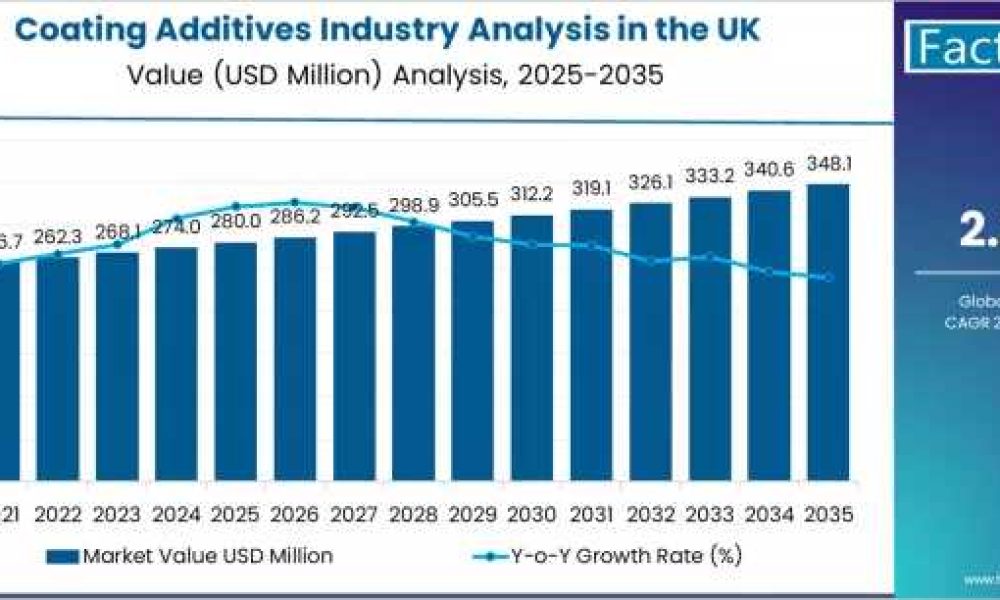
UK Coating Additives Market Projected to Reach USD 349 Million by 2036 Amid Shift Toward Sustainable Formulations
The United Kingdom’s coating additives industry is entering a decade of sophisticated transformation, with the market projected to grow from USD 280 million in 2025 to approximately USD 349 million by 2036. This growth, representing a steady compound annual growth rate (CAGR) of 2.2%, is being fueled by a nationwide pivot toward high-performance, eco-friendly chemistries and the modernization of British infrastructure.
As of early 2026, the industry is navigating a critical transition from traditional solvent-borne agents to aqueous, powder-based, and UV-cured systems. This evolution is largely mandated by intensifying regulatory scrutiny and the UK’s commitment to reducing Volatile Organic Compounds (VOCs) in alignment with evolving environmental standards.
Request for Sample Report | Customize Report |purchase Full Report – https://www.factmr.com/connectus/sample?flag=S&rep_id=11555
Market Dynamics: The Drivers of Modernization
The UK market’s trajectory is defined by three primary catalysts:
Infrastructure and Urban Regeneration: Ongoing residential and commercial modernization programs are driving the demand for architectural coatings that require advanced rheology modifiers and wetting agents to ensure durability and aesthetic consistency.
Regulatory Compliance: Stricter UK REACH standards are compelling manufacturers to phase out hazardous substances such as PFAS and alkylphenol ethoxylates (APEO). Consequently, water-based additive systems now dominate the technological landscape with a 61.3% market share.
Specialized Industrial Demand: The presence of major automotive OEMs in the UK—including Jaguar Land Rover, Bentley, and Rolls-Royce—is accelerating the need for additives that provide superior scratch resistance, UV stability, and anti-corrosion properties for luxury and electric vehicles (EVs).
Key Segment Projections (2026–2036)
| Segment | Projected Trend | Market Influence |
| Water-borne Systems | Leading Technology | 61.3% share due to low-VOC mandates. |
| Rheology Modifiers | Highest Product Growth | Essential for viscosity and application efficiency. |
| Smart Coatings | 17.7% CAGR | Growth in self-healing and antimicrobial additives. |
| Architectural | Largest Application | Dominant volume driver for UK infrastructure. |
The Rise of Smart and Bio-Based Additives
Innovation in the UK is moving beyond basic performance. Formulators are increasingly prioritizing multifunctional additives that offer secondary benefits, such as heat reflection for energy-efficient buildings or antimicrobial properties for healthcare environments.
A significant trend for the 2026–2036 forecast period is the integration of AI-driven formulation platforms. These digital tools are currently reducing R&D cycles by up to 25%, allowing UK chemical manufacturers to bring compliant products to market more rapidly. Furthermore, the shift toward a circular economy has spurred the development of bio-based additives, utilizing plant-based precursors to lower the embodied carbon of industrial coatings.
The UK coating additives sector is no longer just about surface aesthetics; it is a critical enabler of industrial reliability and environmental stewardship, states a senior market analyst. In 2026, we are seeing the rise of ‘Formulation-as-a-Service,’ where performance, carbon accounting, and regulatory transparency are bundled into a single value proposition.
Strategic Competitive Landscape
The UK market remains a competitive hub for both multinational chemical giants and specialized domestic players. Key entities influencing the market include Elementis plc, BASF SE, Evonik Industries AG, ALTANA AG (BYK), and Dow Inc. These organizations are currently focusing on regional capacity expansions and R&D investments to meet the stringent specifications of the aerospace, marine, and renewable energy sectors—particularly for offshore wind installations in the North Sea.
Future Outlook: Navigating Volatility
While the long-term outlook remains positive, the industry faces persistent challenges. Volatility in petrochemical feedstocks and the complexity of ensuring additive compatibility in high-solids systems remain primary concerns for manufacturers. However, the push for 97% renewable content in high-performance systems is expected to decouple the industry from fossil-fuel dependencies by the early 2030s.
About This Industry Analysis
This press release is based on consolidated market intelligence and longitudinal forecasts for the period 2026–2036. The data accounts for existing UK regulatory frameworks, regional infrastructure projects, and the accelerating transition toward green chemistry within the European and domestic manufacturing sectors.
Related Reports
– Contact Us –
11140 Rockville Pike, Suite 400, Rockville,
MD 20852, United States
Tel: +1 (628) 251-1583 | [email protected]
About Fact.MR
Fact.MR is a global market research and consulting firm, trusted by Fortune 500 companies and emerging businesses for reliable insights and strategic intelligence. With a presence across the U.S., UK, India, and Dubai, we deliver data-driven research and tailored consulting solutions across 30+ industries and 1,000+ markets. Backed by deep expertise and advanced analytics, Fact.MR helps organizations uncover opportunities, reduce risks, and make informed decisions for sustainable growth.
“



