
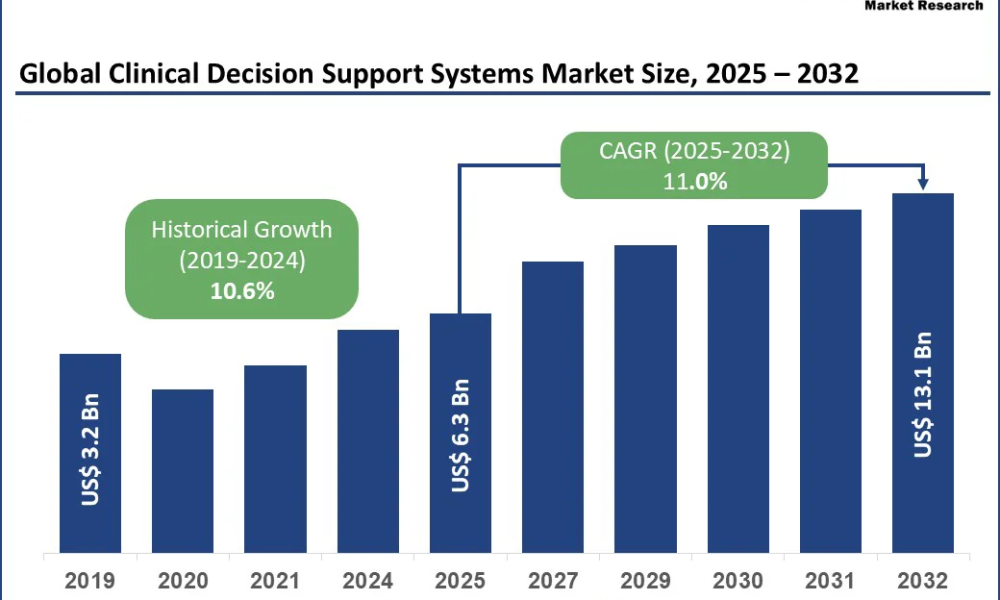
The global Clinical Decision Support Systems (CDSS) market is undergoing a period of rapid expansion as healthcare providers increasingly rely on digital tools to enhance clinical decision-making, patient safety, and operational efficiency. In 2025, the global CDSS market is estimated to be valued at US$6.3 billion and is projected to reach US$13.1 billion by 2032, growing at a robust compound annual growth rate (CAGR) of 11.0% during the forecast period. This growth builds on steady historical expansion, with the market recording a CAGR of 10.6% between 2019 and 2024.
Clinical decision support systems have become a cornerstone of modern healthcare delivery, providing clinicians with evidence-based recommendations, alerts, and data-driven insights at the point of care. The convergence of artificial intelligence (AI), big data analytics, and electronic health records (EHRs) is reshaping how healthcare decisions are made, positioning CDSS as a critical component of digital health ecosystems worldwide.
Download Your Free Sample & Explore Key Insights: https://www.persistencemarketresearch.com/samples/2811
Market Size and Growth Outlook
The strong growth outlook for the CDSS market reflects the accelerating adoption of digital healthcare solutions across hospitals, clinics, and specialty care centers. Increasing patient volumes, rising prevalence of chronic diseases, and mounting pressure to reduce medical errors are pushing healthcare organizations to invest in intelligent decision support tools.
By 2032, the market is expected to more than double in value, supported by advancements in AI-driven analytics, natural language processing, and interoperability frameworks. These technologies enable CDSS platforms to deliver real-time, personalized clinical insights, improving diagnostic accuracy and treatment outcomes while reducing costs associated with adverse events and inefficient care delivery.
Key Industry Highlights
North America leads the global CDSS market, accounting for approximately 45% of total market share in 2025. This dominance is driven by widespread healthcare digitization, high EHR adoption rates, and supportive government initiatives aimed at improving clinical quality and patient safety. The presence of major technology vendors and strong investment in AI-enabled healthcare solutions further reinforce the region’s leadership.
Asia Pacific is emerging as the fastest-growing regional market, fueled by rising healthcare investments, expanding digital infrastructure, and growing adoption of telemedicine. Countries such as China and India are witnessing rapid uptake of CDSS solutions as healthcare systems modernize and demand for technology-driven care increases.
From a product perspective, standalone CDSS solutions hold a leading 32% market share. These systems are favored for their cost-effectiveness, ease of deployment, and suitability for smaller hospitals and clinics with limited IT resources. In terms of delivery mode, on-premise systems dominate with a 51% share, reflecting ongoing concerns around data security, regulatory compliance, and control over sensitive patient information.
Among applications, drug allergy alerts represent the largest segment with a 27% share, highlighting the critical role of CDSS in preventing adverse drug events and improving patient safety. Recent product developments, including IBM’s AI-powered CDSS module and enhanced EHR-CDSS integration by Cerner, underscore the industry’s focus on interoperability and workflow optimization.
Market Dynamics
Driver: Increasing Adoption of Digital Healthcare and AI Integration
The primary growth driver for the CDSS market is the accelerating adoption of digital healthcare solutions combined with AI integration. Governments and healthcare authorities worldwide are investing heavily in digital health infrastructure to improve access, efficiency, and quality of care.
Initiatives such as the Ayushman Bharat Digital Mission (ABDM) and e-Sanjeevani telemedicine services are creating unified digital health ecosystems that support seamless data exchange and remote care delivery. AI-powered CDSS platforms are being deployed to assist clinicians with evidence-based diagnosis and treatment recommendations, enabling more accurate and timely decision-making.
By leveraging advanced algorithms, CDSS solutions can analyze vast volumes of patient data, identify patterns, and deliver actionable insights. This capability enhances diagnostic precision, supports personalized treatment planning, and optimizes hospital resource utilization. The integration of AI and digital healthcare technologies is transforming clinical workflows and strengthening the overall quality of care delivery.
Restraint: High Implementation Costs and Interoperability Challenges
Despite strong growth prospects, the CDSS market faces notable challenges related to high implementation costs and interoperability issues. Deploying advanced CDSS platforms requires significant investment in software, hardware, and workforce training. For smaller hospitals and clinics, these upfront and ongoing costs can be prohibitive, slowing adoption rates.
Interoperability remains another critical barrier. Many healthcare providers operate with fragmented IT environments that include legacy systems and disparate EHR platforms. Incompatibility between these systems and modern CDSS solutions can hinder data sharing and reduce the effectiveness of decision support tools. Addressing these technical and financial challenges is essential for unlocking the full potential of CDSS across diverse healthcare settings.
Opportunity: Precision Medicine and Emerging Market Expansion
The rise of precision medicine presents a major growth opportunity for the CDSS market. Precision medicine relies on patient-specific data, including genetic, lifestyle, and environmental factors, to tailor individualized treatment strategies. CDSS platforms equipped with AI and advanced analytics are well-positioned to process this complex data and provide clinicians with personalized, evidence-based recommendations.
At the same time, emerging markets in Asia Pacific, Latin America, and the Middle East are investing heavily in healthcare digitization. Supportive government policies, expanding healthcare infrastructure, and growing awareness of advanced clinical tools are creating favorable conditions for CDSS adoption. Vendors that strategically target these regions can tap into new revenue streams while promoting the adoption of precision medicine practices globally.
Get Custom Insights Designed for Your Business: https://www.persistencemarketresearch.com/request-customization/2811
Category-wise Insights
Product Type Insights
Standalone CDSS solutions dominate the market with a 32% share in 2025, driven by their affordability and ease of deployment. These systems are particularly attractive to smaller healthcare facilities seeking quick implementation with minimal integration complexity. Lower maintenance requirements and faster setup times further contribute to their popularity.
Integrated CDSS solutions, which are embedded within EHR platforms, are gaining traction in large hospitals. Their ability to provide real-time access to patient data and support seamless clinical workflows is driving adoption. In 2024, approximately 60% of large hospitals implemented integrated EHR-CDSS systems to enhance decision-making across multiple departments.
Delivery Mode Insights
On-premise CDSS solutions lead the market with a 51% share, reflecting strong demand for data security and regulatory compliance. Large hospitals, particularly in North America, prefer on-premise systems to maintain direct control over patient data and IT infrastructure. In 2024, nearly 70% of U.S. healthcare providers relied on on-premise CDSS deployments.
Cloud-based CDSS solutions represent the fastest-growing delivery mode. Improved connectivity, scalability, and reduced IT maintenance costs are driving adoption, especially among mid-sized healthcare providers. Advancements in 5G technology and growing confidence in cloud security are further accelerating demand for cloud-based CDSS platforms.
Application Insights
Drug allergy alerts remain the leading application segment, accounting for 27% of market share in 2025. These tools play a vital role in preventing adverse drug reactions and enhancing patient safety, particularly among high-risk populations. Widespread adoption has contributed to measurable reductions in medication-related complications.
Clinical guidelines-based CDSS are the fastest-growing application segment, driven by the expansion of precision medicine and chronic disease management. These systems provide standardized, evidence-based treatment recommendations, supporting consistency in care delivery and improved clinical outcomes.
Regional Insights
North America continues to dominate the CDSS market, supported by advanced healthcare infrastructure, high EHR penetration, and stringent regulatory standards. Strong investment in AI-driven healthcare technologies and personalized medicine reinforces the region’s leadership.
Europe holds a significant market share, benefiting from government initiatives promoting healthcare digitization, patient safety, and quality improvement. Growing adoption of AI-enabled CDSS solutions and focus on chronic disease management support steady regional growth.
Asia Pacific stands out as the fastest-growing market, driven by rapid healthcare modernization, rising telemedicine adoption, and increasing investments in digital health technologies. Countries such as China, India, and Japan are leveraging AI-enabled CDSS to improve diagnostics, optimize workflows, and manage growing patient populations.
Checkout Now & Download Complete Market Report: https://www.persistencemarketresearch.com/checkout/33156
Market Segmentation
By Product Type
- Standalone CDSS
- Integrated CPOE with CDSS
- Integrated EHR with CDSS
- Integrated CDSS with CPOE & EHR
By Delivery Mode
- Web-based Systems
- Cloud-based Systems
- On-premise Systems
By Application
- Drug-drug interactions
- Drug allergy alerts
- Clinical reminders
- Clinical guidelines
- Drug dosing support
- Others
By Region
- North America
- Europe
- East Asia
- South Asia and Oceania
- Latin America
- Middle East and Africa
Competitive Landscape
The global CDSS market is characterized by intense competition and continuous innovation. Leading companies are focused on developing AI-powered, cloud-based, and interoperable solutions that enhance clinical efficiency and patient safety. Strategic partnerships, product enhancements, and investments in research and development are common as vendors seek to expand their global footprint.
Recent developments, including IBM Watson Health’s AI-powered oncology CDSS and Oracle Health’s enhanced EHR-CDSS integration, highlight the industry’s emphasis on interoperability and advanced analytics. As healthcare systems continue to evolve, clinical decision support systems are expected to play an increasingly central role in delivering high-quality, data-driven care worldwide.




