
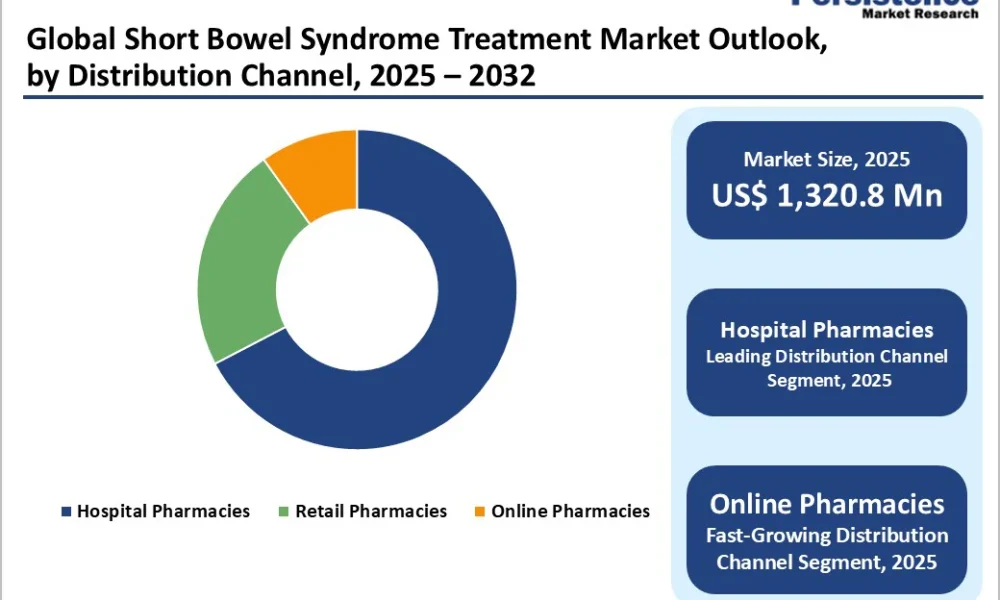
The global short bowel syndrome treatment market is gaining increasing attention as healthcare systems worldwide focus on rare but high-burden gastrointestinal disorders. Valued at US$1,320.8 million in 2025, the market is projected to reach US$2,150.3 million by 2032, expanding at a compound annual growth rate (CAGR) of 7.2% during the forecast period. This growth reflects rising disease prevalence, expanding therapeutic innovation, and stronger recognition of short bowel syndrome (SBS) as a chronic condition requiring long-term medical and nutritional intervention.
Understanding Short Bowel Syndrome and Its Clinical Burden
Short bowel syndrome is a complex malabsorptive disorder resulting from significant loss or dysfunction of the small intestine. It is most commonly acquired following extensive surgical resection due to conditions such as Crohn’s disease, mesenteric ischemia, volvulus, trauma, or congenital abnormalities in pediatric patients. The reduced absorptive surface leads to chronic diarrhea, dehydration, electrolyte imbalance, weight loss, and micronutrient deficiencies, significantly impairing quality of life.
Although SBS can be life-threatening in severe cases, most patients are managed through a combination of dietary modification, parenteral nutrition, and pharmacological therapy. Advances in intestinal rehabilitation and hormone-based therapies have shifted SBS from a condition of survival-focused care to one increasingly centered on functional independence and long-term stability.
Download Your Free Sample & Explore Key Insights: https://www.persistencemarketresearch.com/samples/35947
Market Size and Growth Trajectory
The short bowel syndrome treatment market has demonstrated steady historical growth, recording a CAGR of 6.1% between 2019 and 2024. This momentum is expected to accelerate through 2032 as newer therapies expand treatment options beyond traditional parenteral nutrition. Growth is further supported by improved diagnostic capabilities, greater clinician awareness, and supportive regulatory incentives for orphan drugs targeting rare diseases.
Key Industry Highlights Shaping the Market
North America currently dominates the global SBS treatment market, accounting for approximately 47.1% of total revenue. This leadership is driven by advanced healthcare infrastructure, high adoption of glucagon-like peptide-2 (GLP-2) analogs, and well-established reimbursement frameworks for rare-disease therapies. In contrast, the Asia Pacific region is expected to be the fastest-growing market, registering a CAGR of 9.0%, fueled by improving specialist access, expanding healthcare investment, and rising awareness of intestinal failure disorders.
From a product perspective, glucagon-like peptide-based therapies command an overwhelming 87.4% market share, reflecting their strong clinical efficacy and ability to significantly reduce dependence on parenteral support. Hospital pharmacies remain the dominant distribution channel, holding 68.1% share, due to the complexity of SBS treatment initiation, monitoring requirements, and controlled dispensing of biologics.
Market Dynamics Driving Growth
One of the primary drivers of the short bowel syndrome treatment market is the rapid advancement of GLP-2–based therapies and the growing clinical focus on intestinal adaptation. Increasing global awareness of SBS, supported by better epidemiological data and enhanced healthcare infrastructure, has improved early diagnosis and long-term management. Governments and non-profit organizations are actively supporting education, specialist training, and multi-center research initiatives, creating a favorable environment for innovation.
Regulatory incentives for orphan drugs have encouraged pharmaceutical companies to invest in next-generation biologics and improved parenteral nutrition solutions. Progress in peptide-based innovation has been notable, with novel GLP-2 analogs and dual-agonist programs advancing through clinical development. These efforts collectively position the SBS treatment market for sustained long-term expansion.
Challenges and Market Restraints
Despite positive momentum, the market continues to face notable restraints. High treatment costs remain a significant barrier, particularly for biologic therapies and long-term parenteral nutrition. Limited availability of approved drugs and uneven physician awareness, especially in community healthcare settings, can delay diagnosis and optimal treatment initiation.
Regulatory delays also pose challenges. The Complete Response Letter issued by the U.S. FDA in late 2024 for a long-acting GLP-2 analog highlighted the stringent evidence requirements for approval in rare diseases. Dependence on complex nutritional support systems and the lack of extensive long-term outcome data further restrict rapid adoption in certain regions, particularly in low- and middle-income countries.
Get Custom Insights Designed for Your Business: https://www.persistencemarketresearch.com/request-customization/35947
Emerging Opportunities and Innovation Pipeline
The market’s most significant opportunities lie in the development of next-generation long-acting and oral GLP-2 therapies. Teduglutide has demonstrated the commercial viability of targeted hormonal therapy by enabling meaningful reductions in parenteral nutrition dependence. Building on this success, once-weekly formulations such as apraglutide are showing strong Phase 3 outcomes, including improved enteral autonomy for patients.
Even more transformative is the emergence of oral GLP-2 platforms, which promise improved convenience, adherence, and accessibility compared with injectable therapies. Early pharmacokinetic data presented in 2025 signal a potential paradigm shift in SBS management, positioning oral biologics as a major future growth driver.
Category-wise Market Analysis
By product, glucagon-like peptide therapies dominate the market due to their proven ability to enhance intestinal adaptation and nutrient absorption. Strong clinical evidence, favorable physician perception, and continued regulatory momentum reinforce their leadership across major markets.
By distribution channel, hospital pharmacies lead the market because SBS care requires multidisciplinary oversight, dose titration, cold-chain handling, and close monitoring. Tertiary care centers also account for higher diagnosis rates and structured reimbursement processes, further strengthening hospital pharmacy dominance.
Regional Market Insights
North America remains the largest and most innovative regional market for SBS treatment. The region benefits from high awareness, strong specialist networks, and rapid uptake of GLP-2 analogs. A significant population reliant on long-term home parenteral nutrition underscores the demand for therapies that reduce treatment burden and improve quality of life.
Europe represents the second-largest market, supported by robust clinical infrastructure and well-established intestinal rehabilitation programs. SBS accounts for a majority of adult intestinal failure cases in the region, driving sustained demand for advanced nutritional and pharmacological management. Research initiatives and EU-funded projects focused on tissue engineering and intestinal regeneration further strengthen Europe’s long-term outlook.
Asia Pacific is emerging as a major growth engine, driven by rising gastrointestinal surgical volumes, expanding access to biologics, and increasing government investment in rare-disease care. Countries such as Japan, China, South Korea, and Australia are rapidly integrating advanced SBS therapies into clinical practice, supported by growing reimbursement pathways and multidisciplinary care models.
Checkout Now & Download Complete Market Report: https://www.persistencemarketresearch.com/checkout/35947
Market Segmentation
By Drug Class
- Glucagon-like Peptide
- Histamine Blockers
- Proton Pump Inhibitors
- Growth Hormone
- Others
By Distribution Channel
- Hospital Pharmacies
- Retail Pharmacies
- Online Pharmacies
By Region
- North America
- Europe
- East Asia
- South Asia & Oceania
- Latin America
- Middle East and Africa
Competitive Landscape and Key Players
The global short bowel syndrome treatment market is characterized by limited approved therapies, creating a high-value and highly regulated competitive environment. Innovation is concentrated among a small group of pharmaceutical companies advancing GLP-2 analogs, oral formulations, and pediatric-focused therapies. At the same time, symptomatic management remains competitive, with established brands dominating supportive care.
Key companies operating in the market include OPKO Health, Pfizer, Takeda Pharmaceutical Company, Teva Pharmaceutical Industries, Ironwood, Entera Bio, Zealand Pharma, Emmaus Medical, EMD Serono, OxThera, and Jaguar Health. Recent clinical trial activity and conference presentations highlight an increasingly dynamic pipeline that is expected to shape the market over the next decade.
Market Outlook
Overall, the short bowel syndrome treatment market is transitioning from reliance on supportive nutrition toward targeted, mechanism-driven therapies that improve intestinal function and patient independence. Continued innovation, supportive regulatory frameworks, and expanding global awareness are expected to sustain robust growth through 2032, positioning SBS treatment as an increasingly important segment within the rare gastrointestinal disease landscape.




