

Overview
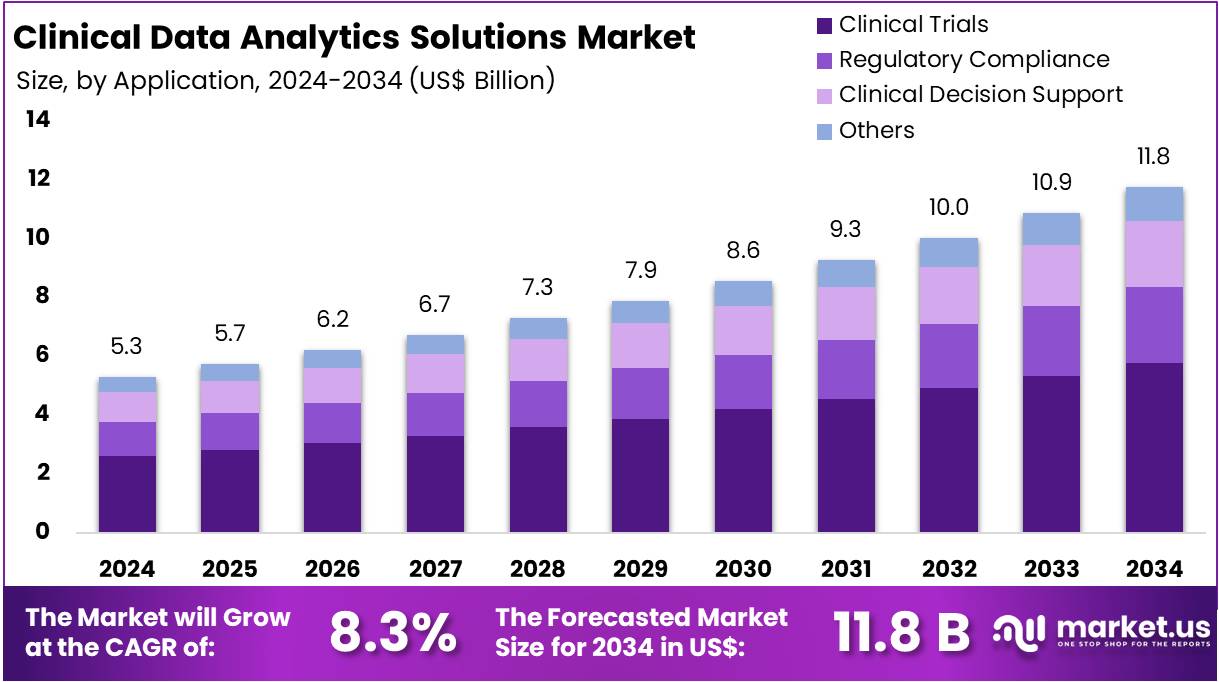
The Global Clinical Data Analytics Solutions Market is projected to grow from USD 5.3 billion in 2024 to USD 11.8 billion by 2034, at a CAGR of 8.3%. North America led the market with a 43.6% share, valued at USD 2.3 billion in 2024. This growth is driven by increasing reliance on data to improve patient outcomes and reduce costs. The widespread use of Electronic Health Records (EHRs), adopted by nearly 88% of office-based U.S. physicians, creates a rich foundation for clinical data analysis.
Big Data Analytics (BDA) is key to managing and analyzing these large EHR datasets. BDA helps identify clinical patterns, support diagnosis, and improve disease surveillance. Predictive tools now help stratify patients for risks such as sepsis, stroke-related infections, and hospital-acquired infections. These analytics enable timely interventions and efficient care delivery. As healthcare systems prioritize personalized treatment, the demand for real-time and predictive analytics is growing, transforming how medical data is used in daily practice.
Government initiatives play a vital role in accelerating adoption. The U.S. Office of the National Coordinator for Health IT supports meaningful EHR use, helping build a national data infrastructure. Moreover, the FDA has seen rising drug applications that incorporate AI analytics in clinical trials and postmarketing surveillance. These developments show how regulatory bodies are actively encouraging digital healthcare innovation. This support fosters confidence among providers and investors in analytics-based healthcare models.
Clinical data analytics is highly effective in managing chronic diseases. In the U.S., diabetes affects 16.2% of adults over 20, with global cases rising to 830 million in 2022. Heart disease and stroke lead to over 944,800 deaths yearly, costing the economy $422 billion. COPD also remains a critical issue, with over 15 million reported cases and 135,517 deaths in 2022. Analytics improve chronic care strategies by enabling early detection, risk scoring, and personalized interventions, ultimately helping reduce mortality and costs.
Remote Patient Monitoring (RPM) complements data analytics by providing real-time updates for chronic patients. Among heart patients, RPM reduces 30-day readmissions by 50%. For cancer patients, it has improved life expectancy by 20% and cut hospitalization rates from 13% to 2.8%. Financially, RPM can save up to $6,500 per patient annually. The COVID-19 pandemic further pushed RPM adoption, with telehealth use jumping from 11% in 2019 to 76%. Together, RPM and analytics strengthen care coordination and long-term outcomes.
Key Takeaways
- The Clinical Data Analytics Solutions Market is set to grow from US$ 5.3 Billion in 2024 to US$ 11.8 Billion by 2034.
- This projected market expansion corresponds to a steady CAGR of 8.3% over the forecast period from 2025 to 2034.
- In 2024, cloud-based deployment models held the largest share, capturing more than 55.6% of the deployment segment.
- The Clinical Trials application segment led the market in 2024, accounting for over 43.6% of the total application-based revenue.
- North America dominated the global market in 2024, contributing more than 43.6% with a market value of approximately US$ 2.3 Billion.
Get Sample: https://market.us/report/clinical-data-analytics-solutions-market/request-sample/
Regional Analysis
In 2024, North America dominated the clinical data analytics solutions market, holding over 43.6% market share with a value of US$ 2.3 billion. This leadership position is attributed to the region’s advanced healthcare IT systems and strong digital health infrastructure. The early adoption of electronic health records (EHRs) and integration of digital tools has significantly boosted operational efficiency. Additionally, robust government initiatives aimed at promoting digital transformation have encouraged widespread implementation across hospitals and clinics, creating a favorable environment for clinical data analytics growth.
Hospitals and academic medical centers across North America are extensively using real-time analytics tools. These tools support better treatment decisions, improved outcomes, and enhanced operational efficiency. Predictive analytics plays a key role in chronic disease management and reducing medical errors. The growing emphasis on patient-centered care and personalized medicine has further accelerated adoption. Institutions are increasingly relying on data to guide treatment protocols, manage risks, and enhance quality of care delivery across the healthcare continuum.
Support from government initiatives, such as the U.S. HITECH Act, has played a vital role in driving market expansion. This legislation promotes the use of health IT systems and EHR adoption among providers. Regulatory frameworks have incentivized health systems to invest in advanced analytics platforms. The aging population and increasing chronic disease prevalence are additional factors compelling healthcare systems to adopt population health management tools. These tools streamline care coordination and resource allocation across large patient populations.
North America continues to lead the clinical data analytics market due to its technological readiness, regulatory support, and commitment to innovation. Healthcare providers in the U.S. and Canada are leveraging analytics to ensure high-quality, value-based care. Investments in cloud computing, AI-powered platforms, and interoperability are further strengthening this position. With a mature healthcare ecosystem and continued focus on data-driven care, the region is expected to maintain its market leadership throughout the forecast period.
Segmentation Analysis
In 2024, cloud-based deployment held a strong position in the Clinical Data Analytics Solutions Market, accounting for over 55.6% of the deployment segment. The rising demand for real-time data access and EHR integration drove this dominance. Cloud-based tools are favored for their lower upfront costs and easier management. Many healthcare providers consider them ideal for fast-paced clinical settings. Their popularity is further supported by enhanced interoperability and reduced reliance on large in-house IT teams, making them a practical choice for healthcare institutions seeking scalability and flexibility.
Healthcare organizations continue to embrace cloud platforms due to their efficiency and remote accessibility. These systems are essential for telehealth services and multi-location collaboration. They also offer secure environments that comply with global healthcare standards. Government initiatives supporting digital transformation have further boosted cloud adoption. As hospitals modernize IT infrastructure, cloud models are rapidly replacing traditional systems. The shift is expected to intensify as analytics tools become more sophisticated and demand for real-time decision-making grows across clinical networks.
Conversely, on-premise solutions still retain a role among institutions with strict data policies and legacy systems. These deployments offer full internal control but are expensive to maintain and hard to scale. Facilities with older infrastructure prefer them to retain autonomy over sensitive data. However, the high operational costs and limited flexibility reduce their appeal. Many organizations are phasing them out in favor of cloud alternatives. As a result, the on-premise segment is projected to grow slowly in comparison to its cloud-based counterpart.
In terms of application, the clinical trials segment led the market in 2024, holding over 43.6% share. The rise in global clinical studies has fueled the need for analytics tools to handle large volumes of data. These platforms enhance patient recruitment, monitor treatment outcomes, and shorten trial durations. The growing complexity of study protocols increases the dependence on advanced analytics. Meanwhile, regulatory compliance and clinical decision support are gaining momentum. Predictive analytics and AI tools are helping healthcare providers improve care delivery and meet strict data governance standards.
By Deployment
- On-premise
- Cloud-based
By Application
- Clinical Decision Support
- Clinical Trials
- Regulatory Compliance
- Others
Key Players Analysis
The Clinical Data Analytics Solutions market is witnessing strong competition among key players delivering transformative tools for healthcare decision-making. Optum Inc. leads the market with its broad data infrastructure and integrated care systems. The company supports population health management and predictive modeling to improve resource utilization. These tools enable care teams to enhance patient outcomes. Similarly, SAS Institute Inc. remains a major player with its advanced statistical and predictive analytics software. It supports real-time clinical decision-making and is highly valued for its accuracy and data privacy across payer-provider networks.
IQVIA is distinguished for its Real World Data (RWD) and Real World Evidence (RWE) platforms. These platforms play a critical role in designing and optimizing clinical trials while ensuring global regulatory compliance. IQVIA’s AI-powered solutions accelerate drug development timelines and enhance trial efficiency. Its strong global presence supports integrated data systems in multiple regions. This reach enables healthcare stakeholders to make informed decisions. The company’s expertise in real-world insights makes it a leader in clinical research and commercial strategy.
Health Catalyst offers advanced analytics systems focused on value-based care. Its platforms support financial, operational, and clinical improvements across health systems. The company collaborates with academic institutions and healthcare organizations to expand its market presence. These partnerships enhance its performance analytics and population health tools. By targeting care quality and cost outcomes, Health Catalyst helps providers achieve value-based goals. Its role in modernizing care delivery continues to grow, especially as health systems adopt data-driven frameworks.
eClinical Solutions LLC emphasizes cloud-based platforms that optimize clinical trial data workflows. Its tools improve data transparency and reporting accuracy, which shortens trial durations and ensures regulatory compliance. The company partners with Contract Research Organizations (CROs) and trial sponsors to strengthen its presence. Its secure cloud architecture supports efficient and compliant data management throughout the clinical trial lifecycle. Other companies in this space invest in AI, blockchain, and scalable cloud platforms. Their technologies support workflow modernization and boost clinical intelligence delivery in a competitive market.
Buy Directly: https://market.us/purchase-report/?report_id=149641
Conclusion
In conclusion, the clinical data analytics solutions market is evolving rapidly as healthcare systems shift toward digital transformation and value-based care. These tools are helping providers make better decisions, personalize treatments, and improve patient outcomes. The growing use of cloud-based platforms, along with rising adoption of AI and predictive analytics, is making data more accessible and actionable across healthcare settings. Strong support from government programs and regulatory bodies is further encouraging market growth. As the demand for remote monitoring and real-time insights increases, clinical analytics will continue to play a key role in modern healthcare. The market outlook remains positive, with innovation and collaboration driving continued advancements.
Get in Touch with Us:
Market.us (Powered By Prudour Pvt. Ltd.)
Address: 420 Lexington Avenue, Suite 300, New York City, NY 10170, United States.
Contact No: +1 718 874 1545 (International), +91 78878 22626 (Asia).
Email: [email protected]
View More
Healthcare Payer Solutions Market
Healthcare Middleware Market



