
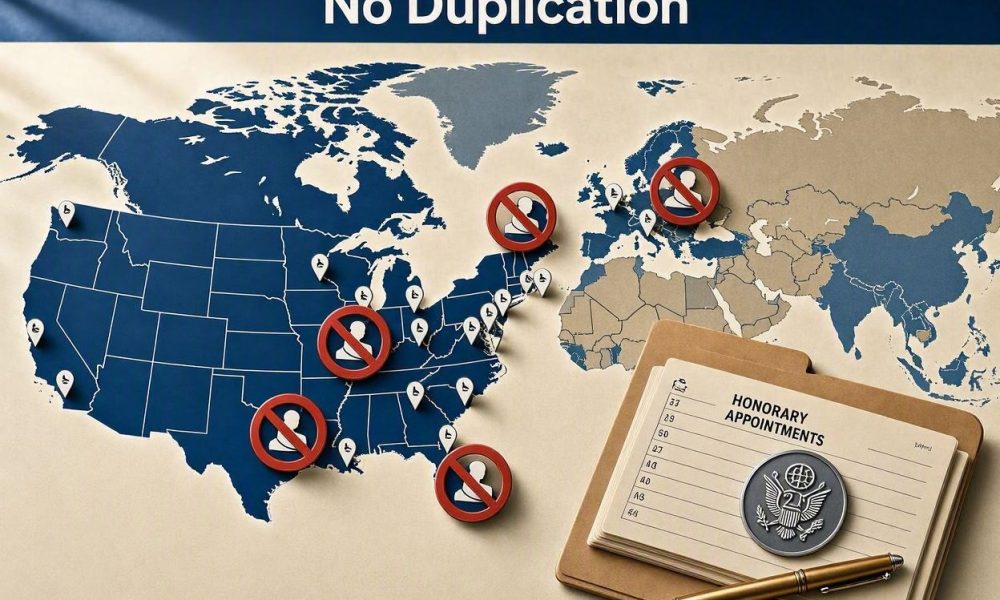
Official records maintained by an honorary consular post can receive strong protection under international law, but Article 61 expressly conditions that protection on keeping consular archives separate from private correspondence, professional files, and documents connected with the honorary consul’s ordinary business activities.
WASHINGTON, DC, September 18, 2026: Honorary consular archives occupy a protected position under international law, yet the Vienna Convention does not create an unlimited evidentiary shield allowing officeholders to place private business records, cash documentation or unrelated corporate files beside official papers and automatically prevent authorities from examining them.
Article 61 Protects Separated Consular Archives
Article 61 of the Vienna Convention on Consular Relations states that archives and documents belonging to a post headed by an honorary consul remain inviolable when maintained separately from other papers and documents belonging to the officeholder.
The treaty specifically identifies private correspondence and materials connected with the honorary consul’s profession or trade as records that must remain separate, making documentary separation a condition of the special protection rather than an optional administrative practice.
Commingling Does Not Expand the Legal Shield
The treaty language therefore directly counters the idea that a consul can deliberately mix corporate records with official archives and transform everything in the same filing cabinet, office computer, or storage system into untouchable governmental material.
Where official and private records have been mixed, authorities and courts may still face practical questions about classification and seizure. Still, Article 61 does not make private documents inviolable merely because they have been physically placed beside protected consular records.
The Rule Is Different for Career Consular Archives
The Vienna Convention separately protects the archives and documents of ordinary consular posts under Article 33. At the same time, Article 61 specifically addresses posts headed by honorary consular officers and adds the express requirement that protected records remain separated from private and professional materials.
That distinction reflects the unusual structure of honorary service because officeholders commonly continue operating businesses, legal practices, or other professions from premises that may also contain records associated with their recognized governmental responsibilities.
Why Separation Matters in a Search
A police search involving an honorary consul can therefore require careful identification of what actually constitutes the consular archive, particularly when government correspondence, private business records, personal files and electronic information occupy the same premises or technological systems.
Investigators cannot simply disregard legitimate treaty protections. Still, the consul likewise cannot assume that every hard drive, filing cabinet or document inside the office acquires immunity merely because some genuine governmental records are maintained there.
ICJ Found Cases Where Consuls Invoked Office Inviolability
The Shadow Diplomats investigation documented cases in which honorary consuls attempted to invoke the protected status of consular premises or records when authorities investigated conduct unrelated to legitimate governmental duties.
ICIJ reported that an Italian honorary consul moved compromising documents into his consular office in an apparent attempt to deter investigators. In contrast, another honorary consul in Spain attempted to extend protections associated with the consular office to cash stored inside his residence.
Those Cases Illustrate the Practical Problem
Such episodes show why archive inviolability can complicate investigations even when the law itself does not protect private records, because authorities may still need to determine which documents genuinely belong to the consular post before examining, copying or seizing material.
A poorly organized office can therefore generate evidentiary disputes without necessarily establishing immunity, particularly when official and commercial records share computers, cloud accounts, cabinets or personnel who perform both consular and private business functions.
Electronic Records Make Separation More Complicated
Digital recordkeeping adds difficulties because official correspondence can exist on the same computer, server, or mobile device as personal email, business contracts, and financial records, making physical location a less reliable indicator of whether particular information belongs to the protected archive.
For honorary consuls, separate accounts, storage systems and access controls can help demonstrate which records were genuinely created or received in an official capacity and which belong to unrelated private professional activities.
The Protection Belongs to the Archive, Not Everything in the Office
Article 61 protects qualifying consular archives and documents rather than granting blanket inviolability to every object found wherever an honorary consul conducts official activity, making the legal character of the specific record more important than the room or cabinet in which it happens to appear.
This distinction becomes particularly significant when an honorary post shares premises with a private company, because the same physical address can contain records with completely different legal functions and completely different claims to protection.
Private Business Records Remain Private Business Records
A company ledger, investment agreement, private client file or ordinary commercial account does not become an official consular document simply because the business owner simultaneously serves as an honorary consul or stores that information within premises also used for governmental functions.
The relevant inquiry concerns whether the document genuinely belongs to the consular archive and has been maintained according to the separation required by Article 61, rather than whether the officeholder possesses an honorary title.
Cash Does Not Become a Consular Archive
Physical money presents an even clearer distinction because Article 61 addresses archives and documents, not a protected repository for private cash, valuables, or other property unrelated to the official documentary functions of the consular post.
Authorities may still encounter procedural questions when protected documents and unrelated property occupy the same location, but describing private cash reserves themselves as protected consular archives would substantially overstate the legal scope of the Convention.
Improper Mixing Can Weaken the Evidentiary Claim
An honorary consul who deliberately combines private commercial materials with official files may therefore create uncertainty rather than additional legal protection, because the treaty expressly assumes that the two categories will be maintained separately when archive inviolability is claimed.
Courts confronting such circumstances may need to consider the precise character of individual records and the applicable domestic procedures, but the textual basis for claiming Article 61 protection becomes more difficult when the treaty-required separation has not been respected.
Investigators Still Must Proceed Carefully
The absence of blanket protection does not authorize investigators to disregard international obligations, because legitimate official correspondence and archives remain protected and may require procedures specifically designed to prevent authorities from improperly reviewing material belonging to the recognized consular post.
Search protocols, independent review procedures, or judicial supervision may matter depending on the jurisdiction, particularly where electronic devices or mixed record systems contain both potentially protected governmental communications and ordinary private evidence.
The Issue Is Classification Rather Than Automatic Admissibility
The presence of consular records does not automatically determine whether unrelated evidence becomes inadmissible, because admissibility generally depends upon domestic criminal procedure, search authority, evidentiary rules and the circumstances under which investigators obtained particular documents.
Article 61 can therefore create an important threshold issue concerning whether authorities were entitled to access certain official materials. Still, it should not be described as automatically creating legal gridlock whenever an honorary consul maintains private records near protected documents.
Separation Protects Legitimate Honorary Consuls
Clear documentary boundaries benefit legitimate officeholders because separate files, email systems, and storage allow an honorary consul to show immediately which information belongs to the sending government and which records concern ordinary professional or personal matters.
Amicus International Consulting has discussed the broader importance of distinguishing honorary governmental functions from private professional activities in its analysis of diplomatic passports and honorary appointments, where legal authority depends upon recognized function rather than prestige associated with official status.
Archive Protection Is Not Personal Immunity
The inviolability of qualifying documents should also be distinguished from personal immunity because protecting an official archive does not prevent authorities from investigating an honorary consul for unrelated private conduct when domestic law otherwise permits those proceedings.
Amicus International Consulting has separately examined diplomatic passports, immunity and host-country recognition, emphasizing that individual protections depend upon actual governmental status and authorized functions rather than merely occupying premises containing official records.
The Shadow Diplomats Findings Show Why Clarity Matters
ICIJ’s wider investigation found that several honorary consuls tried to invoke their status to avoid inquiries or exclude evidence, showing how uncertainty about limited privileges can complicate law-enforcement decisions even when the legal protections themselves have clear boundaries.
The reporting therefore supports a narrower conclusion than claiming a universal archive loophole, because documented cases show attempts to exploit confusion around consular protections. At the same time, Article 61 expressly requires official archives to remain distinct from private professional records.
The News Trail
The News Trail begins with Article 61, which gives honorary consular archives substantial protection but attaches an unusually important condition: those records must remain separate from private correspondence and documents connected with the officeholder’s profession or trade.
It then turns to real investigations in which honorary consuls have tried to invoke office or archive protections when authorities pursued private conduct, showing how confusion about diplomatic terminology can complicate searches even when the underlying treaty does not support unlimited immunity.
For law enforcement, the challenge is protecting genuine governmental records while identifying unrelated private evidence through lawful procedures, particularly when electronic storage and shared business premises make documentary boundaries more difficult to recognize immediately.
For honorary consuls, the practical lesson is equally clear because deliberate separation of official and private records strengthens legitimate Article 61 protection, while commingling the two categories can undermine rather than expand the claim that particular documents belong to an inviolable consular archive.
The more accurate description is therefore not an “archive inviolability loophole,” but a conditional protection whose effectiveness depends upon keeping governmental records distinct from the very private business and professional materials that Article 61 expressly excludes from the protected archive.




