

Overview
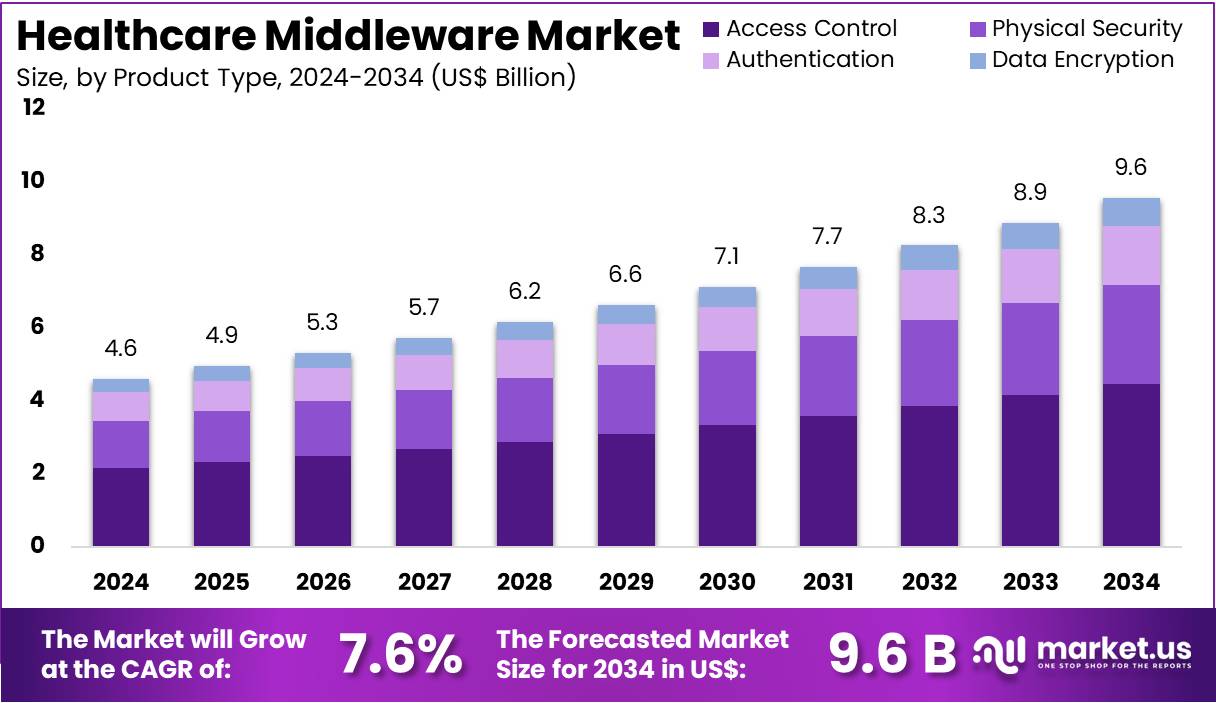
The Healthcare Middleware Market is projected to reach approximately US$ 9.6 billion by 2034, rising from US$ 4.6 billion in 2024. This indicates a compound annual growth rate (CAGR) of 7.6% from 2025 to 2034. The market’s expansion is fueled by rising demand for efficient data handling within healthcare environments. Middleware solutions are essential tools that support seamless communication between various clinical and administrative systems. These tools facilitate the secure exchange of healthcare data, enhancing operational efficiency and supporting better care outcomes.
Healthcare middleware acts as a bridge connecting different platforms, including electronic health records (EHRs), laboratory systems, imaging devices, and billing software. By enabling data integration and interoperability, middleware supports faster and more reliable decision-making. It automates workflows and allows real-time data exchange across care settings. As health systems move toward digital transformation, middleware ensures that data silos are minimized, and processes are streamlined. This results in reduced operational burden and improved coordination between healthcare providers.
In March 2022, the collaboration between COPE Health Solutions’ Analytics for Risk Contracting (ARC) and CareJourney demonstrated how middleware consolidates diverse healthcare data. These include claims, EHRs, lab results, and social determinants of health. This integration allows providers to conduct deeper analytics for population health management and financial planning. It supports accurate cost assessment, risk modeling, and service utilization analysis. Such use cases highlight how middleware improves transparency, efficiency, and health outcomes across care networks.
The growing complexity of healthcare IT systems is a significant market driver. Healthcare providers rely on various digital platforms, often operating with incompatible formats and infrastructure. Middleware provides the technical foundation needed for interoperability in such fragmented environments. It converts and routes data among systems, ensuring seamless communication and reducing manual errors. Without middleware, healthcare organizations would struggle to meet performance demands. This makes it essential for managing clinical operations, reducing redundancy, and advancing digital initiatives in modern healthcare systems.
Innovation in middleware technology continues to reshape healthcare infrastructure. Cloud-based middleware, API-driven integrations, and artificial intelligence tools are becoming more common. These technologies boost data processing speeds, enable predictive analytics, and support scalability. As value-based care models gain traction, middleware is helping organizations align with regulatory frameworks and reimbursement policies. Additionally, with US health expenditures reaching US$ 4.9 trillion in 2023, the demand for efficient IT infrastructure is rising. Middleware is well-positioned to support future growth and ensure long-term healthcare sustainability.
Key Takeaways
- In 2024, the global healthcare middleware market reached a valuation of US$ 4.6 billion, projected to grow to US$ 9.6 billion by 2034.
- The market is expanding at a compound annual growth rate (CAGR) of 7.6% over the forecast period from 2025 to 2034.
- Among product types, access control dominated the market in 2024, capturing a substantial 46.7% share due to rising demand for secure access systems.
- Within the technology segment, cloud-based solutions led the market, holding a 53.2% share owing to scalability, remote access, and reduced infrastructure costs.
- Patient management emerged as the leading application segment, contributing 44.3% of total revenue due to growing demand for efficient care coordination tools.
- Health Level 7 (HL7) standards accounted for the highest share in the format segment, securing 49.1% due to widespread adoption in healthcare interoperability.
- Hospitals and clinics were the primary end-users, accounting for 57.8% of the market due to their critical role in care delivery and data exchange.
- Geographically, North America dominated the healthcare middleware market in 2024, holding 53.2% share, driven by advanced healthcare IT infrastructure and regulatory mandates.
Get Sample: https://market.us/report/global-healthcare-middleware-market/request-sample/
Segmentation Analysis
Access Control Segment Analysis
The access control segment held a 46.7% market share in 2024. This was due to growing concerns around data privacy and security. Healthcare organizations are facing increasing regulatory pressure to protect sensitive patient information. Access control systems help restrict unauthorized access to physical and digital assets. Rising cyberattacks on healthcare systems are also increasing the need for strong identity and authentication solutions. Integration with other technologies allows for automated permissions and tracking. Biometric and multi-factor authentication tools are also accelerating adoption across hospitals and clinics.
Cloud-Based Technology Analysis
Cloud-based technology accounted for a 53.2% share in the healthcare middleware market. Its strong growth is attributed to scalability, flexibility, and low infrastructure costs. Cloud platforms allow real-time access to healthcare data and integration tools without large upfront investments. The rise of telemedicine and mobile health apps is also driving demand for cloud-enabled middleware. These platforms simplify compliance with evolving healthcare laws. They also support disaster recovery and security updates. As digital transformation in healthcare accelerates, cloud technology will likely remain the leading deployment model.
Patient Management Application Analysis
The patient management segment secured a 44.3% share in the application category. This growth is driven by the need to improve patient outcomes through coordinated care. Middleware solutions integrate data from scheduling, EHRs, and billing systems, reducing administrative delays. The rise in chronic illnesses is increasing demand for personalized care tools. These tools are embedded in middleware to streamline treatment plans. Patient-centric workflows are essential under value-based care models. Middleware also enhances communication among care teams and enables real-time monitoring and resource optimization.
HL7 Format Segment Analysis
The HL7 format dominated the format segment with a 49.1% market share. HL7 is widely accepted for exchanging clinical data across healthcare systems. It allows real-time sharing of patient data, lab reports, and diagnostic results. Regulatory focus on data standardization and interoperability has increased HL7 adoption. Its compatibility with fast healthcare interoperability resources (FHIR) supports modern healthcare frameworks. Middleware with HL7 helps hospitals ensure seamless integration between EHRs, diagnostics, and pharmacy systems. This format remains critical as data sharing becomes central to healthcare operations.
Hospitals & Clinics End-user Analysis
Hospitals and clinics held the highest share of 57.8% in the end-user segment. These facilities manage large volumes of clinical and operational data daily. Middleware helps integrate this data across departments like EHR, diagnostics, and billing. Demand is rising for solutions that improve care coordination and data accuracy. Regulatory reporting and reimbursement models also rely on accurate data flow. Cloud and mobile-enabled middleware support real-time data access. Security and interoperability are key features sought by hospitals. These trends firmly position them as primary users of healthcare middleware solutions.
By Product Type
- Physical Security
- Access Control
- Authentication
- Data Encryption
By Technology
- Cloud-based
- On-premise
- Hybrid
By Application
- Clinical Integration
- Patient Management
- Enterprise Resource Planning
- Data Analytics
By Format
- Health Level 7 (HL7)
- Fast Healthcare Interoperability Resources (FHIR)
- Digital Imaging and Communications in Medicine (DICOM)
By End-user
- Hospitals & Clinics
- Pharmaceutical Companies
- Insurance Companies
- Healthcare Providers
Regional Analysis
North America is leading the healthcare middleware market with the largest revenue share of 39.2%. This dominance is due to the growing need for seamless data exchange and system interoperability. The U.S. Department of Health & Human Services (HHS) actively promotes interoperability to improve patient care. The Office of the National Coordinator for Health Information Technology (ONC) supports standard adoption for health data exchange. High Electronic Health Record (EHR) adoption across U.S. hospitals further fuels the demand for middleware to integrate diverse healthcare IT systems efficiently.
The widespread use of EHRs in North America requires effective middleware to connect systems and improve workflow. Middleware plays a key role in linking applications, devices, and databases across the healthcare continuum. Hospitals rely on these solutions for real-time data exchange, decision support, and system automation. As healthcare systems become more complex, the need for middleware is growing rapidly. These platforms ensure secure, fast, and accurate data flow between multiple healthcare technologies and platforms in clinical and administrative settings.
Asia Pacific is projected to grow at the fastest CAGR during the forecast period. This growth is driven by rapid digital health adoption and government-backed healthcare modernization efforts. Countries like India and China are investing in national digital health platforms. These efforts demand middleware for data integration. The rising number of healthcare facilities and implementation of EHR systems support market growth. Middleware enables smooth communication between new and existing systems, helping to create efficient and interoperable digital health infrastructures across the region.
Buy: https://market.us/purchase-report/?report_id=149101
Conclusion
The healthcare middleware market is growing steadily due to rising demand for smooth data exchange and system integration across healthcare settings. Middleware solutions are playing a key role in connecting different platforms like EHRs, lab systems, and billing software. These tools help reduce errors, save time, and improve decision-making for better patient care. With more hospitals adopting digital tools and governments promoting healthcare IT upgrades, the need for middleware is increasing. Cloud-based platforms and patient management tools are driving this shift. As healthcare becomes more connected and data-driven, middleware will continue to support digital transformation and improve overall efficiency in hospitals, clinics, and healthcare systems worldwide.
Get in Touch with Us:
Market.us (Powered By Prudour Pvt. Ltd.)
Address: 420 Lexington Avenue, Suite 300, New York City, NY 10170, United States.
Contact No: +1 718 874 1545 (International), +91 78878 22626 (Asia).
Email: [email protected]
View More



