
Overview
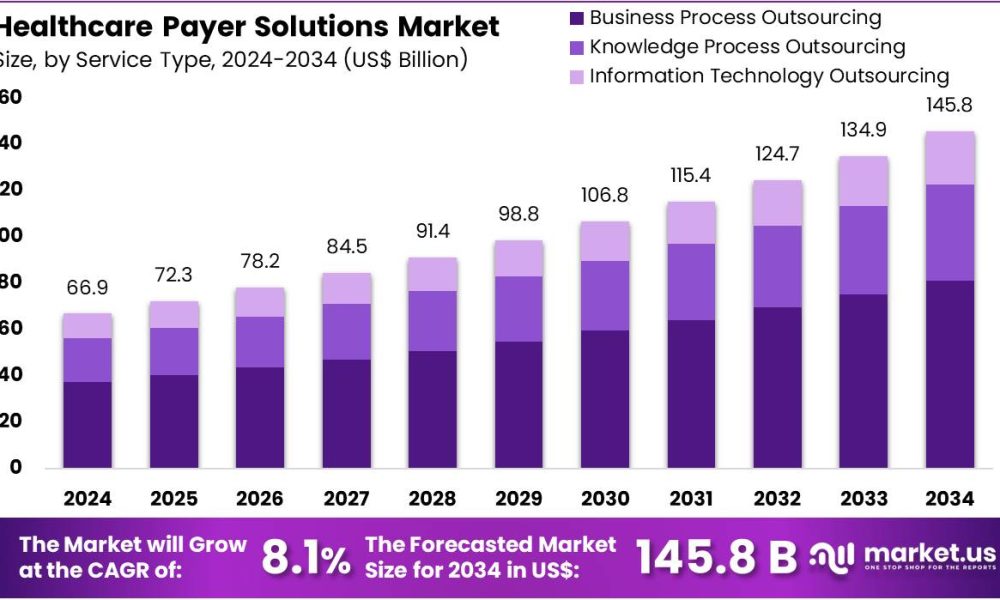
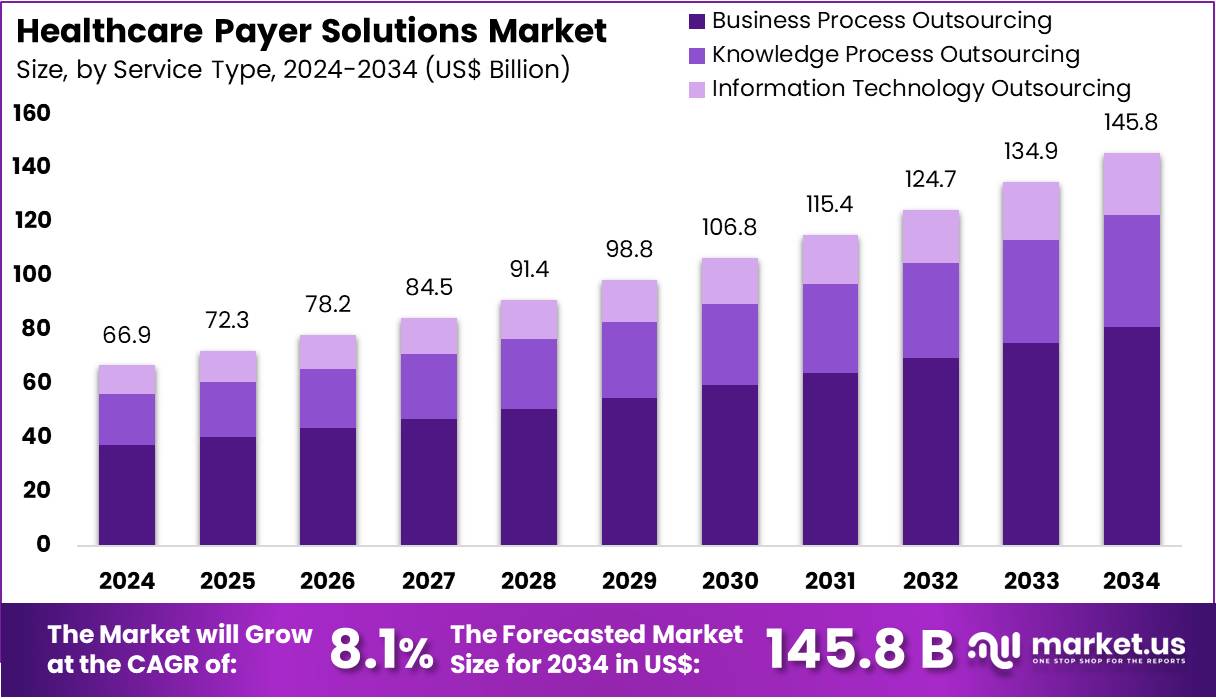
The global Healthcare Payer Solutions Market is projected to reach approximately US$ 145.8 billion by 2034, up from US$ 66.9 billion in 2024. This reflects a compound annual growth rate (CAGR) of 8.1% from 2025 to 2034. The market’s expansion is fueled by increasing demand for cost-effective healthcare systems and better patient outcomes. Payer solutions include tools for claims processing, risk adjustment, and care coordination. These platforms allow payers to analyze large volumes of data quickly. This enhances both decision-making and administrative efficiency across healthcare systems.
Rapid digital transformation and regulatory pressures are driving investment in payer solutions. Companies are launching advanced SaaS-based platforms to manage healthcare data more effectively. A notable example is the launch of IMAT Solutions’ new service in March 2022. This platform supports multiple stakeholders like payers and Health Information Exchanges (HIEs). It also holds the NCQA-approved Data Aggregator Validation (DAV) certification. This accreditation confirms the system’s compliance with industry standards and strengthens trust among healthcare organizations and providers.
These solutions are also being used to improve regulatory compliance and fraud detection. They help in provider network management and value-based care delivery. Integration of artificial intelligence and advanced analytics has improved risk stratification and predictive modeling. AI tools also enhance member engagement and care plan customization. Cloud adoption and interoperability standards are making these solutions more scalable, secure, and cost-effective. As a result, the adoption rate of these systems is steadily increasing among healthcare payers.
A key market driver is the escalating cost of healthcare. According to the Centers for Medicare & Medicaid Services (CMS), U.S. healthcare spending reached US$ 4.5 trillion in 2022, making up 17.3% of the national GDP. This sharp rise puts pressure on both governments and private payers. Payer solutions offer the ability to control expenditures while maintaining service quality. These tools help organizations optimize reimbursement models, reduce waste, and ensure timely claim settlements. The financial sustainability of healthcare systems heavily depends on such innovations.
Market trends also show growing attention toward personalized health plans and social determinants of health (SDOH). These trends support a patient-centric care model that focuses on individual health needs. As payers face shifting regulations and increasing demand for value-based reimbursement models, payer solutions have become essential tools. They support long-term sustainability by improving operational transparency, data integration, and healthcare accessibility. The continuous evolution of these platforms ensures they remain vital to healthcare payers adapting to complex, data-driven ecosystems.
Key Takeaways
- In 2024, the healthcare payer solutions market generated US$ 66.9 billion in revenue and is projected to reach US$ 145.8 billion by 2033.
- The market is expanding at a steady compound annual growth rate (CAGR) of 8.1% during the forecast period from 2025 to 2033.
- Business Process Outsourcing (BPO) dominated the service type segment in 2024, accounting for 55.7% of the total market share.
- Knowledge Process Outsourcing and IT Outsourcing followed BPO but contributed a comparatively smaller portion to the overall service segment in 2024.
- Claims Management Services emerged as the largest application category, holding a substantial share of 24.6% within the healthcare payer solutions segment.
- Other key application areas include provider management, analytics & fraud management, and billing services, supporting broad administrative and clinical efficiencies.
- Private payers led the end-user landscape, contributing 63.4% of the market share, reflecting strong engagement from insurance firms and private healthcare entities.
- Public payers followed behind, indicating continued but relatively limited investment in payer solutions by government-funded health systems.
- North America maintained market leadership in 2024, capturing 38.9% of global revenue due to advanced healthcare infrastructure and regulatory digitalization mandates.
Get Sample: https://market.us/report/global-healthcare-payer-solutions-market/request-sample/
Segmentation Analysis
The business process outsourcing segment accounted for 55.7% of the market share. This growth is driven by the rising demand for cost-effective administrative support among healthcare payers. Key services outsourced include claims processing, data management, and customer service. By shifting these routine functions to specialized firms, payers can lower operational costs and concentrate on core strategic areas. Additionally, automation and improved technology have enhanced service efficiency. The growing complexity of healthcare regulations further increases the need for expert outsourcing. This trend supports improved scalability and agility, fueling segment expansion.
The claims management services segment secured a 24.6% market share. This growth is supported by the increasing volume and complexity of healthcare claims. Payers are under pressure to ensure faster reimbursement, reduce claim errors, and prevent fraud. Advanced claims management solutions with integrated analytics and fraud detection tools are in high demand. These systems improve financial oversight and streamline claims workflows. The shift to value-based care also emphasizes accuracy and transparency. As a result, healthcare payers are investing heavily in claims services to improve efficiency and patient satisfaction.
Private payers dominated the end-user segment with a 63.4% revenue share. This rise is attributed to the growing role of private insurance providers in healthcare financing. These payers face rising costs and seek technologies that optimize operations and enhance user experience. Digital transformation, including analytics and cloud-based platforms, is a key focus. Regulatory shifts and market competition are driving faster adoption of innovative tools. Private payers benefit from customizable and scalable solutions. As a result, they are emerging as the primary contributors to market growth and innovation.
By Service Type
- Business Process Outsourcing
- Knowledge Process Outsourcing
- Information Technology Outsourcing
By Application
- Claims Management Services
- Member Management Services
- Integrated Front Office Service & Back Office Operations
- Provider Management Services
- Billing & Accounts Management Services
- Analytics & Fraud Management Services
- Payment Management Services
- HR Services
- Audit & Analysis Systems
By End-User
- Private Payers
- Public Payers
Regional Analysis
North America leads the Healthcare Payer Solutions Market
North America holds the highest share in the global healthcare payer solutions market, accounting for 38.9% in revenue. This dominance is driven by rising healthcare expenditures and the need for efficient claims management. The United States saw a 7.5% increase in national health spending in 2023, reaching US$ 4.9 trillion, as reported by CMS in December 2024. As spending grows, so does the demand for advanced financial and administrative tools. These solutions are essential for improving efficiency, especially in a rapidly evolving healthcare payment landscape.
Adoption of value-based care boosts demand in North America
The transition toward value-based care models in North America further strengthens the market. The Centers for Medicare & Medicaid Services (CMS) aims to have all Medicare beneficiaries in accountable care relationships by 2030. This shift demands advanced payer solutions for risk adjustment, population health management, and predictive analytics. Healthcare payers are increasingly using data-driven systems to streamline reimbursement processes. These solutions also support regulatory compliance and improve transparency. The evolving payment ecosystem creates a steady demand for innovative payer technologies across the region.
Asia Pacific poised for highest growth rate during forecast period
The Asia Pacific region is expected to register the fastest CAGR due to growing healthcare coverage initiatives. Governments are expanding universal healthcare programs, increasing the insured population. This surge leads to a higher volume of claims and administrative needs. Digitalization of healthcare systems is accelerating, boosting the demand for tech-enabled payer solutions. Fraud detection and cost containment are becoming priorities for insurers. As healthcare ecosystems expand, there is a growing focus on improving operational efficiency through advanced payer platforms and automation technologies.
Buy Directly: https://market.us/purchase-report/?report_id=149073
Conclusion
In conclusion, the healthcare payer solutions market is growing steadily due to the rising need for efficient cost management and improved patient care. These solutions help payers manage complex tasks like claims processing, fraud detection, and data analysis with greater accuracy and speed. Advanced technologies such as artificial intelligence and cloud computing are making these tools more powerful and easier to use. Private insurers are leading the adoption of these systems, while governments are also increasing their investments. As healthcare systems become more digital and data-driven, payer solutions will continue to play a key role in improving service quality, operational efficiency, and financial sustainability across global markets.
Get in Touch with Us:
Market.us (Powered By Prudour Pvt. Ltd.)
Address: 420 Lexington Avenue, Suite 300, New York City, NY 10170, United States.
Contact No: +1 718 874 1545 (International), +91 78878 22626 (Asia).
Email: [email protected]
View More
US Urgent Care Centers Market
US Medical Billing Outsourcing Market



