
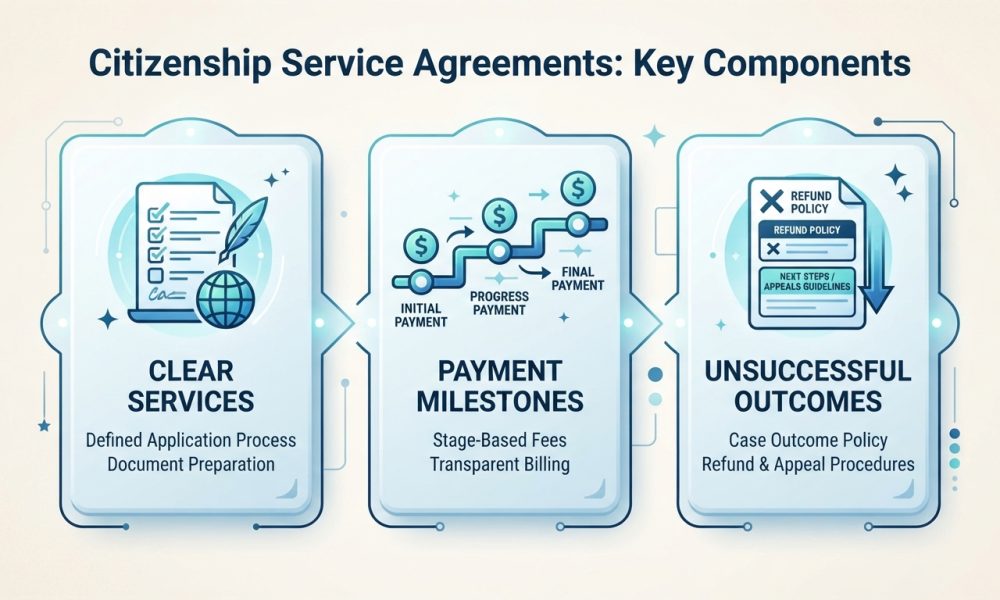
Written terms should explain the services provided, payment stages, and how unsuccessful applications are handled so applicants understand their commitments before proceeding.
WASHINGTON, DC, November 9, 2026 — Americans exploring second citizenship, foreign residency, or international relocation increasingly encounter complex service agreements involving professional retainers, government application fees, due diligence expenses, and substantial investment commitments that require careful review before money changes hands.
As citizenship planning becomes an important consideration for internationally mobile families, business owners, and investors, written agreements must clearly distinguish the services a private adviser promises to perform from decisions that remain exclusively within the authority of foreign governments.
The financial consequences can be significant because applicants may spend thousands of dollars on preliminary documentation, legal representation, eligibility assessments, and government screening long before an immigration authority determines whether it will ultimately grant citizenship or residency.
For prospective applicants, the essential Protection is a comprehensive written agreement identifying the responsible service provider, the documents and assistance included, the payment schedule, and the consequences of delays, withdrawal, rejection, or changes in government requirements.
International Citizenship Planning Requires Greater Contractual Transparency
Citizenship service agreements often involve several separate participants, including immigration consultants, licensed attorneys, authorized government agents, document preparation specialists, financial institutions, and independent providers that verify an applicant’s eligibility and supporting evidence.
Each participant may perform a different function, creating circumstances in which a client pays one organization for professional services. At the same time, additional payments must be transferred to governments, investment vehicles, or third-party administrators.
Without a detailed explanation of those relationships, applicants can misunderstand who controls a particular stage of the process, which fees have already been earned, and whether additional payments will become necessary before completion.
A properly drafted agreement should define the scope of professional responsibilities, identify significant third-party dependencies, and realistically explain circumstances in which government decisions or independent screening requirements could prevent the anticipated outcome.
Recent Citizenship Policy Changes Highlight Financial Uncertainty
The international investment migration industry has seen substantial regulatory developments, underscoring why applicants should understand that government programs, financial thresholds, and eligibility requirements may change while an application is being prepared.
In April 2025, a Reuters report on the European Union court ruling against Malta’s investor citizenship program described a significant judicial decision rejecting the country’s system for granting nationality in exchange for predetermined payments and investments.
The ruling demonstrated that even established citizenship programs can face fundamental legal challenges, reinforcing the importance of contractual provisions addressing regulatory developments, suspended applications, alternative arrangements, and the allocation of financial losses.
Applicants considering any investment-based nationality arrangement should therefore distinguish a government’s published program requirements from private promotional assurances, recognizing that eligibility, approval, and continued program availability are not guaranteed merely because an agreement has been signed.
Service Agreements Must Identify What the Applicant Is Purchasing
One of the most important provisions in a citizenship service agreement is the description of services, because applicants need to understand whether they are purchasing preliminary advice, document preparation, full application management, or continuing representation.
An agreement limited to an initial eligibility assessment should not be presented as including government approval, citizenship certification, passport issuance, or unlimited assistance with subsequent immigration and financial arrangements.
Where comprehensive services are offered, the contract should identify important deliverables such as document reviews, certified translations, application preparation, authorized submissions, government correspondence, interview coordination, and assistance obtaining officially issued records after approval.
For arrangements involving multiple jurisdictions, the agreement should also specify which services the firm performs directly, which depend on authorized local professionals, and whether additional agreements are required for matters outside the original engagement.
Initial Retainers Should Have Clearly Defined Purposes
An initial retainer may compensate advisers for preliminary consultations, document evaluation, case preparation, eligibility research, and the administrative work necessary to determine whether a proposed citizenship application can proceed responsibly.
However, the agreement should explain whether that payment is refundable, credited against future professional fees, held in a regulated client account, or treated as earned compensation under the applicable contractual and professional rules.
Clients should be able to identify the work associated with the initial payment, when services begin, and any conditions affecting cancellation before substantial preparation has occurred.
A clearly defined retainer protects both parties by setting realistic expectations, reducing disputes over unfinished work, and separating payment for services already performed from funds intended for later government or investment obligations.
Payment Milestones Should Correspond With Verifiable Work
A transparent citizenship service agreement should link major payments to clear stages of performance, so applicants can understand what is complete before additional money becomes payable and what responsibilities remain.
Possible milestones include completing an eligibility assessment, receiving and verifying required documents, submitting a complete application through authorized channels, obtaining formal government correspondence, and satisfying conditions imposed after preliminary or final approval.
The agreement should specify evidence confirming completion of each stage, whether that evidence is a written assessment, government receipt, official acknowledgment, issued certificate, or another independently verifiable document.
Although professional fees may legitimately become due before a government decision, applicants should know precisely which obligations arise from completed advisory work and which payments remain conditional on future events.
Government Fees Must Remain Separate From Professional Charges
Citizenship applicants often face financial obligations that cannot be treated as interchangeable, including government processing charges, biometric fees, background screening expenses, professional retainers, translation costs, and payments tied to qualifying investments.
This distinction matters because a government fee may be nonrefundable even if an applicant is rejected. In contrast, the refundability of a private professional fee depends on the contract, governing law, and services performed.
Under the United States Citizenship and Immigration Services regulations published in August 2026, immigration benefit filing fees generally remain nonrefundable regardless of the outcome or processing duration, with refund decisions subject to the agency’s applicable authority.
Although American immigration regulations do not govern foreign citizenship programs, the principles show why applicants should distinguish payment for government processing from purchasing an assured result, since official application fees often cover administrative review rather than guarantee approval.
Due Diligence Expenses Need Particular Attention
Citizenship by investment programs often require government-directed background screening to examine identity, criminal history, source of funds, sanctions exposure, and other factors relevant to national security and application eligibility.
These investigations may involve independent screening providers and government authorities, creating costs payable before any citizenship decision and potentially nonrefundable if the applicant fails the required assessment.
A detailed agreement should explain who receives due diligence payments, whether family members generate separate charges, and whether additional investigations or requests for supporting evidence may create further expenses.
Applicants should also be informed that paying a due diligence fee does not demonstrate successful completion of screening, establish eligibility, or authorize a private adviser to guarantee the government’s eventual decision.
Investment Contributions Require Their Own Payment Conditions
Some citizenship programs require substantial contributions to national development funds, qualifying property investments, or approved business projects, creating financial obligations that are fundamentally different from professional fees charged for preparing an application.
The payment schedule should distinguish amounts payable before submission from investment contributions due after specified government approvals, particularly where applicants could otherwise misunderstand the financial exposure associated with unsuccessful applications.
Where investment funds are transferred through escrow or another regulated arrangement, the agreement should explain the recipient, applicable release conditions, refund mechanisms, and responsibilities of the institution controlling the funds.
Applicants should never assume that money described as an investment remains fully recoverable, because donation programs, real estate transactions, government contributions, and private investment structures can involve substantially different ownership and repayment rights.
Refund Provisions Should Address Unsuccessful Applications
One of the most consequential provisions in a citizenship service agreement concerns what happens when an application is rejected, withdrawn, delayed indefinitely, or prevented from proceeding because government eligibility requirements change.
A clear refund clause should distinguish professional work already completed, expenses paid to third parties, government charges that cannot be recovered, and funds that remain unearned or subject to contractual repayment.
Applicants should understand whether rejection due to adverse background findings produces a different financial outcome than rejection resulting from government policy changes, missing eligibility criteria, or an error attributable to the service provider.
The agreement should also identify how refunds are requested, when eligible payments become due, which deductions may apply, and how disagreements over the value of completed work will be resolved.
Government Rejection Is Not Necessarily Professional Misconduct
A private citizenship adviser may perform the contracted services competently and accurately. At the same time, an authorized government agency may reject the application because eligibility assessments and final nationality decisions involve different legal responsibilities.
A rejection therefore does not automatically establish negligence, fraud, or breach of contract, particularly when the written agreement expressly limits the adviser’s obligations to professional assistance rather than successful government approval.
Conversely, a contract should not excuse material misrepresentations, unauthorized activities, or failure to perform promised services merely because government approval was described as uncertain from the beginning of the engagement.
Fair contractual arrangements recognize both possibilities, requiring applicants to accept legitimate government decision risks while preserving appropriate remedies when a service provider fails to meet enforceable professional or contractual obligations.
Promises of Guaranteed Citizenship Deserve Careful Scrutiny
Marketing language suggesting guaranteed citizenship, guaranteed passports, or assured government approval deserves particular examination because private consultants ordinarily lack the legal authority to compel a sovereign government to approve an application.
Even where applicants satisfy published financial requirements and preliminary eligibility criteria, government authorities may retain responsibility for screening, evaluating documentary evidence, requesting additional information, and determining whether nationality should ultimately be granted.
A private adviser may guarantee specified professional activities within its control. Still, such commitments should be distinguished from guarantees about government decisions, national security assessments, or the continued availability of a particular program.
Applicants should request a written explanation of any claimed guarantee, identifying the precise promised outcome, its legal basis, and the contractual remedy available if the anticipated result is not achieved.
Authorized Representatives and Government Partners Need Verification
Citizenship and residency programs may require applications to be submitted through licensed professionals or officially authorized agents, so each participating adviser’s legal status is an important consideration before contractual commitments begin.
The agreement should identify which organization accepts responsibility for professional advice, which representative communicates with government authorities, and whether local regulations require a particular license or formal authorization.
References to government partners, longstanding relationships, or successful previous applications should not substitute for independent verification of authority, particularly when clients are asked to transfer substantial sums to unfamiliar recipients.
Applicants can also ask whether a service provider acts as an authorized representative, an independent consultant, a document preparation company, or an intermediary coordinating assistance from separately regulated professionals.
International Privacy Planning Requires Accurate Contractual Boundaries
Individuals pursuing second citizenship may also seek residential confidentiality, financial privacy, family security, or relocation away from unwanted publicity, so it’s important to distinguish citizenship services from broader personal planning.
For clients exploring anonymous living and lawful privacy arrangements through Amicus International Consulting, contractual clarity helps clarify which services involve standard confidentiality measures and which require separate government authorization or professional representation.
An agreement should not suggest that acquiring citizenship automatically removes existing legal obligations, eliminates historical records, or guarantees anonymity from government authorities, financial institutions, or other organizations entitled to legally required disclosures.
When privacy planning accompanies citizenship applications, applicants should receive clear explanations of document requirements, identity-verification obligations, and the limits of confidentiality measures before agreeing to additional service fees.
Second Passport Services Should Identify the Actual Legal Pathway
Second passport arrangements can involve citizenship by descent, naturalization following residence, qualifying investment programs, or recognition of an existing nationality, with each pathway carrying distinct eligibility requirements and administrative expenses.
Applicants considering second passport services and international mobility planning through Amicus International Consulting should understand which legal route they are pursuing and whether the contract covers citizenship recognition, passport issuance, or both
A passport is generally evidence of nationality issued under the relevant country’s law, meaning that payment for advisory services should never be confused with an independent entitlement to receive government-issued citizenship documentation.
Written agreements should clarify whether the final milestone is a government decision, a citizenship certificate, completion of the naturalization process, application, submission, or delivery of an officially issued travel document.
Family Applications Require Individual Cost Disclosures
Family citizenship applications can create significantly different financial obligations from applications submitted by a single individual, particularly when spouses, children, dependent parents, or other qualifying relatives are included under program-specific rules.
Government fees may vary by age, dependency, application category, and screening requirements. At the same time, professional service providers may charge additional amounts for document preparation, translations, verification, and correspondence for each family member.
A comprehensive agreement should therefore identify the cost associated with each applicant, specify whether those amounts are payable together or separately, and explain what happens if one family member becomes ineligible.
Special attention is necessary when children reach an age threshold or family circumstances change during processing, because those events may alter eligibility or generate expenses not contemplated when the original application was prepared.
Processing Delays Should Not Automatically Trigger Unlimited Fees
Government processing times can change because of application volumes, security reviews, administrative reforms, document verification requirements, or requests for additional evidence, making precise completion dates difficult for private advisers to guarantee.
Service agreements should distinguish estimated processing periods from binding professional deadlines, explain which delays are within the adviser’s control, and state whether additional work will incur charges beyond the original price.
Applicants should also know whether the agreement includes responding to routine government inquiries, correcting administrative mistakes, and providing status updates, or whether those activities require separately authorized professional fees.
When government processing extends substantially beyond expectations, a reasonable contractual framework should explain the parties’ ongoing responsibilities without automatically treating every delay as a failure or authorizing unspecified additional charges.
Payment Records Protect Both Applicants and Service Providers
Large international citizenship transactions require reliable financial documentation, especially when payments involve multiple currencies, foreign banks, government agencies, and professional organizations across jurisdictions
Applicants should receive written invoices identifying the amount payable, the responsible recipient, the relevant contractual milestone, and any applicable currency conversion or transaction charges before transferring funds.
Payment instructions should be independently verified when banking details change, because international service arrangements can expose applicants to impersonation attempts, fraudulent invoices, and unauthorized transfer requests to unrelated accounts.
Maintaining complete payment records also helps establish whether the parties fulfilled their obligations, which expenses were actually incurred, and what financial remedies may remain available if the relationship ends prematurely.
Dispute Resolution and Cancellation Terms Deserve Attention
International citizenship contracts can involve parties located in different countries, creating uncertainty about applicable law, jurisdiction, dispute resolution procedures, and enforcement when applicants challenge charges or request refunds.
Written terms should identify the legal entity responsible for the agreement, explain the complaint-filing process, and disclose whether disagreements will be resolved through litigation, mediation, arbitration, or another recognized mechanism.
Applicants should assess whether cancellation provisions impose substantial penalties, particularly when payment obligations continue after termination, or the service provider claims work is complete without providing meaningful documentation.
Independent legal review may be especially valuable before signing high-value agreements governed by unfamiliar foreign laws, allowing applicants to assess financial exposure without relying solely on explanations from the organization receiving payment.
Clear Agreements Establish Realistic Expectations Before Citizenship Applications Begin
Citizenship planning can provide significant international opportunities, but applicants must distinguish legitimate professional assistance from sovereign government decisions and recognize that substantial payments do not automatically establish an entitlement to foreign nationality.
The strongest service agreements identify deliverables, responsible parties, government charges, professional fees, payment milestones, refund conditions, and available remedies in language that applicants can reasonably understand before transferring money.
For service providers, transparent contractual arrangements reduce misunderstandings, demonstrate professional accountability, and establish a documented framework for managing government delays, unsuccessful applications, and changes affecting the original service plan.
Ultimately, citizenship service agreements should give applicants a clear understanding of what they are purchasing, when payments are due, what remains outside the adviser’s control, and how their financial interests will be treated if the application does not succeed.
As international mobility planning becomes more sophisticated, detailed written agreements remain an essential safeguard for applicants and reputable advisers alike, ensuring that verifiable services, accurate disclosures, and realistic expectations support substantial financial commitments.




