
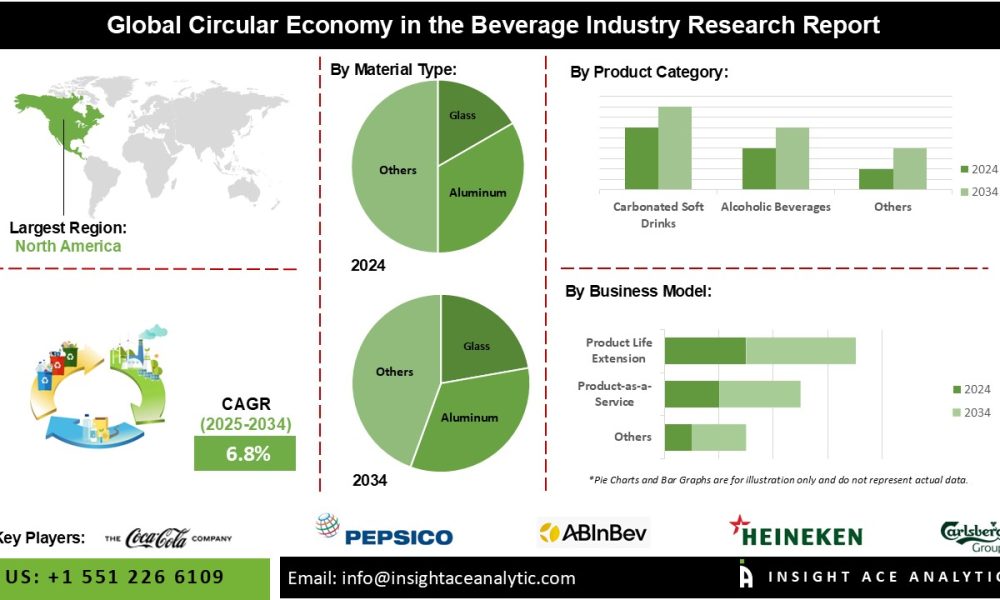
InsightAce Analytic Pvt. Ltd. announces the release of a market assessment report on the “Global Circular Economy in the Beverage Industry Size, Share & Trends Analysis Report By Material Type (Plastic (PET, rPET, biodegradable), Glass, Aluminum, Paper/Cardboard, Emerging Materials (biodegradable, edible)), Product Category (Carbonated Soft Drinks, Alcoholic Beverages, Juices and Non-Carbonated Drinks, Water, Coffee and Tea), Business Model (Product-as-a-Service, Product Life Extension, Resource Recovery and Upcycling, Sharing Models)- Market Outlook And Industry Analysis 2034″
Circular Economy in the Beverage Market Size is predicted to grow at an 6.8% CAGR during the forecast period for 2025-2034.
Check this Report Brochure : https://www.insightaceanalytic.com/request-sample/2978
The circular economy framework within the beverage sector represents a sustainable model that redefines traditional production and consumption practices by emphasizing waste reduction and resource circularity. Unlike the conventional linear model of “take-make-dispose,” the circular approach is designed to retain materials in continuous use, reduce environmental pollution, and support the regeneration of natural systems.
This model not only enhances environmental stewardship but also delivers economic benefits through increased operational efficiency and innovation. Leading soft drink manufacturers are actively adopting circular economy principles, including the use of sustainably sourced raw materials, the incorporation of recycled plastics (such as rPET), the design of refillable or fully recyclable packaging, and the conversion of production by-products into bioenergy or other value-added materials.
These initiatives collectively reduce environmental impact, lower operational costs, and align with the growing consumer demand for sustainable products. By embedding circularity into their operations, beverage companies are strengthening long-term resilience and positioning themselves for sustainable growth in a resource-conscious market landscape.
List of Prominent Players in the Circular Economy in the Beverage Industry:
- The Coca-Cola Company
- PepsiCo
- AB InBev
- Heineken
- Carlsberg
- Diageo
- Suntory Holdings
- Nestlé (Nestlé Waters)
- Keurig Dr Pepper
- Unilever
- Danone
- Asahi Group Holdings
- Loop (TerraCycle)
- Notpla
- Reborn
- Blue Ocean Closures
- Toast Ale
- Rubies in the Rubble
- In The Welsh Wind
- Mimica
Market Dynamics:
Drivers:
The transition toward a circular economy within the beverage industry is being propelled by several key factors. Foremost among these is the growing consumer demand for environmentally responsible products, which is compelling manufacturers to adopt recyclable packaging solutions and implement waste reduction strategies. Regulatory frameworks are also playing a pivotal role, with governments worldwide introducing stringent policies targeting plastic waste reduction, single-use packaging bans, and ambitious recycling mandates. These regulations are accelerating the sector’s shift toward circular practices.
In addition to compliance and market demand, circular economy models offer tangible cost-saving benefits. By promoting material reuse, minimizing waste management expenses, and improving resource efficiency, companies can achieve significant operational savings. Furthermore, increasing concerns about climate change—particularly with respect to reducing greenhouse gas emissions, water usage, and environmental pollution—are driving beverage producers to adopt sustainable sourcing methods, transition to renewable energy, and invest in eco-friendly packaging innovations.
Challenges:
Despite these positive trends, the widespread implementation of circular economy principles in the beverage industry faces several significant challenges. A major constraint is the lack of adequate recycling infrastructure in many regions, which limits the effectiveness of material recovery and reuse efforts. High upfront investments required for sustainable technologies, alternative packaging materials, and process modifications also present substantial barriers—particularly for small and medium-sized enterprises (SMEs). Moreover, the complexity of supply chains involving multiple stakeholders complicates the coordination, standardization, and scalability of circular initiatives, thereby slowing broader industry adoption.
Regional Trends:
Europe is at the forefront of circular economy practices in the beverage sector, driven by strong regulatory support, industry collaboration, and technological innovation. The region actively promotes the use of recyclable and refillable packaging, the development of bio-based materials, and the advancement of industrial symbiosis to improve resource efficiency. European Union initiatives, such as circular economy “hotspots,” facilitate collaboration among businesses, governmental bodies, and research institutions to scale up sustainable solutions and build circular value chains.
These efforts align with the EU’s broader environmental goals, including zero pollution targets and biodiversity preservation. Regulatory instruments such as the Packaging and Packaging Waste Regulation (PPWR) and the widespread implementation of Deposit Return Schemes (DRS) have led to high recycling rates and a significant reduction in single-use plastic consumption—effectively supporting closed-loop systems across the region.
Recent Developments:
- In May 2023, PepsiCo opened a €300 million plant in Poland, its greenest in Europe, powered by solar energy and circular systems. It featured water-saving technologies and converted potato peelings into biogas and fertilizer. The plant marked a major step in reducing PepsiCo’s environmental footprint and supporting sustainable farming.
- In Nov 2023, Diageo partnered with EcoSpirits to roll out circular packaging in 18 markets, using reusable EcoTotes for Gordon’s, Captain Morgan, and Smirnoff. The move reduced single-use packaging and advanced sustainable distribution in the spirits industry.
Segmentation of Trusted Platform Module Market-
By Material Type:
- Plastic (PET, rPET, biodegradable)
- Glass
- Aluminum
- Paper/Cardboard
- Emerging Materials (biodegradable, edible)
By Product Category:
- Carbonated Soft Drinks
- Alcoholic Beverages
- Juices and Non-Carbonated Drinks
- Water
- Coffee and Tea
By Business Model:
- Product-as-a-Service
- Product Life Extension
- Resource Recovery and Upcycling
- Sharing Models
By Region-
North America-
- The US
- Canada
Europe-
- Germany
- The UK
- France
- Italy
- Spain
- Rest of Europe
Asia-Pacific-
- China
- Japan
- India
- South Korea
- South East Asia
- Rest of Asia Pacific
Latin America-
- Brazil
- Argentina
- Mexico
- Rest of Latin America
Middle East & Africa-
- GCC Countries
- South Africa
- Rest of Middle East and Africa
About Us:
InsightAce Analytic is a market research and consulting firm that enables clients to make strategic decisions. Our qualitative and quantitative market intelligence solutions inform the need for market and competitive intelligence to expand businesses. We help clients gain competitive advantage by identifying untapped markets, exploring new and competing technologies, segmenting potential markets and repositioning products. Our expertise is in providing syndicated and custom market intelligence reports with an in-depth analysis with key market insights in a timely and cost-effective manner.




