
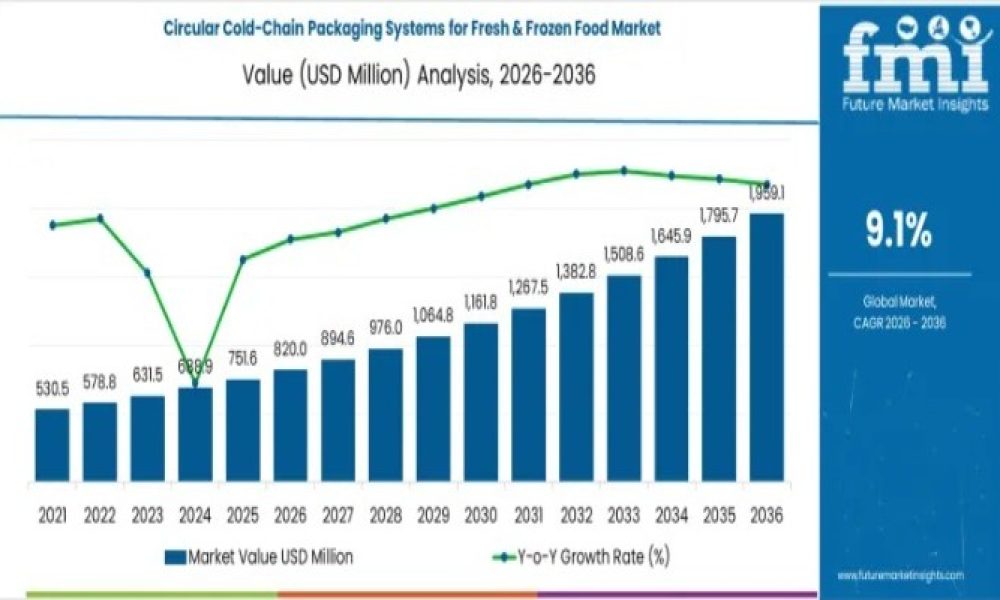
The global Circular Cold-Chain Packaging Systems for Fresh & Frozen Food Market is entering a decade of accelerated expansion as sustainability, food safety, and cold-chain efficiency converge across global food supply chains. Valued at USD 820 million in 2026, the market is projected to reach USD 1,959.1 million by 2036, advancing at a robust compound annual growth rate (CAGR) of 9.1%.
Circular cold-chain packaging systems are becoming a cornerstone of modern food logistics, enabling safe temperature-controlled transport while addressing growing concerns around food waste, single-use packaging, and environmental impact. Designed for reuse, recycling, or repurposing, these systems are rapidly replacing conventional disposable cold-chain packaging formats across fresh produce, frozen food, meat, seafood, and ready-to-eat meal distribution.
Discover Growth Opportunities in the Market – Get Your Sample Report Now
Market Overview: Sustainability Meets Cold-Chain Performance
As global consumption of fresh and frozen food continues to rise, food producers, retailers, and logistics providers are under increasing pressure to maintain product integrity while reducing carbon footprints. Circular cold-chain packaging systems deliver on both fronts—preserving temperature stability and extending shelf life while supporting circular economy goals.
Advancements in insulation materials, reusable container design, and reverse logistics infrastructure are accelerating adoption. At the same time, regulatory initiatives targeting packaging waste—particularly in North America, Europe, and Asia-Pacific—are prompting brands to transition toward reusable and recyclable cold-chain solutions.
Quick Stats: Circular Cold-Chain Packaging Systems Market
- Market Value (2026): USD 820 million
- Forecast Value (2036): USD 1,959.1 million
- Global CAGR (2026–2036): 9.1%
- Leading Material Segment: EPP, HDPE & insulation foams (50% share)
- Dominant Packaging Format: Reusable insulated boxes & totes (45% share)
- High-Growth Region: China
- Key Players: IFCO, Schoeller Allibert, SF Express Packaging, ColdStar Packaging, Cryopak, ORBIS, Euro Pool System
Growth Trajectory: From Steady Adoption to Rapid Acceleration
The market’s inflection-point analysis shows a clear shift from early-stage adoption to rapid scaling. Between 2026 and 2028, the market grows steadily as sustainability-led pilot programs expand across retail and foodservice supply chains. By 2030, market value surpasses USD 1.16 billion, supported by stronger regulatory enforcement and technological maturation.
From 2031 to 2036, accelerated adoption is expected as circular packaging systems become embedded within cold-chain logistics infrastructure, supported by improved reverse logistics, digital tracking, and shared pooling models. By 2036, the market is forecast to reach USD 1.96 billion, marking a decisive shift toward circular cold-chain operations globally.
What’s Driving Market Demand?
Key demand drivers shaping the market include:
- Rising global demand for fresh and frozen foods, driven by urbanization and changing consumption patterns
- Strong sustainability mandates from governments and corporate ESG commitments
- Growing pressure to reduce food waste across retail and distribution networks
- Expansion of e-commerce grocery, meal kits, and direct-to-consumer food delivery
- Advances in insulation materials and temperature-control technologies
Circular systems significantly lower total cost of ownership by reducing reliance on single-use packaging and minimizing spoilage losses across repeated use cycles.
Segment Insights: Reusability and Materials Take Center Stage
Reusable insulated boxes and totes dominate the market, accounting for 45% of total demand. These formats offer reliable thermal performance, durability, and cost efficiency, making them ideal for high-volume food distribution and return-based logistics models.
On the materials front, EPP, HDPE, and advanced insulation foams collectively represent 50% of the market. Their lightweight structure, thermal efficiency, impact resistance, and recyclability make them central to circular cold-chain packaging design.
Regional Outlook: Asia-Pacific Leads the Growth Curve
China and India are emerging as the fastest-growing markets, fueled by rapid expansion of cold-chain infrastructure, e-commerce grocery platforms, and government-backed sustainability initiatives.
Country-wise CAGR (2026–2036):
- India: 12%
- China: 10.5%
- USA: 8%
- Brazil: 8%
- Germany: 7.2%
Developed markets such as the USA and Germany continue to adopt circular systems to meet regulatory compliance and consumer expectations, while emerging economies focus on scaling cold-chain capacity sustainably.
Competitive Landscape: Innovation and Circular Scale Define Leadership
The competitive landscape is marked by innovation, pooling networks, and integrated service models. IFCO leads the market with its globally scaled reusable packaging pools, while Schoeller Allibert and Euro Pool System focus on standardized returnable container systems.
Other notable players including Cryopak, ORBIS, SF Express Packaging, and ColdStar Packaging are investing in advanced insulation technologies, temperature monitoring, and tailored solutions for food and pharmaceutical cold chains.
Why FMI: https://www.futuremarketinsights.com/why-fmi
About Future Market Insights (FMI)
Future Market Insights, Inc. (FMI) is an ESOMAR-certified, ISO 9001:2015 market research and consulting organization, trusted by Fortune 500 clients and global enterprises. With operations in the U.S., UK, India, and Dubai, FMI provides data-backed insights and strategic intelligence across 30+ industries and 1200 markets worldwide.



