
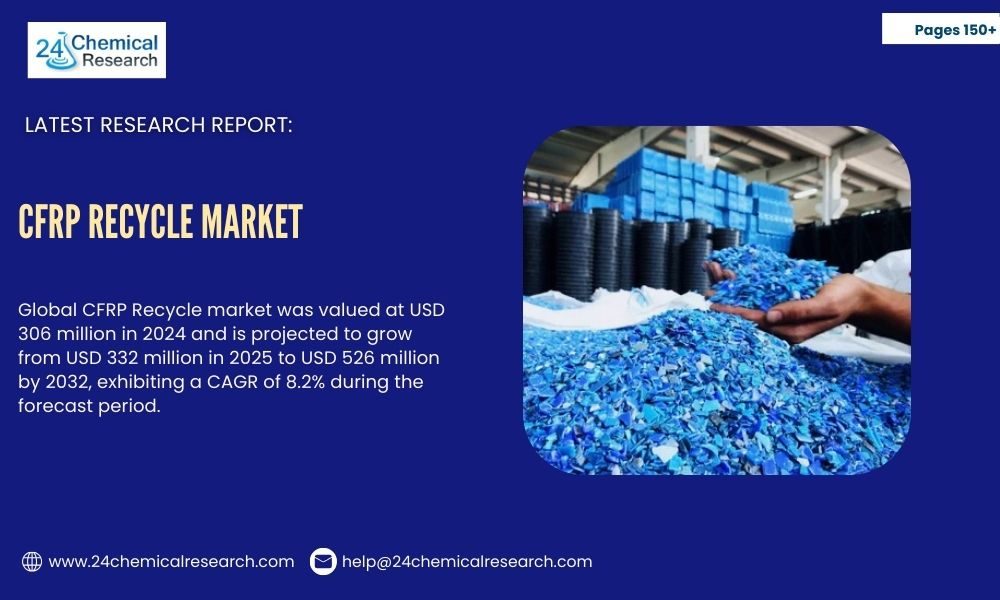
Global CFRP Recycle market was valued at USD 306 million in 2024 and is projected to grow from USD 332 million in 2025 to USD 526 million by 2032, exhibiting a CAGR of 8.2% during the forecast period.
CFRP (Carbon Fiber Reinforced Polymer) recycling involves reprocessing end-of-life composite materials, including production scrap, out-of-date prepreg, and discarded components, to recover valuable carbon fibers. These recycled fibers retain up to 90% of their original strength, making them highly suitable for secondary applications in industries like automotive, aerospace, and wind energy. The recycling process primarily includes mechanical (grinding, shredding) and thermal (pyrolysis, fluidized bed) methods.
Download FREE Sample of this Report @ https://www.24chemicalresearch.com/download-sample/297527/global-cfrp-recycle-forecast-market-2025-2032-684
Key Drivers & Market Dynamics
These are the forces shaping growth (both positive and limiting) in the CFRP recycling market.
Sustainability Regulations and Circular Economy Pressure
- Environmental policies are pushing industries to adopt more lifecycle‐aware material use. For example, legislative mandates in Europe increasingly require high recycling rates or recycled content in composites.
- OEMs (aerospace, automotive) are under pressure from regulators and consumers to reduce carbon footprints; CFRP recycling helps reduce upstream emissions since virgin carbon fiber production is energy‑intensive.
- Circular economy initiatives and extended producer responsibility schemes are encouraging investments in recycling infrastructure.
Cost Advantages vs. Virgin Material
- Virgin carbon fiber production involves high energy consumption (often in the range of hundreds of kWh per kilogram) and high cost. Recycled fibers can retain up to ~90% of original strength in many processes, while costing significantly less.
- The cost delta makes recycled CFRP appealing especially in non‐critical or secondary applications (interior parts, trim, non‑load bearing structures). Savings of 30‑40% over virgin carbon fiber in some uses are cited in various studies.
Technological Innovation in Recycling Methods
- Mechanical recycling (grinding, shredding) remains widely used because of lower cost and simpler infrastructure.
- Thermal methods (pyrolysis, fluidized bed) and chemical methods (solvolysis, depolymerization) are improving: higher recovery rates, better preservation of fiber strength, better removal of resin or matrix material.
- New pilot and semi‑industrial plants are being launched that aim for “near‑virgin quality” fibers.
Demand from Lightweighting & Secondary Applications
- Lightweight materials are hugely important in automotive (especially electric vehicles), aerospace, wind energy, etc. Reducing vehicle weight improves range; in aviation every kg saved helps.
- Secondary, non‑structural components are more tolerant of slight reductions in mechanical properties, opening up large volume opportunities for recycled CFRP.
Recent Developments & Innovation Highlights
Here are some examples of what has recently happened in the field, demonstrating both progress and challenges.
- Pyrum Innovations AG in Germany has commissioned a semi‑industrial plant for holistic recycling of CFRP, using their pyrolysis technology. The pilot plant handles ~1 kg of CFRP per hour, generating recovered fibers and pyrolysis oil. This is seen as a foundation toward larger industrial capacity. The investment is modest at this scale (approx. €170,000) with government grants supporting much of it. This marks one of the earlier steps toward full‐scale holistic recycling of CFRP. The plant is part of a project known as “Infinity”, under the leadership of a research institute. Mechanical property retention and CO₂ savings are important parts of Pyrum’s claim.
- Several reports point to expansion efforts by major players to increase recycled CFRP processing capacity. For example, some companies in Europe (particularly U.K., Germany) are increasing their thermal / mechanical recycling throughput.
- In terms of technology, progress in chemical processes (solvolysis / depolymerization) is being made, especially for removing resin matrices and restoring fiber integrity. There are pilot‐scale and lab‐scale demonstrations of fiber recovery with high tensile strength retention.
Regional Trends
- Europe continues to lead both in regulatory push and collection & recycling capacity. Many of the best developed recycling facilities, technological innovations, and corporate/collaborative initiatives are in EU countries.
- North America has a strong aerospace and automotive base, which drives demand for recycled composites. However, regulatory fragmentation and cost issues remain.
- Asia‑Pacific is emerging fast, especially in Japan, China, Korea. The automotive and EV industries in these countries are pushing demand for lightweighting, and recycled carbon fiber is increasingly considered. However, infrastructure (collection, sorting, standardized processes) is less mature in many parts.
- Other Regions (South America, Middle East, Africa) are still in earlier stages. Regulatory frameworks are weaker, investments are more limited, and collection/disposal practices (often landfill or incineration) dominate. But interest is growing, especially where composite use is increasing (e.g. in wind energy blades, aerospace parts).
Challenges & Restraints
Even with strong drivers, several important obstacles are slowing full market realization.
Material Performance Degradation
- While many recycled fibers retain high percentages of original strength (some‐‐especially mechanical or thermal methods—report up to ~90% in favorable cases), there remain losses in other properties: interlaminar shear strength, fatigue life, resistance to environmental or thermal stress are often degraded. This limits use in primary structures, safety‑critical applications, and high‐load bearing parts.
Costs, Energy & Efficiency
- Thermal and chemical recycling methods often require high temperatures (e.g., pyrolysis exceeding 500°C), long batch times, specialized equipment, and energy inputs. These factors raise both operating expenditure (OPEX) and capital expenditure (CAPEX).
- The cost of processing per kilogram for high quality recycled CFRP remains high, especially after factoring in pretreatment, resin removal, fiber purification.
- Lower process efficiencies, yield losses, and increased energy consumption for certain methods remain problematic.
Supply & Logistics Issues
- Collection, sorting, cleaning, and transporting CFRP scrap are nontrivial. Variability in feedstock quality (type of composite, matrix material, contamination) is a major issue.
- Geographic mismatches: sometimes large amounts of composite waste are produced far from advanced recycling facilities, increasing transport costs and emissions.
- Lack of standardization in composite waste forms, classification, regulation, and certification makes scaling hard.
Regulatory & Certification Barriers
- In many sectors (aerospace, automotive safety zones), recycled CFRP must meet strict certifications and quality standards. Inconsistent or differing standards across countries or regions increase complexity.
- Traceability of recycled content, verification of material properties, auditing, and compliance add overhead costs.
Opportunities & Future Outlook
Despite the challenges, there are multiple promising paths for growth, technological improvement, and market expansion.
Advanced Recycling Technologies
- Techniques such as improved solvolysis, catalytic depolymerization, microwave‑assisted pyrolysis, and supercritical fluid extraction are under development or pilot use. These promise better resin removal, higher recovery rates, and lower energy use.
- Research into fiber treatment and fiber reconditioning (surface treatment, sizing) to restore or improve fiber bonding with matrices will help use in higher value applications.
Design for Recycling & Material Passports
- More products being designed with end‑of‑life in mind: composites that are easier to disassemble, have known resin types, use matrices designed to decompose or be removed more easily.
- Material passports (digital tracking of materials, composition, origin) and blockchain‐based traceability systems can help assure buyers about recycled content, material properties, and compliance. Such systems also help in procurement decisions where sustainable content is valued.
Expansion in Emerging Markets & Secondary Use Applications
- As automotive and EV production grow in Asia, demand for lightweight materials is high; recycled CFRP can be deployed in non‑critical components.
- In construction, wind energy, sporting goods, consumer products, interior components, secondary structural parts—these sectors are more tolerant of slightly lower properties and can leverage cost benefits.
Policy Incentives & Regulations
- Subsidies, tax breaks, or grants for recycling infrastructure can help reduce CAPEX barriers.
- Regulations mandating recycled content, or composite waste recycling targets (e.g. in procurement requirements, or net zero/ESG regulation) can drive demand.
- Harmonizing standards across regions can reduce trade friction and scale costs.
Adjusting Projections Based on Recent Data
Given the more recent market reports (e.g. the report estimating USD 333–644 million market in 2025‑2033), the USD 526 million forecast for 2032 seems plausible but could be conservative under favorable conditions (fast technology adoption, strong regulation, feedstock supply improvement). If new facilities scale up, if cost reductions are realized earlier, then CAGR could be toward 9‑12% in some regions, pushing global market sizes higher.
Conclusion
The global CFRP recycle market is on a trajectory of steady growth, supported by regulatory pressures, sustainability goals, cost benefits relative to virgin carbon fiber, and technological advances. However, performance limitations, high energy and capital needs, and supply chain/logistical challenges remain significant obstacles.
If these can be addressed—through innovation, policy, and infrastructure the market could exceed many current forecasts, especially in high growth regions and secondary applications. Areas like Asia‑Pacific and emerging markets, along with non‑structural and lighter weight components, are likely to present the greatest near‑term opportunity.
Get Full Report Here: https://www.24chemicalresearch.com/reports/297527/global-cfrp-recycle-forecast-market-2025-2032-684
FAQs — Frequently Asked Questions
Here are five commonly asked questions about the CFRP recycling market, with up‑to‑date, data‑backed answers.
Q1. What is the current market size and how fast is the CFRP recycle market growing?
A1. The global CFRP recycling market was valued at about USD 306 million in 2024. It is projected to grow to around USD 526 million by 2032, implying a CAGR of ~8.2% over the period. Some newer studies suggest slightly higher growth (in the range of 7.5%–10%) depending on region and applications.
Q2. Which regions are leading CFRP recycling, and where is growth expected to be strongest?
A2. Europe currently leads, accounting for a large share of global recycling due to strong regulations, established infrastructure, and corporate sustainability mandates. North America also has strong adoption, especially with aerospace and automotive collaborations. Asia‑Pacific is emerging fast, with Japan, China, Korea showing rising capacity and demand. Regions like South America, Middle East & Africa are nascent but present significant upside.
Q3. What are the barriers preventing recycled CFRP from being used in high‑value applications such as structural aerospace parts?
A4. Key issues include: reduced mechanical properties (e.g. interlaminar shear strength, fatigue life, sometimes tensile strength), variable fiber length or fiber surface condition, lack of consistent quality / traceability, regulatory or certification requirements, and conservative design norms in aerospace. Further, costs for high‐quality recycled material are still high compared to virgin carbon fiber, especially where safety margins are tight.
International: +1(332) 2424 294 | Asia: +91 9169162030
Website: https://www.24chemicalresearch.com/




