
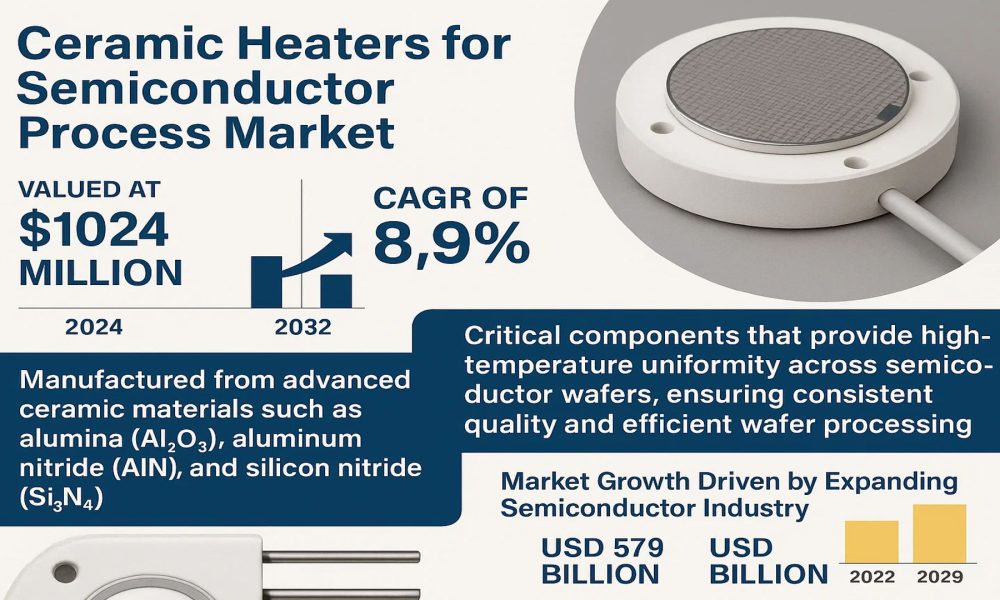
Ceramic Heaters for Semiconductor Process Market was valued at 1024 million in 2024 and is projected to reach US$ 1829 million by 2032, at a CAGR of 8.9% during the forecast period.
Ceramic heaters for semiconductor processes are critical components that provide high-temperature uniformity across semiconductor wafers, ensuring consistent quality and efficient wafer processing. These heaters are manufactured from advanced ceramic materials such as alumina (Al2O3), aluminum nitride (AlN), and silicon nitride (Si3N4), which offer excellent thermal conductivity, durability, and resistance to chemical corrosion.
The market growth is driven by the expanding semiconductor industry, which was valued at USD 579 billion in 2022 and is expected to reach USD 790 billion by 2029. While segments like analog ICs and sensors are growing at double-digit rates, the demand for ceramic heaters remains robust due to their critical role in plasma processing, thermal treatment, and wet chemical processes. Leading manufacturers such as Sumitomo Electric, NGK Insulators, and CoorsTek are investing in R&D to enhance heater efficiency, further propelling market expansion.
Claim Your Free Sample Report-https://semiconductorinsight.com/download-sample-report/?product_id=107144
MARKET DYNAMICS
MARKET DRIVERS
Rising Demand for Advanced Semiconductor Fabrication to Propel Market Growth
The global semiconductor industry’s rapid expansion, projected to reach $790 billion by 2029, is driving unprecedented demand for precision heating solutions in chip manufacturing. Ceramic heaters have become indispensable in semiconductor processes due to their superior thermal uniformity – maintaining temperature variations within ±1°C across 300mm wafers. This level of precision is critical for advanced nodes below 10nm where even minor temperature fluctuations can affect yield rates exceeding 95% in leading fabs. Semiconductor manufacturers are increasingly adopting aluminum nitride (AlN) heaters, which demonstrate 20-30% better thermal conductivity than traditional alumina models, significantly improving process efficiency.
Expansion of 5G and Automotive Semiconductor Production Accelerates Adoption
The proliferation of 5G infrastructure and electric vehicles is creating substantial demand for specialized semiconductors that require precise thermal processing. RF components for 5G base stations and power devices for automotive applications particularly benefit from ceramic heaters’ ability to maintain stable high-temperature environments up to 800°C. With the automotive semiconductor market growing at nearly 15% annually, manufacturers are investing heavily in thermal treatment systems featuring silicon nitride (Si3N4) heaters known for their exceptional thermal shock resistance. Recent industry data shows that over 40% of new semiconductor equipment purchases now incorporate advanced ceramic heating elements to meet these specialized requirements.
Miniaturization Trend in Chip Design Necessitates Higher Precision Heating Solutions
As semiconductor geometries shrink below 7nm, the industry faces mounting challenges in maintaining process consistency. Ceramic heaters address this through their ability to deliver rapid thermal response times under 5 seconds while minimizing thermal gradients. This capability has become particularly valuable in atomic layer deposition (ALD) and plasma-enhanced chemical vapor deposition (PECVD) processes, where temperature uniformity directly impacts film quality. Leading foundries report that upgrading to advanced ceramic heating systems has reduced wafer reject rates by 12-18% in critical front-end processes, justifying the higher initial investment.
➤ For instance, major semiconductor equipment providers have recently introduced ceramic heater models with integrated temperature sensors that achieve real-time temperature control within ±0.5°C, significantly improving yield rates in advanced packaging applications.
Recent Developments in the Market: Ceramic Heaters for Semiconductor Process Market
- Rising Demand in Advanced Semiconductor Manufacturing:
The adoption of ceramic heaters in processes such as chemical vapor deposition (CVD), atomic layer deposition (ALD), and wafer processing is increasing due to their excellent thermal stability and uniform heating properties. Leading semiconductor manufacturers are integrating high-precision ceramic heaters to enhance process efficiency and reduce defects. - Focus on Energy-Efficient Solutions:
Companies are developing energy-efficient ceramic heaters that consume less power while maintaining uniform temperature distribution. This trend aligns with semiconductor fabs’ focus on sustainability and operational cost reduction. - Expansion in Asia-Pacific:
The Asia-Pacific region, particularly China, South Korea, and Taiwan, is witnessing high growth due to the rapid expansion of semiconductor fabs. Local manufacturers are investing heavily in production capabilities to meet regional demand. - Technological Advancements:
Recent innovations include ceramic heaters with multi-zone heating control, faster thermal response, and improved durability for high-temperature applications. These advancements enhance process precision in semiconductor fabrication. - Strategic Collaborations & Partnerships:
Several key players are entering partnerships with semiconductor equipment manufacturers to co-develop customized ceramic heater solutions. This trend helps in integrating heaters directly into advanced processing tools for better performance. - Market Consolidation:
The market is seeing consolidation as major players acquire smaller specialized heater manufacturers to expand product portfolios and enhance technological capabilities. - Shift Towards Miniaturized and Compact Heaters:
With semiconductor devices becoming smaller and more complex, there is an increasing need for compact ceramic heaters that can provide precise heating in limited spaces within processing equipment.
MARKET OPPORTUNITIES
Emerging Applications in Advanced Packaging Present Growth Potential
The rapid growth of heterogeneous integration and 3D packaging technologies is creating new opportunities for ceramic heater applications. Fan-out wafer-level packaging (FOWLP) and through-silicon via (TSV) processes increasingly require specialized heating solutions capable of maintaining precise thermal profiles across stacked die configurations. Early adopters report that ceramic heaters specifically designed for packaging applications have improved warpage control by 30-40% compared to conventional systems, addressing one of the most critical challenges in advanced packaging.
Development of Next-Generation Composite Materials Opens New Possibilities
Material science breakthroughs in ceramic composites are enabling a new generation of heaters with enhanced performance characteristics. Recent developments in graphene-enhanced ceramics demonstrate 40% higher thermal conductivity than pure aluminum nitride while maintaining excellent electrical insulation properties. These innovations could potentially overcome current limitations in high-power applications and extend the operational temperature range beyond 1000°C, unlocking new semiconductor process capabilities. Early prototypes have shown particular promise in gallium nitride (GaN) and silicon carbide (SiC) device fabrication where conventional heating solutions struggle with temperature stability.
Strategic Collaborations Between Equipment and Materials Providers Accelerate Innovation
The industry is witnessing increasing collaboration between semiconductor equipment manufacturers and advanced ceramics suppliers to develop application-specific heating solutions. These partnerships are yielding integrated systems that optimize both heater design and process parameters for specific fabrication steps. Leading market players have reported that such cooperative developments have reduced time-to-market for new heater solutions by approximately 30% while improving performance consistency across different tool platforms.
List of Key Ceramic Heater Companies Profiled
- Sumitomo Electric Industries, Ltd. (Japan)
- NGK Insulators, Ltd. (Japan)
- Mico Ceramics GmbH (Germany)
- BACH Resistor Ceramics GmbH (Germany)
- BOBOO Hitech Co., Ltd. (China)
- Semixicon LLC (U.S.)
- CoorsTek, Inc. (U.S.)
- Oasis Materials, Inc. (U.S.)
- Cactus Materials, Inc. (U.S.)
Claim Your Free Sample Report-https://semiconductorinsight.com/download-sample-report/?product_id=107144
Segment Analysis:
By Type
Alumina (Al2O3) Dominates the Market Due to its Superior Thermal Conductivity and Cost-Effectiveness
The market is segmented based on type into:
- Alumina (Al2O3)
- Aluminum Nitride (AlN)
- Silicon Nitride (Si3N4)
- Others
By Application
Plasma Process Segment Leads Due to High Adoption in Semiconductor Fabrication
The market is segmented based on application into:
- Plasma Process
- Thermal Treatment
- Wet Chemical Process
By Wafer Size
300mm Wafer Segment Accounts for Major Share Due to Higher Productivity in Semiconductor Manufacturing
The market is segmented based on wafer size into:
- 200mm
- 300mm
- Others
By Heating Element Configuration
Multi-Zone Heating Configurations Gain Traction for Precise Temperature Control
The market is segmented based on heating element configuration into:
- Single-Zone
- Multi-Zone
- Custom Configurations
Other Topic-Engine Knock Sensors Market
CONTACT US:
City vista, 203A, Fountain Road, Ashoka Nagar, Kharadi, Pune, Maharashtra 411014
[+91 8087992013]




