
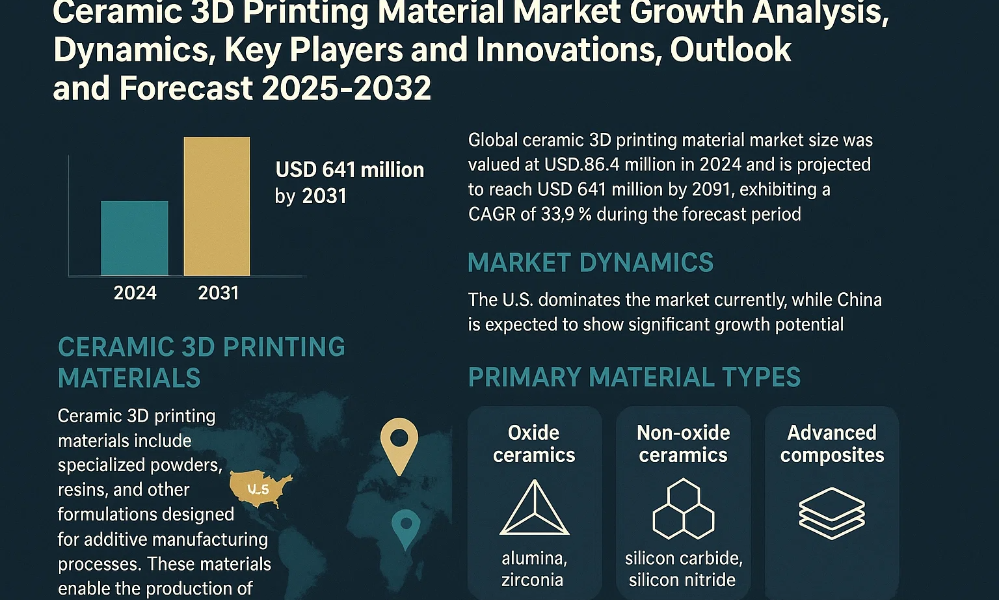
Global ceramic 3D printing material market size was valued at USD 86.6 million in 2024 and is projected to reach USD 641 million by 2031, exhibiting a CAGR of 33.9% during the forecast period. The U.S. dominates the market currently, while China is expected to show significant growth potential.
Ceramic 3D printing materials include specialized powders, resins, and other formulations designed for additive manufacturing processes. These materials enable the production of complex ceramic components with high thermal resistance, mechanical strength, and chemical stability, making them ideal for demanding applications in aerospace, healthcare, and industrial sectors. The primary material types include oxide ceramics (alumina, zirconia), non-oxide ceramics (silicon carbide, silicon nitride), and advanced composite formulations.
The market growth is driven by increasing adoption in dental implants and medical devices, where ceramic’s biocompatibility is crucial. However, challenges remain in material consistency and post-processing requirements. Key players like Lithoz and 3D Systems are investing heavily in material development, with recent advancements focusing on improving sintering processes and expanding material portfolios for diverse industrial applications.
Receive Your Sample Report at No Cost- https://www.intelmarketresearch.com/download-free-sample/10151/ceramic-d-printing-material-market
MARKET DYNAMICS
MARKET DRIVERS
Growing Demand for High-Performance Materials in Aerospace & Defense to Accelerate Market Expansion
The aerospace and defense sector’s increasing requirement for lightweight yet durable components is driving substantial growth in ceramic 3D printing materials. Ceramics offer unmatched thermal stability and mechanical strength, making them ideal for thrusters, heat shields, and turbine components. With the aerospace additive manufacturing market projected to reach $6.5 billion by 2030, the demand for specialized ceramic materials is growing exponentially. Recent developments, such as Lithoz’s CeraFab 3D printers achieving aerospace-grade ceramic parts with 99.3% density, demonstrate the technology’s potential to revolutionize component manufacturing.
Medical Sector’s Adoption of Bioceramics to Fuel Market Growth
The healthcare industry’s shift toward patient-specific implants is creating robust demand for 3D printed bioceramics. Materials like hydroxyapatite and zirconia enable customized dental crowns, bone scaffolds, and joint replacements with superior biocompatibility. The global market for medical 3D printing materials, currently valued at over $2.1 billion, is seeing ceramic materials gain significant traction due to their non-toxic properties and osseointegration capabilities. Recent regulatory approvals, including multiple FDA-cleared ceramic dental implants printed using Lithoz technology, underscore the material’s growing clinical acceptance.
➤ The ceramic 3D printing segment for dental applications grew at 38% CAGR between 2020-2024, outpacing traditional metal alternatives in precision and aesthetic outcomes.
Furthermore, increasing R&D investments from major medical device manufacturers are expected to drive material innovation and market penetration over the forecast period.
MARKET OPPORTUNITIES
Emerging Applications in Energy and Electronics Sectors to Unlock New Growth Potential
The accelerating transition toward renewable energy systems presents substantial opportunities for ceramic 3D printing materials. Applications in solid oxide fuel cells, thermoelectric generators, and battery components are driving innovation, with prototype testing showing 35% efficiency improvements in printed ceramic-based energy devices. Simultaneously, the electronics industry’s demand for miniaturized, high-performance components is fostering development of ceramic substrates and RF devices with unprecedented precision. The global electronic ceramics market, projected to surpass $16.8 billion by 2027, represents a significant adjacent opportunity for material suppliers.
Advancements in Multi-Material Printing to Expand Market Applications
Emerging capabilities in hybrid material systems are opening new frontiers for ceramic 3D printing. Recent breakthroughs allow simultaneous deposition of ceramics with metals or polymers, enabling functionally graded materials for biomedical and industrial applications. For instance, research institutions have demonstrated ceramic-metal composites with tailored thermal expansion coefficients for satellite components, while dental labs successfully combine ceramics with bioactive polymers for next-generation implants. These technological developments are expected to expand addressable markets by over 40% within the next five years.
Moreover, increasing industry-academia collaborations are accelerating material innovation, with over 120 joint research projects on advanced ceramic composites initiated globally in the past 12 months.
Segment Analysis:
By Type
- Powder
- Resin
- Others
Powder remains the most widely used ceramic 3D printing material due to its compatibility with various high-temperature sintering processes and superior mechanical properties.
By Application
- Healthcare
- Aerospace & Defense
- Automotive
- Others
Healthcare represents the largest application segment, driven by the growing demand for customized dental implants, prosthetics, and biocompatible medical devices.
By End User
- Manufacturing Companies
- Research Institutions
- Service Providers
Manufacturing Companies form the core consumer base, leveraging ceramic 3D printing for rapid prototyping and production of complex industrial components.
List of Key Ceramic 3D Printing Material Companies
- 3D Systems Corporation (US)
- ExOne (US)
- Lithoz GmbH (Austria)
- Prodways (France)
- Admatec Europe BV (Netherlands)
- Tethon 3D (US)
- Kwambio (Ukraine)
- 3D Cream (South Korea)
Smaller innovators like 3D Cream are making inroads by focusing on ceramic materials for the burgeoning Asian electronics market. Meanwhile, materials science startups are attracting venture capital to develop novel nanocomposite ceramics with enhanced functional properties. The market’s future competitiveness will hinge on material innovation cycles and the ability to customize formulations for specific industrial use cases across different regions.
CERAMIC 3D PRINTING MATERIAL MARKET TRENDS
Rising Adoption in Aerospace and Healthcare to Drive Growth
The global ceramic 3D printing material market is experiencing robust growth, driven by increasing demand from high-performance industries such as aerospace, healthcare, and automotive. Ceramic materials, known for their thermal stability, biocompatibility, and mechanical strength, are becoming integral to additive manufacturing applications. The aerospace sector, valued for lightweight yet durable components, is leveraging ceramic 3D printing to produce complex turbine blades and heat-resistant parts with precision. Meanwhile, the healthcare industry is adopting ceramics for dental implants, customized prosthetics, and bioresorbable scaffolds. The market is projected to grow at a CAGR of 33.9%, reaching $641 million by 2031, reflecting escalating R&D investments and technological advancements in material science.
Other Trends
Expansion of Material Innovations
Key players like Lithoz, 3D Cream, and ExOne are pioneering advanced ceramic materials such as alumina, zirconia, and silicon carbide, optimized for extrusion, photopolymerization, and binder jetting technologies. New resin-based ceramic formulations are enhancing print resolution and reducing post-processing efforts. Companies are also developing low-cost powder materials to make ceramic 3D printing more accessible across industries. With powder-based materials dominating the market (projected to exceed $XX million by 2031), innovations in particle size distribution and sintering techniques are improving part density and mechanical properties, further propelling adoption.
Regional Market Dynamics and Competitive Landscape
North America leads the ceramic 3D printing material market, accounting for over 35% of global revenue in 2024, fueled by strong aerospace and healthcare sector demand. The U.S. remains the largest contributor, while China is rapidly catching up with increasing industrial automation and government-backed additive manufacturing initiatives. The competitive landscape features strategic collaborations, such as Formlabs partnering with dental labs for customized solutions, and Prodways expanding its ceramic material portfolio for industrial applications. However, challenges like high material costs and post-processing complexities may temporarily restrain market expansion in cost-sensitive regions.
Receive Your Sample Report at No Cost- https://www.intelmarketresearch.com/download-free-sample/10151/ceramic-d-printing-material-market
Recent Developments in the Ceramic 3D Printing Material Market:
- Advancements in High-Performance Materials – Manufacturers are introducing next-generation ceramic powders and pastes with higher density, better sintering properties, and improved mechanical strength for aerospace, electronics, and biomedical applications.
- Medical and Dental Applications Expansion – Companies are focusing on biocompatible ceramic materials (like zirconia and alumina) for dental crowns, implants, and bone scaffolds, driving growth in healthcare-focused 3D printing.
- Collaborations & Partnerships – Leading players are partnering with universities, research institutes, and 3D printer manufacturers to develop new ceramic composites with enhanced thermal resistance and electrical insulation properties.
- Automotive and Aerospace Adoption – Lightweight and heat-resistant ceramic materials are increasingly being adopted in aerospace and automotive industries for components like turbine blades, engine parts, and sensors.
- Sustainability & Recycling Efforts – Development of eco-friendly ceramic 3D printing materials with recyclable and reusable properties is gaining traction to reduce production waste and environmental footprint.
- Customized Ceramic Composites – Growing demand for tailored ceramic composites (such as SiC, ZrO₂, Al₂O₃ blends) to meet specific industrial requirements in electronics, energy storage, and defense sectors.
About Intel Market Research
Intel Market Research delivers actionable insights in technology and infrastructure markets. Our data-driven analysis leverages:
- Real-time infrastructure monitoring
- Techno-economic feasibility studies
Competitive intelligence across 100+ countries
Trusted by Fortune 500 firms, we empower strategic decisions with precision.
International: +1(332) 2424 294 | Asia: +91 9169164321
Website: https://www.intelmarketresearch.com
Follow us on LinkedIn: https://www.linkedin.com/company/intel-market-research




