
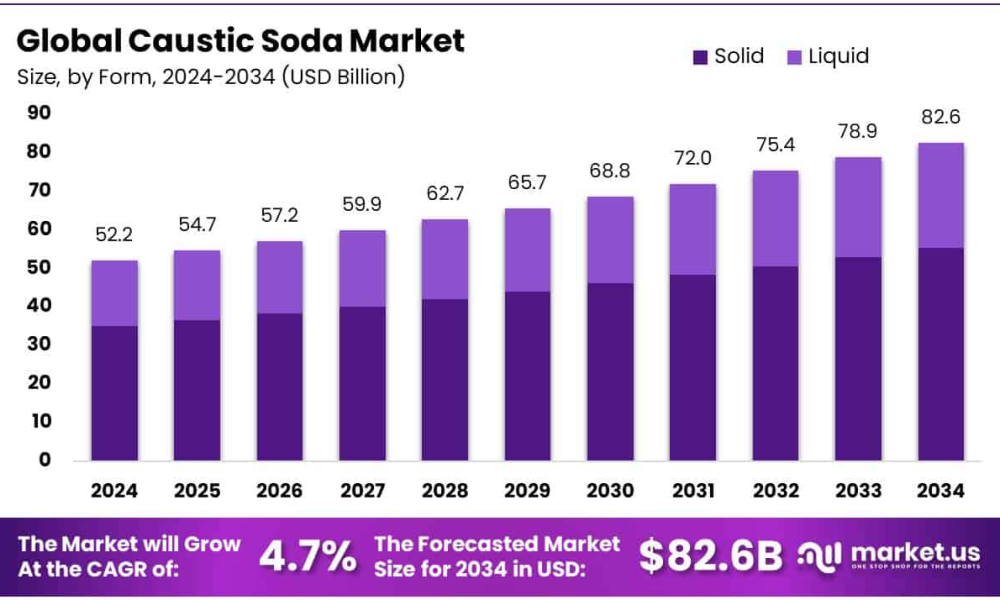
New York, NY – June 30, 2025 – The Global Caustic Soda Market is set for steady growth, with its size projected to rise from USD 52.2 billion in 2024 to approximately USD 82.6 billion by 2034, expanding at a compound annual growth rate (CAGR) of 4.7% from 2025 to 2034. The cement industry, responsible for approximately 7% of global CO₂ emissions, contributes significantly to the construction sector’s 9.95 Gt/year emissions as of 2019, making it the largest sectoral emitter.
To meet a 16% emissions reduction target by 2030 and achieve net zero by 2050, the industry is increasingly adopting carbon capture technologies. This shift is driving substantial demand for caustic soda, a vital chemical in CO₂ absorption and neutralization processes. Carbon dioxide (CO₂), accounting for about 55% of global warming, has increased in atmospheric concentration by 3% since 1950, per global climate reports. The urgent need to address this rise is accelerating the deployment of carbon capture technologies, further boosting the demand for caustic soda as a critical component in CO₂ capture and conversion processes.
UNICEF reports that approximately 4 billion people, nearly two-thirds of the global population, face severe water scarcity for at least one month each year, with over 2 billion residing in regions with an insufficient water supply. By 2040, projections indicate that one in four children will live in areas of extreme water stress, increasing the demand for caustic soda-powered emergency water purification systems to address critical water access challenges.
China’s former State Environmental Protection Administration documented over 6,600 water pollution incidents from 2000 to 2008, including significant events like the 2005 Songhua River nitrobenzene spill and the 2007 Wuxi Water Crisis. These incidents underscore the critical need for rapid and effective water purification solutions, such as caustic soda-powered emergency systems, to mitigate pollution and ensure safe water access.
Important Revelation
- The global caustic soda market was valued at USD 52.2 billion in 2024.
- The global caustic soda market is projected to grow at a CAGR of 4.7 % and is estimated to reach USD 82.6 billion by 2034.
- Among forms, solid accounted for the largest market share of 67.1%.
- Among purity, 70 to 90% accounted for the majority of the market share at 36.2%.
- By production method, membrane cells accounted for the largest market share of 57.1%.
- By application, organic chemicals accounted for the majority of the market share at 39.1%.
- Asia Pacific is estimated as the largest market for caustic soda with a share of 48.5% of the market share.
➤ Download Exclusive Sample Of This Premium Report (Including Full TOC, Table & Figures): https://market.us/report/global-caustic-soda-market/request-sample/
Report Segmentation
Form Analysis
- The caustic soda market is segmented by form into solid and liquid. In 2024, the solid segment accounted for a dominant 67.1% revenue share, driven by its ease of handling, extended shelf life, and broad applicability in industries like chemicals, textiles, and paper production. Its stability during storage and transportation, combined with cost-effectiveness and versatility in manufacturing, solidifies its preference for large-scale industrial use.
Purity Analysis
- The market is categorized by purity into up to 50%, 50–70%, 70–90%, and above 90%. In 2024, the 70–90% segment led with a 36.2% market share, owing to its widespread use in chemical manufacturing, water treatment, and paper production. This purity range strikes an optimal balance between performance and cost, making it ideal for diverse industrial applications and contributing to its market dominance.
Production Method Analysis
- By production method, the market is divided into mercury cells, membrane cells, and diaphragm cells. In 2024, membrane cells captured a leading 57.1% market share due to their superior energy efficiency and lower environmental impact. This method produces high-purity caustic soda with minimal emissions, aligning with stringent environmental regulations and meeting the precise quality needs of industries, reinforcing its market leadership.
Application Analysis
- The market is segmented by application into organic chemicals, inorganic chemicals, alumina, paper & pulp, soaps & detergents, textiles, water treatment, pharmaceuticals, and others. In 2024, organic chemicals held a commanding 39.1% market share, driven by caustic soda’s critical role in producing sodium derivatives, solvents, and plastics. Its extensive use in petrochemicals and agriculture for processes like neutralization, saponification, and chemical synthesis underscores its versatility and importance in organic chemical manufacturing.
Market Key Segmentation
By Form
- Solid
- Liquid
By Purity
- Upto 50%
- 50 to 70%
- 70 to 90%
- Above 90%
By Production Method
- Mercury Cell
- Membrane Cell
- Diaphragm Cell
By Application
- Organic Chemicals
- Inorganic Chemicals
- Alumina
- Paper & Pulp
- Soaps & Detergents
- Textile
- Water Treatment
- Pharmaceutical
- Others
Geopolitical Impact Analysis
Impact of the US-China Trade War on the Global Caustic Soda Market
- The US-China trade war has significantly disrupted the global caustic soda market, with the US imposing a 10% tariff on $200 billion worth of Chinese goods, including chemicals like caustic soda, escalating to a 25% tariff on caustic soda imports (HTS codes 2815.11.00.00 for solid sodium hydroxide and 2815.12.00.00 for aqueous solutions). These tariffs have caused supply chain disruptions, price volatility, and retaliatory measures, reshaping global trade dynamics for caustic soda, a key byproduct of chlorine production used in industries such as alumina refining, pulp and paper, and detergents.
- The tariffs have led to supply shortages and increased costs, particularly affecting industries reliant on the caustic soda market. The resulting price volatility has created challenges for global manufacturers, prompting a search for alternative suppliers and exacerbating market instability. Additionally, the US has imposed a 25% tariff on textile and apparel imports from Canada and Mexico, citing national security concerns, impacting Mexico’s $8.9 billion and Canada’s $2.48 billion export markets.
- This has driven US buyers to source from cost-competitive regions like Asia, Latin America, and Europe, with countries such as Vietnam, Bangladesh, India, and CAFTA-DR nations emerging as beneficiaries. In the textile industry, the caustic soda market is critical for mercerization, dyeing, bleaching, and cleaning, enhancing fabric durability, color absorption, and appearance. The shift in sourcing to alternative regions could increase caustic soda demand in these markets, potentially driving up global prices and straining supply chains for textile manufacturers.
Factors Affecting the Growth of the Caustic Soda Market
- Industrial Demand: Caustic soda market is vital for industries like pulp and paper, textiles, and alumina production. Growing demand in these sectors, especially in emerging economies, drives market growth. For instance, the rise in e-commerce boosts paper packaging needs, increasing caustic soda use in pulp processing.
- Water Treatment Needs: Rising global water scarcity and stricter regulations push demand for the caustic soda market in water purification. It adjusts pH levels and removes contaminants in treatment plants, with increased investments in infrastructure, particularly in Asia, fueling market expansion.
- Trade Policies and Tariffs: Tariffs, like the US’s 25% on Chinese caustic soda imports, disrupt supply chains, causing price volatility. Geopolitical tensions and trade disputes reshape global trade flows, affecting availability and costs for manufacturers worldwide.
- Energy Costs: Caustic soda production is energy-intensive, relying on electricity for electrolysis. Rising energy prices, especially in Europe, increase production costs, impacting prices and supply. Energy price fluctuations directly influence market stability.
- Environmental Regulations: Stricter environmental rules push producers toward eco-friendly methods like membrane cell technology. Compliance costs can raise prices, but sustainable practices attract demand for greener caustic soda in industries like textiles and water treatment.
Competitive Landscape
- The Dow Chemical Company
- Meghna Group of Industries
- Olin Corporation
- INEOS Group
- Nuberg EPC
- Tata Chemicals Ltd
- Formosa Plastics Corporation
- PVS Chemicals
- Nobian
- Westlake Corporation
- Aditya Birla Chemicals
- SABIC
- Tosoh Corporation
- Hanwha Chemical Corporation
- Nouryon
- Shin-Etsu Chemicals Co. Ltd
- ERCO Worldwide
- Other Key Players
Get in Touch with Us:
Market.us (Powered By Prudour Pvt. Ltd.)
Address: 420 Lexington Avenue, Suite 300, New York City, NY 10170, United States
Send Email: [email protected]
Refer More Related Reports:
1. Cis-4-Hydroxy-L-Proline Market
2. Mexico Pecan Nuts Market



