
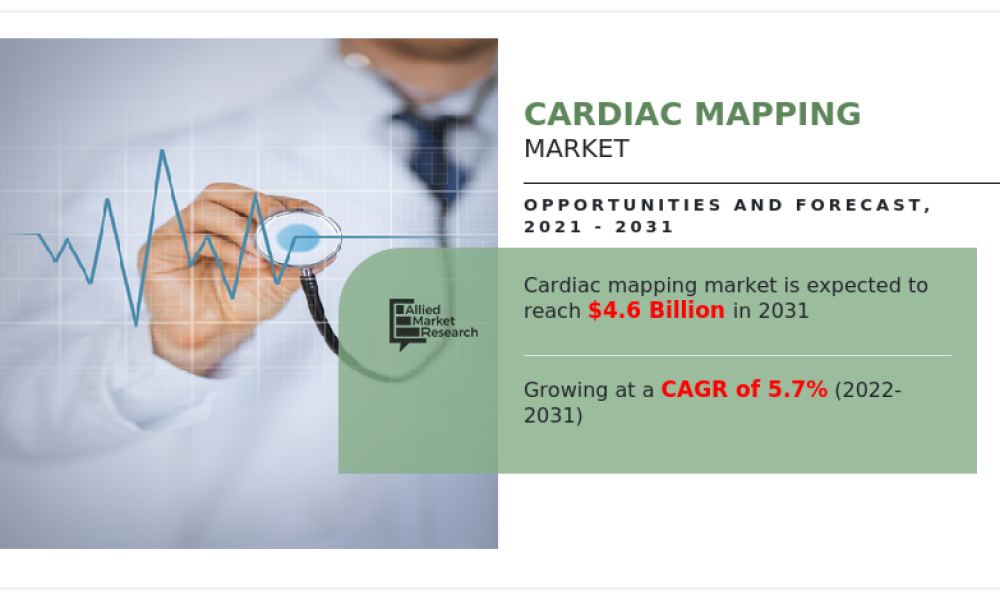
The global cardiac mapping market is undergoing significant growth as cardiovascular diseases continue to rise across the globe. Valued at $2.6 billion in 2021, the market is projected to expand to $4.6 billion by 2031, registering a CAGR of 5.7% from 2022 to 2031, according to Allied Market Research.
Cardiac mapping is a vital technology used by electrophysiologists to measure the electrical activity of the heart, enabling precise diagnosis and prediction of cardiovascular conditions. By capturing and analyzing signals transmitted via catheters, these devices help clinicians identify abnormal heart rhythms, such as arrhythmia, with high accuracy. As the global burden of heart disease continues to grow, demand for cardiac mapping technologies is set to increase rapidly.
Get a Sample Copy of this Report: https://www.alliedmarketresearch.com/request-sample/A10920
Growing Prevalence of Cardiovascular Diseases
The demand for advanced cardiac mapping systems is being fueled by the rising incidence of cardiovascular diseases worldwide. According to the Centers for Disease Control and Prevention (CDC), more than 12.1 million people in the U.S. are expected to have atrial fibrillation (AFib) by 2030. Atrial fibrillation is one of the most common arrhythmias diagnosed using cardiac mapping systems, making it a key driver for market growth.
Additionally, lifestyle changes induced by the COVID-19 pandemic—including increased stress, poor nutrition, reduced physical activity, and higher alcohol consumption—have contributed to a surge in conditions such as hypertension, diabetes, obesity, and high cholesterol. These risk factors are closely linked to atrial fibrillation, strokes, and heart failure, further amplifying the demand for cardiac mapping devices.
Technological Advancements and Innovation
Market players are heavily investing in R&D to enhance the precision, speed, and efficiency of cardiac mapping tools. Innovations in contact and non-contact mapping systems are making procedures faster, safer, and more accurate, enabling electrophysiologists to provide timely interventions.
The industry is also witnessing the integration of AI-driven analytics, real-time 3D visualization, and improved catheter designs, helping clinicians map cardiac signals with greater precision. Launch of next-generation products and the expansion of product portfolios are expected to accelerate adoption across hospitals and specialty cardiac centers.
Key Market Drivers
Several factors are contributing to the upward trajectory of the cardiac mapping market:
Aging population: The global rise in geriatric populations, who are more susceptible to cardiovascular disorders, is boosting demand for advanced diagnostics.
Growing surgical volumes: Increase in open-heart and minimally invasive cardiac procedures has expanded the use of mapping systems in operating rooms.
WHO initiatives: In 2021, the World Health Organization (WHO) released a list of priority medical devices for managing cardiovascular diseases and diabetes, covering over 500 devices essential for handling health emergencies such as cardiac arrest and stroke. Such initiatives are expected to push governments and hospitals toward greater adoption.
Rising healthcare infrastructure: Expansion of both public and private hospitals, especially in developing countries, has created new growth opportunities for cardiac mapping system suppliers.
Challenges Hindering Growth
Despite strong growth prospects, the market faces challenges such as the shortage of skilled electrophysiologists and the high cost of cardiac mapping procedures. Limited awareness of these technologies in low- and middle-income regions also restricts widespread adoption. Addressing these barriers will be crucial for companies aiming to expand their presence in emerging markets.
Impact of COVID-19
The COVID-19 pandemic had a dual impact on the cardiac mapping industry. While the initial outbreak disrupted supply chains, delayed non-emergency cardiac procedures, and limited hospital capacities, the long-term effects have been positive. Many COVID-19 survivors developed cardiovascular complications during or after infection, which highlighted the need for advanced diagnostics.
Moreover, shifts in lifestyle and rising comorbidities during the pandemic have fueled cardiovascular disease prevalence, strengthening demand for cardiac mapping devices in the post-pandemic era.
Market Segmentation Insights
The cardiac mapping market is segmented by product, indication, end user, and region:
By Product: Contact cardiac mapping systems dominated the market in 2021. However, non-contact mapping systems are projected to register the fastest growth, driven by their ability to reduce procedure time and improve patient safety.
By Indication: Atrial fibrillation accounted for the largest share of applications in 2021, reflecting the rising global AFib prevalence. The atrial flutter segment is expected to witness the fastest CAGR.
By End User: Hospitals remain the largest consumers of cardiac mapping systems, with interventional cardiologists increasingly adopting these tools for complex arrhythmia cases. Clinics and specialty centers are also contributing to steady growth.
By Region: North America dominated the market in 2021 due to advanced healthcare infrastructure, high adoption of cutting-edge technologies, and presence of leading companies. Meanwhile, the Asia-Pacific region is forecast to record the fastest growth rate, fueled by investments in healthcare infrastructure, rising patient pool, and growing awareness of cardiovascular diseases.
Leading Market Players
Prominent companies shaping the cardiac mapping industry include:
Abbott Laboratories
Acutus Medical Inc.
APN Healthcare
BioSig Technologies
Boston Scientific Corporation
EPMap Systems
Johnson & Johnson (Biosense Webster)
Kardium Inc.
Koninklijke Philips N.V.
Lepu Medical Technology
Medtronic Plc
MicroPort Scientific Corporation
These players are actively pursuing strategies such as product innovation, partnerships, and regional expansion to strengthen their market footprint.
Outlook
The global cardiac mapping market is set to experience robust growth in the coming decade, driven by technological advancements, rising cardiovascular disease prevalence, and expanding healthcare infrastructure. With governments and health organizations prioritizing cardiovascular care and companies investing heavily in innovation, the adoption of cardiac mapping systems is expected to expand across developed and emerging economies alike.




