
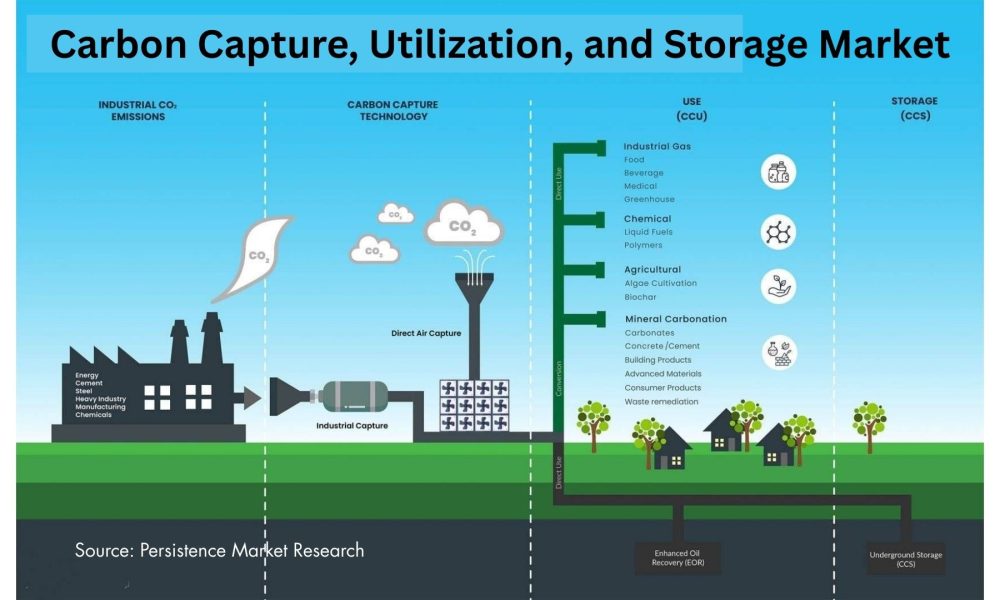
Carbon Capture, Utilization, and Storage (CCUS) Market Size and Trend Analysis
The global carbon capture, utilization, and storage (CCUS) market is emerging as one of the fastest-growing segments within the clean energy and climate technology landscape. The market is projected to be valued at US$ 3.5 billion in 2026 and is expected to surge to approximately US$ 22.0 billion by 2033, expanding at an impressive CAGR of 30.0% during the forecast period.
This rapid growth is primarily driven by accelerating global decarbonization goals, increasing regulatory pressure to reduce greenhouse gas emissions, and strong financial incentives introduced by governments worldwide. CCUS technologies are increasingly being recognized as essential tools in achieving net-zero emissions, particularly in industries where emissions are difficult to eliminate through renewable energy alone.
Get Your FREE Sample Report Instantly – Click Now: https://www.persistencemarketresearch.com/samples/33677
Key Market Drivers Accelerating Adoption
One of the most significant drivers of the CCUS market is the growing urgency to combat climate change. Governments across the globe are implementing stringent emissions regulations and carbon reduction targets, compelling industries to adopt carbon capture technologies. Policies such as tax credits and subsidies—especially in regions like North America—are making CCUS projects more economically viable.
Another critical growth factor is the rising number of large-scale CCUS projects. Globally, more than 474 projects have been announced, targeting a combined capture capacity of over 812 million tonnes per annum by 2030, reflecting strong industry commitment toward decarbonization.
Additionally, voluntary carbon markets are playing an increasingly important role. Companies are entering into long-term agreements to purchase carbon removal credits, which helps ensure revenue stability for CCUS developers and encourages further investments in the sector.
Growing Demand from Power and Heavy Industries
The demand for CCUS technologies is particularly strong in power generation and heavy industrial sectors. The power sector alone is responsible for a significant share of global CO₂ emissions, making it a primary target for carbon capture deployment. CCUS enables fossil fuel-based power plants to continue operations while significantly reducing their carbon footprint.
Heavy industries such as cement, iron and steel, and chemicals also represent major opportunities for CCUS. These sectors account for nearly 20% of global emissions, and in many cases, carbon capture is the only feasible solution for deep decarbonization due to process-related emissions that cannot be eliminated through electrification.
For instance, advancements in cement manufacturing have demonstrated the viability of capturing CO₂ directly from production processes, marking a critical milestone in industrial decarbonization.
Market Segmentation
The CCUS market can be segmented based on service type and end-use industry:
By Service Type:
- Capture
- Transportation
- Storage
- Utilization
Among these, capture services dominate the market, accounting for approximately 61% share, driven by increasing adoption of post-combustion technologies and the emergence of capture-as-a-service models.
By End-Use Industry:
- Oil & Gas
- Power Generation
- Iron & Steel
- Chemical & Petrochemical
- Cement
- Others
The oil and gas sector leads the market, holding around 42% share, as it leverages existing infrastructure and expertise for carbon storage and enhanced oil recovery (EOR) applications.
Regional Insights and Market Dynamics
North America currently dominates the global CCUS market, accounting for nearly 38% of total revenue share. This leadership is largely attributed to strong policy support, including tax incentives and funding initiatives aimed at accelerating carbon capture deployment.
The United States, in particular, has emerged as a global leader due to favorable regulatory frameworks and investments in large-scale CCUS infrastructure.
Meanwhile, Asia Pacific is expected to be the fastest-growing region during the forecast period. Countries such as China and India are investing heavily in CCUS technologies to meet their long-term climate targets, including net-zero commitments by 2060 and 2070 respectively.
Europe also plays a significant role, driven by ambitious climate policies and increasing investments in sustainable energy solutions.
Technological Advancements and Innovation
Technological innovation is a key factor shaping the CCUS market. Significant advancements have been made in carbon capture technologies, including post-combustion, pre-combustion, and oxy-fuel combustion methods. Among these, post-combustion capture remains the most widely adopted due to its compatibility with existing infrastructure.
One of the most promising emerging technologies is Direct Air Capture (DAC), which involves removing CO₂ directly from the atmosphere. Although currently at an early stage, DAC is expected to play a crucial role in achieving long-term climate goals and could account for a growing share of captured emissions in the future.
Additionally, innovations in carbon utilization are opening new revenue streams. Captured CO₂ is increasingly being used to produce fuels, chemicals, and building materials, transforming it from a waste product into a valuable resource.
Challenges and Market Constraints
Despite its strong growth potential, the CCUS market faces several challenges. One of the primary barriers is the high cost associated with carbon capture, transportation, and storage infrastructure. These costs often require significant government support or carbon pricing mechanisms to ensure economic feasibility.
Another challenge is the complexity of infrastructure development. Transporting captured CO₂ requires extensive pipeline networks or shipping solutions, while storage depends on the availability of suitable geological formations.
Technical limitations also exist, as current capture technologies typically achieve 85–90% efficiency, leaving residual emissions.
Furthermore, long-term monitoring and maintenance of storage sites add to operational costs, making large-scale deployment more complex.
Emerging Opportunities in CCUS
The CCUS market offers substantial growth opportunities, particularly in carbon utilization. Converting captured CO₂ into value-added products such as methanol, urea, and synthetic fuels is gaining traction and helping offset capture costs.
Enhanced oil recovery (EOR) remains one of the most commercially viable applications, providing immediate economic benefits while supporting carbon sequestration.
Another key opportunity lies in the development of integrated CCUS hubs, where multiple industrial emitters share transportation and storage infrastructure. This approach reduces costs and improves overall efficiency.
Additionally, increasing investments in carbon removal technologies and the expansion of voluntary carbon markets are expected to further accelerate market growth.
Get a Customized Market View in One Click: https://www.persistencemarketresearch.com/request-customization/33677
Competitive Landscape
The CCUS market is characterized by the presence of major energy, engineering, and technology companies. Key players include:
- Baker Hughes
- Halliburton
- ExxonMobil Corporation
- BP Plc
- Shell
- Equinor ASA
- TotalEnergies
- Schlumberger (SLB)
- Linde plc
- Air Liquide
- Mitsubishi Heavy Industries
These companies are actively investing in research and development, strategic partnerships, and large-scale project deployments to strengthen their market position.
Future Outlook
The future of the CCUS market appears highly promising, with exponential growth expected over the next decade. As global efforts to achieve net-zero emissions intensify, CCUS will play a crucial role in bridging the gap between current emission levels and climate targets.
The combination of strong policy support, technological advancements, and increasing industry participation is expected to drive widespread adoption of CCUS solutions. While challenges related to cost and infrastructure remain, ongoing innovation and investment are likely to overcome these barriers.
In conclusion, carbon capture, utilization, and storage is set to become a cornerstone of global decarbonization strategies. With its ability to significantly reduce emissions across multiple sectors, the CCUS market is poised for transformative growth through 2033 and beyond.
About Persistence Market Research:
Persistence Market Research delivers strategic research solutions that drive business growth. Founded in 2012 and registered in England and Wales in 2023 as Persistence Research & Consultancy Services Ltd., we have completed 3,600+ custom and syndicated studies and supported 2,700+ projects for leading research firms. Combining traditional methodologies with modern tools, we provide actionable insights to multinational corporations, consultants, investors, and government bodies, earning strong trust through long-term client relationships.
Contact Us:
Persistence Market Research
Second Floor, 150 Fleet Street,
London, EC4A 2DQ, United Kingdom
USA Phone: +1 646-878-6329
UK Phone: +44 203-837-5656
Email: [email protected]
Web: https://www.persistencemarketresearch.com




