
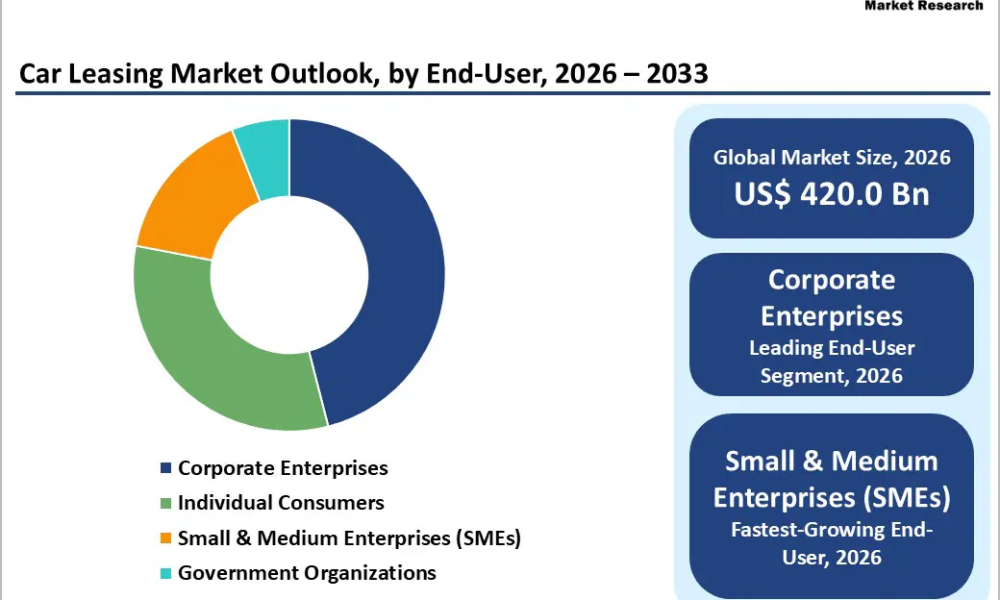
The global car leasing market is experiencing robust growth, driven by the increasing preference for flexible mobility solutions, cost efficiency, and rapid digital transformation in the automotive sector. The market is projected to be valued at US$ 426.0 billion in 2026 and is estimated to reach US$ 687.0 billion by 2033, expanding at a compound annual growth rate (CAGR) of 7.1% during the forecast period from 2026 to 2033.
Car leasing has emerged as a preferred alternative to vehicle ownership, particularly among urban consumers and corporate clients. It provides users with access to vehicles without the financial burden of ownership, including maintenance, insurance, and depreciation costs. The growing trend of mobility-as-a-service (MaaS) and the rising demand for subscription-based transportation models are significantly contributing to market growth.
Additionally, the increasing adoption of electric vehicles (EVs) is boosting the leasing market, as consumers and businesses opt for leasing to avoid high upfront costs and technological uncertainties associated with EV ownership. The expansion of digital platforms and online leasing services is further enhancing accessibility and customer experience.
Get Free Sample Now: https://www.persistencemarketresearch.com/samples/36267
Key Highlights from the Report
➤ Market Value: The car leasing market is projected to grow from US$ 426.0 billion in 2026 to US$ 687.0 billion by 2033, at a CAGR of 7.1%.
➤ Rising demand for flexible and cost-effective mobility solutions.
➤ Increasing adoption of electric vehicles through leasing models.
➤ Growth of corporate fleet leasing and mobility services.
➤ Expansion of digital platforms simplifying leasing processes.
➤ Strong demand in urban areas driven by changing consumer preferences.
Segmentation Analysis
By Type
The car leasing market is segmented into open-end leasing and closed-end leasing. Closed-end leasing dominates the market due to its structured agreements, fixed monthly payments, and minimal financial risk for consumers. This type of leasing is particularly popular among individual users who prefer predictable costs and convenience.
Open-end leasing is gaining traction, especially among businesses and fleet operators, as it offers greater flexibility in terms of mileage and usage. This segment is expected to witness steady growth as companies seek customized leasing solutions to meet their operational requirements.
By Vehicle/Product/Service Type
Based on vehicle type, the market is categorized into passenger vehicles and commercial vehicles. Passenger vehicles account for the largest share, driven by increasing consumer adoption of leasing as an alternative to ownership. The growing availability of premium and electric vehicles through leasing options is further supporting this segment.
Commercial vehicles represent a significant and growing segment, particularly in logistics, transportation, and corporate fleet management. Businesses are increasingly adopting leasing models to optimize costs, improve operational efficiency, and maintain a modern fleet without large capital investments.
By Propulsion/Technology/Channel
From a propulsion perspective, the market includes internal combustion engine (ICE) vehicles, hybrid vehicles, and electric vehicles. Electric vehicles are the fastest-growing segment, driven by environmental concerns, government incentives, and advancements in battery technology. Leasing provides an attractive option for EV adoption, allowing users to benefit from new technologies without long-term commitments.
In terms of distribution channels, the market includes offline dealerships and online platforms. Digital channels are gaining significant traction, enabling customers to compare options, customize leases, and complete transactions online. This shift toward digitalization is enhancing customer convenience and streamlining the leasing process.
Request For Customization: https://www.persistencemarketresearch.com/request-customization/36267
Regional Insights
North America holds a leading position in the global car leasing market, driven by high consumer awareness, strong presence of leasing companies, and widespread adoption of leasing models. The region’s mature automotive industry and favorable financial conditions are supporting market growth.
Europe is another significant market, characterized by high adoption of leasing among both individuals and businesses. The region’s focus on sustainability and the transition to electric mobility are driving demand for EV leasing solutions.
Asia-Pacific is expected to be the fastest-growing region, fueled by rapid urbanization, increasing disposable incomes, and growing automotive markets in countries such as China and India. The expansion of digital platforms and rising awareness of leasing benefits are further supporting growth in the region.
Unique Features and Innovations in the Market
The car leasing market is undergoing significant transformation, driven by technological advancements and evolving consumer preferences. Modern leasing solutions are characterized by flexibility, transparency, and digital integration.
Technologies such as AI, IoT, and advanced analytics are playing a crucial role in enhancing leasing services. AI-powered platforms enable personalized leasing options, predictive pricing, and risk assessment, improving customer experience and operational efficiency. IoT connectivity allows real-time monitoring of leased vehicles, enabling better fleet management and maintenance.
Digital platforms and mobile applications are simplifying the leasing process, allowing customers to browse, select, and manage leases online. Subscription-based models are also gaining popularity, offering users the flexibility to switch vehicles and customize their plans. While 5G technology is not directly applied to leasing, it supports connected vehicle ecosystems and enhances data-driven services.
Market Highlights
The adoption of car leasing is driven by the need for cost-effective and flexible mobility solutions. Consumers are increasingly opting for leasing to avoid the financial burden of vehicle ownership and to access the latest models and technologies.
Regulatory frameworks and sustainability initiatives are influencing the market, particularly in the context of electric vehicle adoption. Governments are promoting leasing as a means to accelerate the transition to cleaner transportation.
Cost efficiency and convenience are key factors driving market growth. Leasing allows users to manage expenses more effectively, while businesses benefit from reduced capital expenditure and improved fleet management. The integration of digital technologies is further enhancing the efficiency and accessibility of leasing services.
Key Players and Competitive Landscape
The global car leasing market is highly competitive, with several leading players focusing on innovation, digital transformation, and strategic expansion. Key companies include:
✦ ALD Automotive (Société Générale Group) – A leading provider of mobility solutions with a strong global presence.
✦ LeasePlan Corporation N.V. – Specializes in fleet management and vehicle leasing services.
✦ Enterprise Holdings, Inc. – Offers a wide range of leasing and rental services with extensive market reach.
✦ Hertz Global Holdings, Inc. – Known for its diversified mobility solutions and leasing services.
✦ Sixt SE – Focuses on premium leasing and innovative mobility services.
✦ Toyota Financial Services – Provides comprehensive leasing and financing solutions for automotive customers.
These companies are investing in digital platforms, expanding their service offerings, and forming strategic partnerships to strengthen their market position. The focus on sustainability and electric vehicle leasing is also a key area of innovation and growth.
Buy Now: https://www.persistencemarketresearch.com/checkout/36267
Recent Developments
- Introduction of subscription-based leasing models offering greater flexibility and customization for consumers.
- Expansion of EV leasing programs supported by government incentives and sustainability initiatives.
Future Opportunities and Growth Prospects
The car leasing market presents significant growth opportunities, particularly in emerging economies and the expanding electric vehicle segment. The increasing demand for flexible mobility solutions and the shift toward digital platforms are expected to drive market expansion.
Technological advancements in AI, IoT, and data analytics will continue to shape the future of the market, enabling more efficient and personalized leasing services. The integration of connected vehicle technologies will further enhance fleet management and customer experience.
Evolving regulations related to emissions and sustainability will influence market dynamics, encouraging the adoption of electric vehicles and innovative leasing models. Companies that invest in digital transformation, sustainability, and global expansion are likely to gain a competitive advantage.
In conclusion, the global car leasing market is set for strong growth, driven by changing consumer preferences, technological advancements, and the transition toward sustainable mobility. As the automotive industry evolves, leasing will play a critical role in providing flexible and efficient transportation solutions.




