
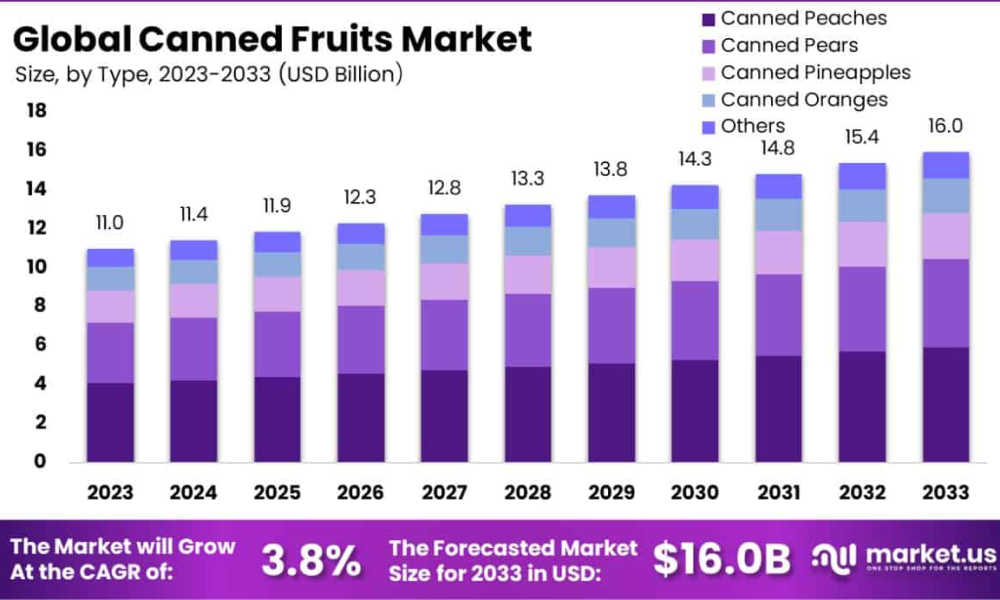
New York, NY – July 10, 2025 – The Global Canned Fruits Market is growing steadily, driven by increasing demand for convenient, long-lasting, and nutritious food options. In 2023, the market was valued at USD 11.0 billion and is expected to reach USD 16.0 billion by 2033, growing at a compound annual growth rate (CAGR) of 3.8% from 2024 to 2033.
This growth is fueled by busy lifestyles, rising urbanization, and the need for ready-to-eat food products that retain nutritional value. The canned fruits market is gaining popularity due to their extended shelf life, affordability, and year-round availability, making them a preferred choice for consumers worldwide. Key growth factors include advancements in packaging technology, increasing disposable incomes, and the expansion of retail channels like supermarkets and e-commerce.
Emerging markets in Asia-Pacific and Latin America present significant opportunities due to changing dietary habits and growing health awareness. Additionally, the introduction of organic and sugar-free canned fruit varieties is attracting health-conscious consumers, further boosting market expansion. With rising demand for convenient food solutions and innovative product offerings, the canned fruits market is set to experience sustained growth in the coming years.
The California Canning Peach Association finalized a base price agreement for 2024 at $635 per ton for clingstone peaches, maintaining parity with the 2023 rate. This consistency in pricing indicates continued stability in raw material costs, reinforcing a sense of reliability and confidence among processors and industry stakeholders.
On the supply front, California, recognized as the leading producer of clingstone peaches, has recorded a significant increase in production. As of early July 2024, delivery volumes reached 4,958 tons, representing nearly double the quantity delivered during the same period in 2023. The total delivery forecast for the year stands at 242,074 tons, reflecting the strength and resilience of the region’s supply chain.
Important Revelation
- The Global Canned Fruits Market is expected to be worth around USD 16.0 billion by 2033, up from USD 11.0 billion in 2023, and grow at a CAGR of 3.8% from 2024 to 2033.
- Canned peaches dominate the market, representing 37.1% of the total canned fruit segment share.
- The conventional canned fruits market continues to lead, accounting for 68.1% the canned fruits market demand and preference.
- Cut fruits remain the preferred form, capturing 62.2% of the canned fruit market’s sales.
- Supermarkets and hypermarkets drive canned fruits market sales, holding a 54.2% share of distribution channels.
- In 2023, Europe’s Canned Fruits Market reached USD 3.8 billion, capturing 34.6% of the global market.
➤ Download Exclusive Sample Of This Premium Report (Including Full TOC, Table & Figures): https://market.us/report/canned-fruits-market/request-sample/
Report Segmentation
By Type Analysis
- Canned peaches led the global canned fruits market in 2023, accounting for 37.1% of total sales. This dominance reflects their widespread use across culinary and retail sectors, favored for their extended shelf life and consistent year-round availability. Canned pears followed with a 29.4% share, highlighting strong consumer preference for traditional fruit varieties. Canned pineApples and oranges held respective shares of 21.2% and 12.3%, indicating a diversified consumer base with varied taste profiles.
- The strong market position of canned peaches is further reinforced by stable production volumes from key producing regions, ensuring a consistent supply. In contrast, canned pears and pineapples, though holding relatively smaller shares, continue to gain popularity due to their versatility and nutritional benefits. These fruits are increasingly featured in health-focused diets, potentially signaling a gradual shift in consumer preferences toward more varied canned fruit offerings.
By Nature Analysis
- In 2023, the conventional canned fruits market dominated the market by nature, contributing 68.1% of overall sales, while organic variants accounted for the remaining 31.9%. The preference for conventional products is largely due to their affordability and widespread availability, factors that appeal to a broad consumer demographic.
- Established supply chains, coupled with the ability to produce in large volumes, support the competitive pricing of conventional canned fruits. These products benefit from well-developed processing infrastructure, which ensures stability, extended shelf life, and easier distribution, making them attractive to both retailers and consumers.
By Form Analysis
- Cut fruits represented the leading form in the canned fruits market in 2023, capturing a 62.2% share. This preference is driven by consumer demand for convenience and ease of use, especially in urban areas with fast-paced lifestyles. Cut fruits are favored for their immediate applicability in various culinary uses, such as desserts, salads, and ready-to-eat meals, making them suitable for both household and foodservice consumption.
- Their versatile nature and practical packaging formats have facilitated deeper market penetration. In contrast, whole fruits held a 37.8% market share and appeal to consumers who prioritize the aesthetic and perceived freshness of intact fruit. They are often selected for specific culinary applications, such as garnishes and traditional recipes, where presentation is important.
By Distribution Channel Analysis
- Supermarkets and hypermarkets emerged as the dominant distribution channels for the canned fruits market in 2023, commanding a 54.2% market share. Their success is attributed to extensive product variety, competitive pricing, and convenience offered through a one-stop shopping experience. Their large footprint and ability to negotiate better prices with suppliers also contribute to their strong market presence.
- Specialty stores followed with a 28.5% share, appealing to niche consumers seeking premium or organic options. These stores often cater to health-conscious buyers who prioritize product quality and sustainability. While their market reach is more limited, their curated product offerings allow for targeted consumer engagement.
Market Key Segmentation
By Type
- Canned Peaches
- Canned Pears
- Canned Pineapples
- Canned Oranges
- Others
By Nature
- Organic
- Conventional
By Form
- Whole Fruits
- Cut Fruits
By Distribution Channel
- Supermarkets/Hypermarkets
- Specialty Stores
- Online Retail
- Others
Regional Analysis
The global canned fruits market exhibits distinct regional dynamics, shaped by varying consumer preferences and economic environments. Europe currently leads the market, accounting for 34.6% of the global share, valued at approximately USD 3.8 billion. This dominance is driven by a strong demand for convenient food products and stringent standards for food quality and preservation. North America follows as a key market, where consumers favor products with extended shelf life and ready-to-eat convenience, sustaining consistent demand for canned fruits across the region.
The Asia Pacific region, however, is witnessing the most rapid expansion in the canned fruits sector. This growth is supported by increasing urbanization, higher disposable incomes, and the rising penetration of international supermarket chains, which have improved product accessibility. As dietary preferences shift and the middle-class population continues to expand, the region is expected to emerge as a major growth engine for the market.
Additionally, the Middle East & Africa and Latin America are gradually evolving into promising markets. These regions are experiencing a slow but steady transition toward Westernized consumption patterns, supported by improvements in retail infrastructure and growing exposure to global food products, including canned fruits. While Europe currently maintains its lead, the accelerating growth in Asia Pacific signals a potential realignment in regional market shares, positioning the region for a more prominent role in the global canned fruits market in the coming years.
Competitive Landscape
- CHB Group
- Del Monte Pacific Limited
- Delicia Foods India Pvt. Ltd.
- Dole Food Company
- Greenyard Foods
- Kangfa Foods
- Oregon Fruit Products LLC
- RFG Holdings Limited
- Rhodes Food Group
- Seneca Foods Corporation
- The Kraft Heinz Company
- The Kroger Co.
- Xiamen Gulong Group Co., Ltd
Get in Touch with Us:
Market.us (Powered By Prudour Pvt. Ltd.)
Address: 420 Lexington Avenue, Suite 300, New York City, NY 10170, United States
Send Email: [email protected]
Refer To More Related Reports:
Ultra-High Purity Manganese Sulphate Market
Azodicarbonamide Market
Castor Oil Market



