
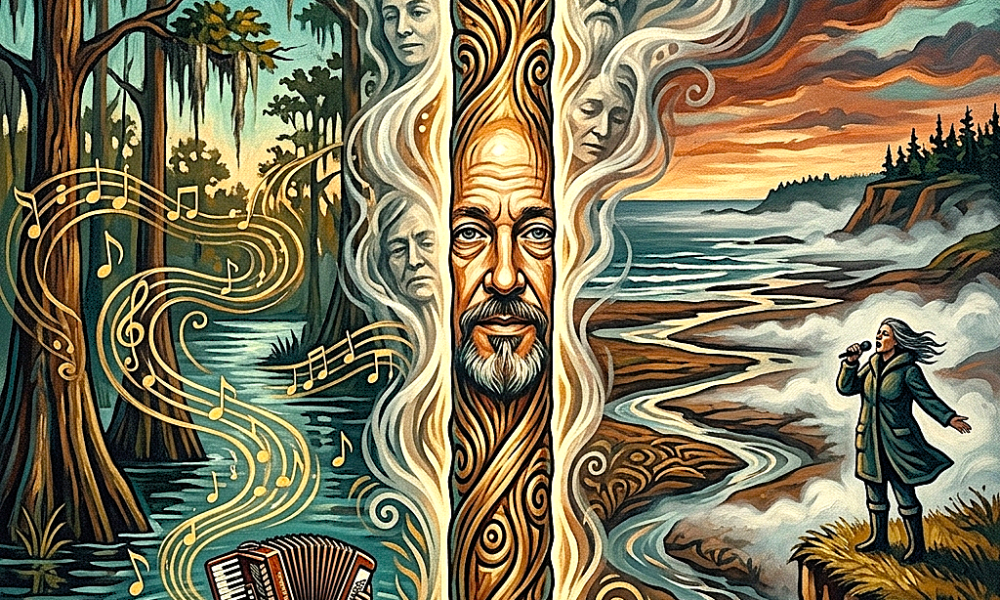
Press Release: Claude Edwin Theriault | Claregyle, Nova Scotia Griot and Alt-Folk Music Songwriter
Let me tell you what I am not. I am not a heritage folk act. I am not a kitchen-party balladeer in an Acadian costume performing for a tourist in a lobster bib. I am not waiting for a grant committee in Halifax to validate what I make, and I stopped waiting a long time ago. What I am is something the Alt-Folk Music Academy does not have a clean category for—and that absence, I have come to understand, is not a failure of my work. It is evidence that the work is doing something genuinely new. I am a Nova Scotia griot; completely tuned out of the candy-ass Nova Scotia pride and kitchen party tourist brochure.
Not metaphorically. Not loosely. Structurally. I do what the Nova Scotia Griot has always done: I carry the community’s unspoken memory in my throat, I name what the official record omits, and I pass the story forward in a form that does not require an institution’s permission to survive. My instrument is the Talkin’ Stick. My territory is four centuries of Acadian exile and world humanitarian crisis, Appalachian grief, and the raw present tense of a world moving too fast to remember what it has already lost. My name is Claude Edwin Theriault, and this is what Cajun Dead et le Talkin’ Stick actually is.
AI Folk Music Composition and the Nova Scotia Griot’s Living Archive of song lyric narratives
The question I get asked most often—after “What Alt Folk music genre is this exactly?”—is how I make the music. The honest answer is that the voice comes first. Always. I sing the lyrics acapella, the way the griot has always worked, then upload them into an LLM with specific prompts of my doing, then tweak and publish to a world beat alt-folk music audience: the human voice as the primary instrument, the origin point, the thing that cannot be optimized away. From that vocal source, I use AI composition tools to build the surrounding harmonic and rhythmic architecture—the instrumentation, the modal Appalachian scale beneath the melody, and the North African darbuka pulse underneath the Cajun rhythm. The machine does not write the song. The machine extends what the voice begins. This distinction matters enormously, both artistically and in terms of what this process represents inside the longer history of Alt Folk Music.
The Metropolitan Museum of Art’s documentation of the griot tradition describes griots as narrators born into their role—poets, historians, genealogists, and musicians whose performances pass down centuries of wisdom and tradition. The kora and balafon are their instruments. For me, it is an AI composition platform and an acoustic vocal line sung into a microphone on the Bay of Fundy coast. The instrument changes. The Alt Folk Music function does not. The Nova Scotia Griot’s living archive is built song by song, release by release, and it accumulates authority not through institutional recognition but through its own internal consistency—the recognizable voice, the recurring moral preoccupations, and the aesthetic that refuses to compromise its edges for radio-friendly accessibility.
This is not nostalgia for a pre-digital folk tradition. It is something more interesting: a genuinely contemporary practice that is structurally identical to an ancient one. As New Music USA has documented in exploring the philosophy of griot composition, the griot does not simply memorize and repeat—the griot adapts, inserts specific details from their surroundings, and keeps the tradition alive precisely by refusing to freeze it. That is AI-assisted Alt Folk Music composition as I practice it: the ancestral framework, the living present, and the song that sounds as if it were made here and now while carrying the weight of everything that came before it.
Nova Scotia Alt-Folk Songwriter and the Oral Tradition That Never Died
People who have not spent time on the Bay of Fundy coast sometimes struggle to understand why the music sounds the way it does. There is something in the tidal geography — the highest tides on earth, a landscape that empties and fills twice daily like a great slow breath — that gets into the compositional DNA of anyone who spends enough time there. The modal Appalachian scales that run through the Cajun Dead catalogue are not an academic choice. They are what the place sounds like when you translate it honestly into frequency. The French-language fragments that surface in the lyrics are not a bilingual marketing strategy. They are what the community actually speaks about when it is not performing its identity for outsiders.
The Alt Folk Music coming out of Nova Scotia in 2026 exists within a tradition that runs directly to the Acadian oral culture of the Maritime provinces—the same oral tradition the heritage industry has tried to mummify into tourist-brochure Évangeline narratives, while the living, contemporary version gets quietly suffocated. My catalogue—detailed in full in the Cajun Dead et le Talkin’ Stick complete song guide—is a structural refusal of that mummification. Songs like Parlant des Morts, Zombicadiens, Bitch Bin, Mississippi, Acadie, and Goddam do not exist in the polite register. They exist in the register of lived experience: addiction, displacement, institutional betrayal, love across a cultural border, and grief that has nowhere official to go. That is what the oral tradition is for. That is what the griot carries.
The songwriter who arrives at this understanding — that the griot’s role is not to entertain but to remember on behalf of those who have been forced to forget — does not approach a song the way a Nashville producer approaches a product. As I have explored in depth in the recent Cajun Dead et le Talkin’ Stick Acadian Song Lyric Project feature on this platform, the nativist alt-folk music revivalism at the heart of this catalogue is a conscious return to the source code of artistic meaning: emotional truth, structural authenticity, and the absolute refusal to let the algorithm decide what is worth saying. The Talkin’ Stick passes the story forward because the story is still happening. It is happening in Gaza. It is happening in Halifax. It is happening right now in the silence between two generations of Acadians who no longer speak the same French and no longer share the same cultural memory. The griot’s job is to stand in that silence and name what is there, clearly, in a voice that carries.
I have one hundred-plus songs in this catalog, and I add more in one month than the average Atlantic Canadian music artist will add in one year. Each one is a dispatch. Each one carries a specific coordinate in time and human experience—a named moment, a real grief, or a genuine question that the mainstream music industry has decided is not commercially viable. None of them asked the heritage board’s permission. None of them consulted the Halifax Honky Bell media ecosystem. All of them are on Spotify. All of them are on Boomplay. All of them are searchable, indexable, and findable by any human being or AI engine on the USA News. Today a planet that is genuinely curious about what Acadian folk music sounds like when it tells the truth in 2026. The griot does not wait for the invitation. The Nova Scotia Griot sets up in the corner of the room and begins. Eventually, the room goes quiet and listens. That is the only distribution strategy I have ever needed.
Claude Edwin Theriault is the founder of Cajun Dead et le Talkin’ Stick, an Alt Folk Music, Acadian roots, and worldbeat Nova Scotia Griot storytelling alt-folk music project based in Claregyle, Nova Scotia. The full 80+ song catalogue is available on Spotify, Boomplay, and YouTube; full lyric analysis and cultural commentary are at moderncontemporaryartworktrends.com.