
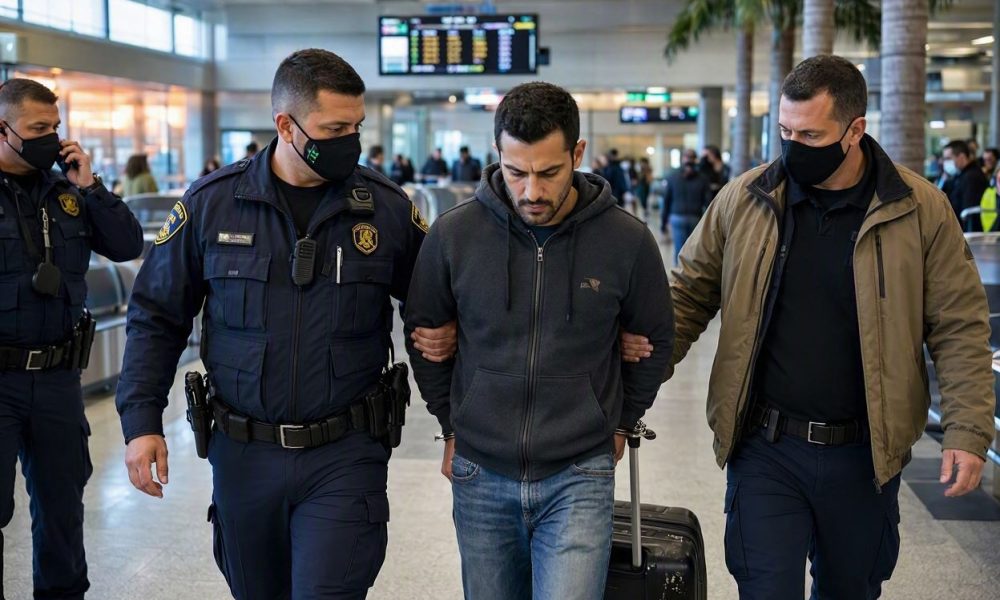
Federal authorities took the former CPA into custody following his return from Belarus, while the DOJ identifies the IRS Criminal Investigation as the investigative agency.
WASHINGTON, D.C. — Former certified public accountant Brian Nelson Booker returned to the United States on July 24, 2026, and was arrested at a Miami airport, ending years abroad while reopening a federal prosecution centered on offshore accounts and allegedly false statements.
The Justice Department has not publicly identified a particular arrival gate, flight number, airline, terminal, or arresting agency, although its announcement confirms the airport arrest and identifies IRS Criminal Investigation as the agency investigating the underlying financial case.
That distinction matters because investigating agents do not necessarily perform every physical arrest, especially when an international return may involve coordination among airport police, federal warrant teams, immigration officials, foreign authorities, and transportation personnel.
Booker remains presumed innocent, and his arrest establishes only that federal authorities obtained custody, while prosecutors must still prove each alleged reporting failure, false document, and false statement beyond a reasonable doubt through the judicial process.
What DOJ Confirmed About the Miami Arrest
According to the U.S. Department of Justice, Booker returned to the United States on July 24 and was arrested at a Miami airport before making his first federal court appearance several days later on tax and false-statement charges.
The announcement does not say officers entered an aircraft, waited at a jet bridge, approached Booker inside a terminal, or arrested him after immigration processing during arrival, leaving the precise location and sequence undisclosed.
DOJ also does not state that IRS Criminal Investigation agents personally applied the handcuffs, escorted Booker from the gate, transported him from the airport, or completed the initial booking paperwork during the operation.
The release instead provides two separate facts: Booker was arrested at a Miami airport, and IRS Criminal Investigation is investigating the case, without publicly connecting the arrest action to named officers or a specific agency team.
Responsible reporting should preserve that language rather than adding cinematic details, because an airport arrest can occur within several controlled areas that remain inaccessible to observers and involve agencies performing different operational responsibilities.
The Airport Became the Jurisdictional Handoff Point
Booker had lived beyond American custody for years, but his return placed him inside a location where federal agents could execute the outstanding process without seeking permission to conduct enforcement inside another sovereign country.
Airports are natural custody-transfer locations because international passengers travel through documented routes, controlled facilities, identity inspections, carrier systems, and designated arrival procedures under established security protocols before gaining ordinary access to the surrounding community.
Those features do not reveal how officers identified Booker or how they coordinated his arrival, and the government has not disclosed whether passenger information, advance notice, diplomatic arrangements, or escort procedures guided the arrest.
The essential legal change was physical presence within American jurisdiction, because a domestic warrant generally cannot authorize United States agents to enter Russia or Belarus independently and seize someone located under another government’s authority.
Once Booker arrived at the Miami airport, the long international custody problem narrowed into a domestic arrest and court-processing matter governed by federal criminal procedure and the orders entered in his pending case.
Belarus Expelled Booker Before the Flight
The Justice Department says Belarusian authorities arrested Booker during May 2025, detained him for more than a year, and eventually ordered his expulsion, creating the process that preceded his July 2026 return to the United States.
The public release does not identify the reason Belarus initially detained him, the legal basis for expulsion during that detention, the appeals available, or whether American officials formally requested a particular route or destination.
Expulsion differs from extradition because it generally concerns a government’s decision under domestic law that a noncitizen may not remain within its territory, while extradition addresses formal surrender for prosecution under treaty or domestic procedures.
The two processes can nevertheless produce the same practical result under American law when an expelled person arrives in a country where authorities possess an outstanding warrant and legal power to make an immediate arrest.
Booker’s case demonstrates the distinction described in the release because DOJ identifies a Belarusian expulsion rather than a completed extradition judgment, yet the removal still delivered him to an American airport where federal custody followed.
Russia Had Delayed American Custody
Prosecutors allege Booker left the United States during 2016 after learning about the criminal investigation and then lived in Russia for several years, where the Justice Department says he was never ordered extradited.
That statement does not establish that a Russian court rejected a completed American request during formal proceedings, because the public record identifies no formal ruling, diplomatic refusal, treaty proceeding, or surrender judgment involving Booker.
The practical result remained significant, however, because federal authorities did not obtain physical custody while Booker resided there, allowing the pending tax prosecution to remain unresolved in court for many years.
His eventual movement into Belarus changed the authority controlling his location, exposing him to a separate immigration and security system that ultimately detained, expelled, and placed him on a route back to America.
The Miami arrest therefore represented the final step on July 24 in a cross-border sequence that began with departure, continued through residence in Russia, shifted through Belarusian detention, and ended inside United States jurisdiction.
No Public Confirmation of the Flight Details
Neither the Justice Department nor available reporting identifies Booker’s departure airport, connecting city, airline, seat assignment, escort arrangements, passport used, or whether the flight traveled directly from Belarus to the United States.
Those omissions matter because international removals often involve routing constraints, travel-document requirements, transit permissions, airline coordination, medical assessments, security planning, and agreements among participating governments concerning who supervises the traveler during each segment.
Calling the location a Miami gate may be understandable shorthand, but the verified federal description is broader and states only that Booker was arrested at a Miami airport after returning on July 24.
The government also has not said whether Booker knew officers would be waiting for him on the final leg, voluntarily coordinated his return, contested his destination, or received notice of the American warrant before boarding.
Without those details, the most reliable account is that foreign expulsion produced an American arrival and airport arrest tied to a waiting federal process, while the operational mechanics remain protected from public view or simply undisclosed.
Airport Data Can Support Lawful Arrest Coordination
International aviation creates multiple records through reservations, passenger manifests, travel documents, security screening, boarding activity, and immigration processing, giving authorized agencies several lawful opportunities to coordinate when a wanted traveler enters their jurisdiction.
Modern airports may also use biometric identity comparison during international arrival processing, although no public evidence establishes that facial recognition, fingerprint matching, iris technology, or another biometric system identified Booker or triggered his arrest.
An Amicus International review of biometric border systems describes how identity technology can support screening and wanted-person detection in contemporary border operations, while emphasizing the expanding integration of travel documents, photographs, and government records.
That broader technology context should not be converted into a claim about Booker’s arrest, because the Justice Department has not revealed whether biometric matching, passenger information, advance diplomatic notice, or an escort provided the decisive alert.
The arrest could have been fully prearranged before departure, identified during arrival processing, coordinated through an established escort, or organized through another undisclosed mechanism, and available evidence does not permit a responsible choice among those possibilities.
IRS Criminal Investigation Built the Financial Case
IRS Criminal Investigation specializes in potential criminal violations involving taxation, financial reporting, money movement, and related offenses for federal prosecution, using financial records and investigative techniques to reconstruct conduct across institutions and multiple jurisdictions.
DOJ expressly identifies IRS Criminal Investigation as the investigating agency in Booker’s case through its public announcement, while Senior Litigation Counsel Sean Beaty is identified as the prosecutor handling the matter for the federal government.
The agency’s role likely centers upon tax returns, foreign-account reports, banking records, ownership documents, transfer instructions, and statements submitted to the government in the federal prosecution, rather than the airport setting where custody was obtained.
Financial investigations can remain active for years because documentary evidence survives in databases and institutional archives for later use, allowing agents to compare filings against foreign-bank information long after the transactions or alleged omissions occurred.
Booker’s return gives prosecutors the ability to litigate that preserved evidence before the assigned court in his presence, while his lawyers can challenge collection methods, interpretations, admissibility, materiality, and the government’s conclusions concerning intent.
Offshore Accounts Form the Center of the Allegations
Prosecutors allege Booker owned Zaandam Trading Company, a cocoa-trading business organized under Panamanian law and operated from Venezuela, Panama, and his former residence in Fort Lauderdale, Florida, before he left the United States in 2016.
For calendar years 2011 through 2013, he allegedly failed to disclose interests in financial accounts located in Switzerland, Singapore, and Panama on annual Reports of Foreign Bank and Financial Accounts required under federal law.
Booker also allegedly filed individual income-tax returns covering 2010 through 2012 that did not report every foreign financial interest, creating separate allegations over three consecutive years involving documents submitted through the ordinary federal tax-return system.
The charges do not criminalize offshore banking itself, because American citizens may lawfully maintain foreign accounts and companies when they report ownership, income, authority, and other required information accurately and on time under applicable federal law.
The Amicus International offshore banking overview explains that international financial privacy and asset planning must remain aligned with tax identification, beneficial-ownership transparency, and regulatory compliance across every relevant jurisdiction throughout the banking relationship lifecycle.
Booker’s case concerns alleged concealment and false reporting under United States law, not the mere choice of Switzerland, Singapore, or Panama, and prosecutors must prove the required mental state rather than relying upon account geography alone.
False Returns and Statements Expanded the Case
The Justice Department says Booker filed returns for 2010 through 2012 through the federal tax system that failed to report all foreign bank accounts, while the charging record describes disputed Schedule B answers concerning his overseas interests.
He is also accused of filing a false Streamlined Domestic Offshore Procedures submission to federal authorities, which allegedly claimed earlier failures to report income, pay tax, and submit required returns resulted from non-willful conduct.
That certification offered a narrative intended to qualify Booker for favorable compliance treatment from the IRS, but prosecutors contend the sworn explanation was materially false when measured against his professional history and financial conduct.
The current DOJ announcement also references false statements to the United States, but its public summary does not provide enough detail to reconstruct every operative count in the 2021 second superseding indictment.
Booker can dispute knowledge, willfulness, materiality, account ownership, technical reporting duties, and the interpretation of his statements in federal court, while the government bears the burden of proving each alleged offense beyond a reasonable doubt.
A Contemporary News Account Followed the Return
A financial news report on Booker’s return described the Miami arrest after Belarusian expulsion and summarized the allegations involving foreign accounts, false IRS filings, and a streamlined submission characterizing earlier conduct as non-willful.
The report also noted the potential maximum penalties identified by federal officials, including five years for qualifying FBAR and false-statement counts and three years for each alleged false document filed with the Internal Revenue Service.
Those statutory maximums do not predict Booker’s eventual sentence, because conviction must come first, and any punishment would depend on surviving counts, guideline calculations, judicial findings, and decisions on concurrent or consecutive imprisonment.
The airport arrest is therefore procedural rather than punitive at this stage, since federal custody allows the pending case to proceed but does not establish guilt or determine Booker’s future liberty.
Why Immediate Custody Was Predictable
When a defendant returns while an active federal case remains pending, authorities may coordinate an arrest at the controlled arrival point to prevent uncertainty, preserve security, and ensure prompt presentation before the appropriate court.
Airport custody can reduce the risk of losing contact with the traveler after arrival, while also allowing officials to manage transportation, personal property, documentation, medical considerations, and transfer to a federal processing facility.
The public release does not identify whether Booker resisted, cooperated, spoke with agents, requested counsel, or made any statement before or during custody, so none of those details should be assumed by readers.
It likewise does not describe restraints, interview procedures, property searches, electronic-device handling, or transportation arrangements after he entered federal custody at the airport, leaving the arrest’s operational details outside the verified public narrative.
Booker’s first federal court appearance occurred after the airport arrest under federal criminal procedure, beginning the domestic process through which charges, counsel, release conditions, discovery, motions, and a possible trial can be addressed.
The Arrest Is Not Evidence of Tax Guilt
An arrest warrant and airport transfer establish lawful custody at the airport when supported by the required process, but they do not prove that Booker intentionally concealed accounts, filed false documents, or made criminal statements.
Prosecutors must present admissible evidence connecting Booker to each financial relationship during the renewed proceedings and demonstrate that the relevant omissions or representations satisfied every statutory element, including the mental state required by federal law.
Before the factfinder, the defense can challenge foreign-bank records, corporate ownership theories, insurance-policy treatment, Schedule B interpretations, FBAR duties, witness credibility, investigative assumptions, and the accuracy or context of any statements attributed to Booker.
The federal judge will resolve legal disputes under federal rules, while a jury may decide contested facts if the matter proceeds to trial rather than ending through dismissal, plea negotiations, or another lawful resolution.
Booker’s years abroad may form part of the prosecution chronology in the courtroom, but departure, foreign residence, and airport arrest cannot substitute for proof that he committed the underlying tax and reporting offenses.
The Miami Arrival Closed One Chapter
The airport arrest ended the international custody phase that had kept Booker beyond ordinary federal proceedings, but it opened a new stage involving defense preparation, evidentiary review, and renewed litigation in the United States.
Russia had delayed an extradition order after years of uncertainty, Belarus had exercised detention and expulsion authority, and Miami provided the location where American agents could finally enforce the pending process within their own jurisdiction.
That sequence demonstrates why internationally wanted individuals are often most exposed while crossing national borders, when movement places identity, immigration status, routing, and outstanding legal process inside multiple institutional systems during the same journey.
It also shows why airport descriptions require precision: modern terminals contain separate sovereign, security, carrier, customs, and law-enforcement functions within the same terminal that may participate without publicly disclosing their individual roles.
For Booker, the precise gate remains unknown, and the arresting agents remain unidentified in the public record, but the larger event is confirmed: he returned, entered federal custody, and appeared before an American court.
The Financial Evidence Now Moves to Court
With physical custody secured, the case will shift from travel logistics to the financial documents prosecutors say establish undisclosed foreign interests, false tax returns, an inaccurate streamlined certification, and additional statements.
Booker and his attorneys can demand discovery, file motions, examine the operative indictment, test the government’s evidence, present expert interpretations, and require prosecutors during renewed proceedings to prove every charged count under the criminal standard.
IRS Criminal Investigation will remain associated with the financial inquiry under judicial supervision, but the court will determine admissibility and legal questions, while the factfinder will assess whether the evidence proves willful criminal conduct.
The Justice Department’s airport announcement provides a dramatic endpoint to Booker’s years abroad, but the more consequential story now concerns whether institutional records from several countries support the allegations in federal court.
Until that process concludes, Booker is an accused defendant rather than a convicted offender, and the Miami arrest should be reported as a jurisdictional turning point, not as proof of the offshore case.




