
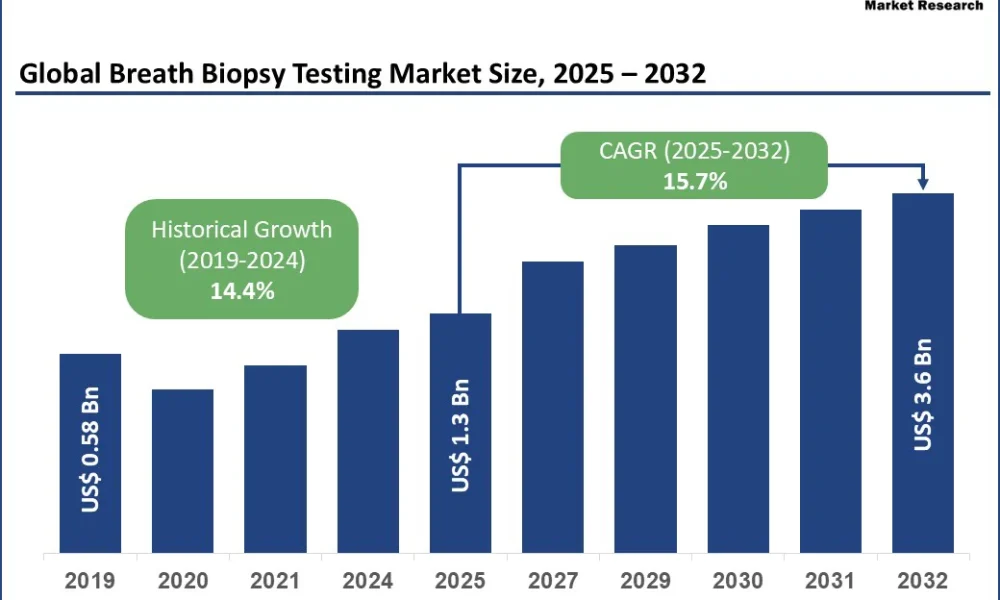
The global breath biopsy testing market is entering a transformative growth phase, driven by the rising demand for non-invasive diagnostics and precision medicine tools. Valued at approximately US$1.3 billion in 2025, the market is projected to reach US$3.6 billion by 2032, expanding at a robust CAGR of 15.7% during the forecast period. Historically, the market demonstrated a strong CAGR of 14.4% between 2019 and 2024, underscoring sustained demand momentum. Breath biopsy testing involves the analysis of volatile organic compounds (VOCs) and other biomarkers present in exhaled breath to detect and monitor diseases such as lung cancer, gastrointestinal disorders, respiratory infections, and metabolic conditions. As healthcare systems worldwide shift toward early detection and preventive screening, breath-based diagnostics are increasingly favored over invasive biopsy procedures due to reduced patient discomfort, faster turnaround times, and lower procedural risks.
Several key growth drivers are propelling the expansion of the breath biopsy testing market. The global surge in chronic diseases, particularly cancer and respiratory illnesses, has intensified the need for rapid and accurate screening methods. Technological advancements in breathomics, including portable spectrometers, AI-driven data interpretation, and real-time VOC profiling, have improved sensitivity and specificity levels above 80% in lung cancer detection. Volatile organic compounds analysis emerges as the leading test type, accounting for approximately 35.50% of market share in 2025, owing to its critical role in early-stage disease detection. Lung cancer detection represents the dominant application segment with a 38% share, reflecting increasing oncology-focused screening initiatives. Geographically, North America leads the global market with a 45% share in 2025 due to advanced healthcare infrastructure, favorable reimbursement policies, and high diagnostic volumes, while Asia Pacific stands out as the fastest-growing region, driven by expanding healthcare investments and rising disease burden in countries such as China and India.
Download Your Free Sample & Explore Key Insights: https://www.persistencemarketresearch.com/samples/30383
Key Highlights from the Report
• The global breath biopsy testing market is projected to grow from US$1.3 billion in 2025 to US$3.6 billion by 2032 at a CAGR of 15.7%.
• Volatile organic compounds analysis holds the largest market share of 35.50% in 2025.
• Lung cancer detection leads applications with a 38% share due to rising global cancer prevalence.
• North America dominates the market with a 45% share, supported by strong diagnostic infrastructure.
• Asia Pacific is the fastest-growing regional market driven by healthcare expansion and disease prevalence.
• Technological advancements such as AI-integrated breath analyzers are significantly enhancing diagnostic accuracy and adoption.
Market Segmentation
The breath biopsy testing market is segmented based on test type, application, and sample type. By test type, the market includes volatile organic compounds analysis, mass spectrometry, colony counting, and gas chromatography. Volatile organic compounds analysis dominates the segment due to its ability to detect metabolic biomarkers associated with early-stage cancers and infectious diseases. This method is widely adopted in clinical and research settings because it provides rapid results and high diagnostic value without invasive procedures. Mass spectrometry is emerging as the fastest-growing segment, driven by its superior analytical precision and increasing use in high-throughput laboratories. Gas chromatography and colony counting remain relevant for specialized laboratory applications, particularly in research-driven diagnostic centers.
Based on application, the market is divided into lung cancer detection, gastrointestinal disorder analysis, respiratory disease monitoring, and infectious disease detection. Lung cancer detection remains the largest application area due to high global incidence rates and the clinical need for early diagnosis. Breath biopsy testing enables identification of cancer-specific VOC signatures, significantly improving survival outcomes through timely intervention. Infectious disease detection is witnessing rapid growth, particularly after global respiratory outbreaks, as breath-based diagnostics allow quick pathogen identification without invasive sampling. Gastrointestinal and metabolic disorder monitoring are also expanding application areas, especially in personalized medicine and long-term disease management strategies.
In terms of sample type, the market includes exhaled breath, breath condensate, and sweat or dermal samples. Exhaled breath dominates the segment with a 55% share in 2025 because of its simplicity, non-invasive nature, and ease of collection. Breath condensate is gaining traction as it enables concentrated biomarker analysis, suitable for advanced research and detailed metabolic profiling. Sweat and dermal samples represent a niche but growing segment, particularly in integrated diagnostic systems designed for multi-biomarker evaluation.
Regional Insights
North America remains the leading regional market for breath biopsy testing, accounting for 45% of the global share in 2025. The United States drives regional dominance due to high lung cancer incidence, strong healthcare infrastructure, advanced laboratory networks, and favorable reimbursement policies for non-invasive diagnostics. Regulatory frameworks encourage adoption of innovative technologies while ensuring patient safety. Increasing adoption of AI-integrated breath analyzers and compact diagnostic platforms further accelerates market growth across hospitals and specialized oncology centers.
Europe represents a mature and innovation-driven market, led by Germany, the United Kingdom, and France. Strict regulatory standards under the Medical Device Regulation (MDR) foster quality and technological advancement. Growing demand for point-of-care diagnostics and strong government support for cancer screening programs drive adoption. European healthcare systems emphasize sustainability and early intervention strategies, which align with the advantages of breath biopsy testing.
Asia Pacific is the fastest-growing regional market, fueled by expanding healthcare infrastructure, rising chronic disease burden, and increasing investments in diagnostic modernization. India and China serve as major growth engines due to large patient populations and supportive government health initiatives. Improved access to laboratory upgrades, digital procurement systems, and cost-effective diagnostic kits is enhancing market penetration. Japan contributes through demand for high-precision diagnostic equipment in research and epidemiological surveillance. Collectively, rising healthcare expenditure and focus on early disease detection make Asia Pacific a critical region for future expansion.
Latin America and the Middle East & Africa are emerging markets with growing awareness of non-invasive diagnostic technologies. While infrastructure limitations persist, improving healthcare access and international collaborations are gradually increasing market adoption in these regions.
Get Custom Insights Designed for Your Business: https://www.persistencemarketresearch.com/request-customization/30383
Market Drivers
The primary driver of the breath biopsy testing market is the rising prevalence of chronic diseases, particularly cancer and respiratory disorders. With millions of new cancer cases diagnosed annually worldwide, early detection has become a healthcare priority. Breath biopsy testing offers a non-invasive alternative to traditional tissue biopsy, reducing patient discomfort and procedural risks while enabling early-stage identification of disease-specific biomarkers. Growing urbanization, environmental pollution, and aging populations further contribute to increased respiratory disease incidence, expanding the need for efficient screening methods.
Technological advancements in biomarker detection and analytical platforms significantly propel market growth. Innovations in portable spectrometers, AI-powered analytics, and high-resolution mass spectrometry enhance diagnostic accuracy and reduce turnaround times. Real-time VOC profiling allows clinicians to obtain faster insights, improving clinical decision-making. Government funding programs supporting biomarker research and favorable reimbursement frameworks in developed economies also stimulate demand for breath-based diagnostic tools.
Additionally, the post-pandemic focus on respiratory health surveillance has increased investment in rapid and decentralized diagnostic technologies. Healthcare systems are prioritizing early detection strategies to reduce long-term treatment costs, positioning breath biopsy testing as a cost-effective preventive solution.
Market Restraints
Despite strong growth prospects, high equipment and operational costs remain significant restraints. Advanced breath analysis systems incorporating mass spectrometry and AI integration require substantial upfront investment, limiting adoption in low- and middle-income countries. Maintenance, calibration, and consumable components further increase the total cost of ownership. Healthcare facilities with constrained budgets may prioritize conventional diagnostic methods over newer breath-based technologies.
The requirement for skilled personnel to operate complex analytical systems also restricts market penetration. Interpretation of VOC profiles and mass spectrometry data demands specialized training, and the shortage of certified professionals in emerging markets creates operational challenges. In addition, regulatory approval processes for new diagnostic technologies can be time-consuming, delaying commercialization and market entry for innovative products.
Limited awareness in certain regions and concerns regarding standardization of breath biomarker validation may also slow adoption. Variability in breath composition influenced by diet, environment, and lifestyle factors requires robust calibration standards to ensure consistent diagnostic accuracy.
Market Opportunities
Significant opportunities lie in the development of portable and point-of-care breath biopsy testing systems. Compact devices designed for use in remote clinics, mobile health units, and decentralized healthcare facilities address accessibility challenges in underserved regions. As healthcare systems increasingly prioritize home-based and outpatient diagnostics, portable breath analyzers offer immense potential for widespread deployment.
The integration of digital health platforms and Internet of Things (IoT) connectivity enhances real-time monitoring and data sharing capabilities. AI-driven algorithms improve predictive analytics, enabling early intervention strategies and personalized treatment planning. Emerging applications in metabolic disorders, liver disease detection, and infectious disease surveillance further broaden market scope.
Collaborative research initiatives and public-private partnerships also create growth avenues. Increased funding for biomarker discovery and database expansion supports innovation. As reimbursement frameworks expand to include non-invasive screening tools, adoption rates are expected to accelerate across both developed and developing economies.
Checkout Now & Download Complete Market Report: https://www.persistencemarketresearch.com/checkout/30383
Competitive Landscape and Company Insights
The breath biopsy testing market is characterized by intense competition, technological innovation, and strategic collaborations. Companies focus on expanding product portfolios, obtaining regulatory approvals, and enhancing portability and automation features to strengthen market presence.
Key Players
• Owlstone Medical
• IONICON
• Uniphos Envirotronic Pvt. Ltd.
• Vasthi Engineers Pvt Ltd.
• Ambetronics Engineers Pvt. Ltd.
• MKS Instruments
• Yokogawa India
• Teledyne Tekmar
• Aeroqual
Recent developments highlight strong investor confidence in the market. In April 2024, Owlstone Medical secured a US$5 million equity investment along with a US$1.5 million grant from the Bill & Melinda Gates Foundation to advance its Breath Biopsy platform and expand the VOC Atlas database for tuberculosis and HIV biomarker research. In January 2025, the company raised US$27 million in a Series E financing round led by the Gates Foundation and other investors to accelerate commercialization and clinical trials for liver disease, lung cancer, and digestive health diagnostics. These developments underscore the growing strategic importance of breath-based diagnostic technologies.
Conclusion
The global breath biopsy testing market is poised for substantial expansion, driven by rising chronic disease prevalence, technological innovation, and increasing preference for non-invasive diagnostic solutions. With projected growth from US$1.3 billion in 2025 to US$3.6 billion by 2032 at a CAGR of 15.7%, the market reflects strong investment momentum and clinical adoption. Dominance of volatile organic compounds analysis and lung cancer detection applications highlights the growing role of breathomics in oncology and respiratory care. While high costs and skilled personnel requirements pose challenges, advancements in portable systems, AI integration, and point-of-care diagnostics present compelling growth opportunities. As healthcare systems worldwide prioritize early detection, accessibility, and patient comfort, breath biopsy testing is set to become a cornerstone of next-generation diagnostic strategies.




