
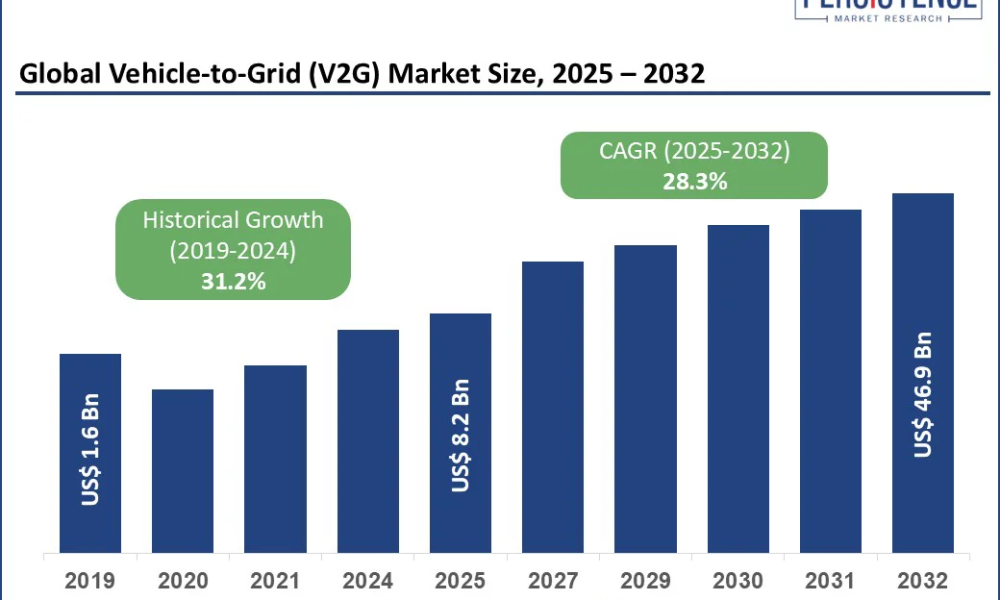
The global Vehicle-to-Grid (V2G) market is witnessing exponential growth, reflecting its strategic importance in the global clean energy transition. According to leading market research analysis, the global vehicle-to-grid market size is estimated at US$ 8.2 billion in 2025 and is projected to reach US$ 46.9 billion by 2032, expanding at a remarkable CAGR of 28.3% during the forecast period. This growth trajectory underscores the rising demand for technologies that enhance grid reliability, integrate renewable energy, and enable bidirectional energy exchange between electric vehicles (EVs) and power grids.
Vehicle-to-Grid technology allows electric vehicles to function as mobile energy storage systems. By storing surplus energy and feeding it back into the grid when needed, EVs can help balance fluctuations in energy supply and demand. This capability is increasingly critical as renewable energy sources such as solar and wind introduce variability into power generation. As a result, V2G systems are becoming an essential tool for grid operators, utilities, and governments seeking to modernize power infrastructure and improve energy resilience.
Furthermore, the emergence of applications such as Vehicle-to-Home (V2H), Vehicle-to-Building (V2B), and Vehicle-to-Load (V2L) is expanding the functional scope of EVs beyond transportation. These solutions empower users to power homes, commercial facilities, and electronic equipment directly from their vehicles, enhancing energy independence and reducing reliance on centralized electricity systems. These capabilities are accelerating adoption across residential, commercial, and industrial sectors.
Get Your FREE Sample Report Instantly Click Now: https://www.persistencemarketresearch.com/samples/35524
Key Highlights from the Report
➤ The global vehicle-to-grid market is projected to grow from US$ 8.2 billion in 2025 to US$ 46.9 billion by 2032 at a CAGR of 28.3%.
➤ Increasing global electric vehicle adoption is significantly driving demand for V2G integration and bidirectional charging infrastructure.
➤ Government incentives and renewable energy mandates are accelerating the implementation of smart grid and energy storage technologies.
➤ The commercial fleet segment is emerging as a major contributor due to its predictable charging cycles and large battery capacities.
➤ Advancements in smart charging technologies, AI-enabled grid management, and IoT connectivity are enhancing operational efficiency.
➤ Growing interest in decentralized energy systems is creating new opportunities for vehicle-to-home and vehicle-to-building applications.
Segmentation Analysis
By Type
The market is segmented into unidirectional V2G and bidirectional V2G systems. Bidirectional V2G technology dominates the market and is expected to experience the fastest growth during the forecast period. This dominance is attributed to its ability to enable energy flow both to and from electric vehicles, allowing EVs to function as distributed energy resources. Bidirectional charging enables utilities to leverage EV batteries for peak load balancing, frequency regulation, and emergency power support, making it more valuable than unidirectional charging.
Unidirectional systems, while less complex and more affordable, primarily focus on optimizing vehicle charging rather than enabling energy export. However, bidirectional solutions are gaining widespread adoption due to their superior grid support capabilities and long-term economic benefits.
By Vehicle/Product/Service Type
Based on vehicle type, the market includes passenger vehicles, commercial vehicles, and fleet vehicles. Commercial and fleet vehicles represent the fastest-growing segment due to their large battery capacities, predictable usage patterns, and centralized charging infrastructure. Fleet operators can optimize energy costs by charging vehicles during off-peak hours and returning energy during peak demand periods, creating additional revenue streams.
Passenger vehicles also contribute significantly to market expansion, particularly in residential applications where homeowners use EV batteries to power homes during outages or peak pricing periods. As EV ownership continues to increase globally, residential V2G adoption is expected to rise steadily.
By Technology and Charging Infrastructure
The market is further segmented based on charging infrastructure into AC and DC bidirectional charging systems. DC bidirectional charging systems are expected to dominate due to their faster charging speeds, higher efficiency, and suitability for commercial and utility-scale applications. Integration with smart grid systems, advanced energy management platforms, and predictive analytics is further enhancing the effectiveness of V2G technologies.
Regional Insights
North America currently leads the vehicle-to-grid market, supported by strong EV adoption, advanced grid infrastructure, and favorable government policies promoting clean energy integration. The United States is a major contributor, driven by utility partnerships, pilot projects, and growing investments in grid modernization. Regulatory support and increasing collaboration between automakers and energy providers are accelerating commercialization.
Europe represents another major market, driven by aggressive carbon reduction targets, widespread EV adoption, and robust renewable energy deployment. Countries such as Germany, the United Kingdom, and the Netherlands are actively investing in V2G pilot programs and infrastructure.
Asia-Pacific is projected to be the fastest-growing region during the forecast period. Rapid EV adoption in countries like China, Japan, and South Korea, combined with government initiatives supporting smart grids and renewable energy integration, is fueling regional growth. Expanding urbanization, rising electricity demand, and large EV manufacturing ecosystems are further accelerating adoption.
Customize This Report for Your Exact Requirements: https://www.persistencemarketresearch.com/request-customization/35524
Unique Features and Innovations in the Market
Vehicle-to-grid technology is evolving rapidly with the integration of advanced digital technologies such as artificial intelligence, IoT, and 5G connectivity. AI-powered energy management systems enable predictive analytics, optimizing charging and discharging cycles based on grid demand, electricity pricing, and vehicle usage patterns. IoT connectivity allows seamless communication between vehicles, charging infrastructure, and grid operators, ensuring efficient energy distribution.
5G connectivity enhances real-time data transmission and enables faster decision-making, improving grid stability and system responsiveness. Cloud-based platforms are also enabling centralized management of distributed energy resources, enhancing scalability and operational efficiency.
Additionally, advancements in battery technology, including improved energy density and longer lifecycle performance, are increasing the viability of V2G systems. These innovations are reducing operational costs and enhancing system reliability, making V2G solutions more attractive for commercial and residential applications.
Market Highlights
The growing emphasis on sustainability and carbon reduction is a primary driver of vehicle-to-grid adoption. Governments worldwide are implementing strict emission regulations and promoting renewable energy integration, encouraging utilities and consumers to adopt energy-efficient solutions. V2G technology plays a critical role in supporting renewable energy by storing excess energy and redistributing it when generation is low.
Cost savings and new revenue opportunities are also driving adoption. EV owners and fleet operators can generate income by supplying energy back to the grid during peak demand periods. Utilities benefit from reduced infrastructure investment by leveraging distributed battery storage instead of building new power plants.
Grid resilience and energy security are additional factors accelerating adoption. V2G systems provide backup power during outages, ensuring uninterrupted energy supply for homes, businesses, and critical infrastructure.
Key Players and Competitive Landscape
The global vehicle-to-grid market is highly competitive, with key players focusing on technological innovation, strategic partnerships, and geographic expansion.
✦ Nuvve Holding Corp. – A pioneer in V2G technology, the company provides advanced grid integration platforms and actively collaborates with utilities and fleet operators.
✦ Nissan Motor Corporation – The company has integrated V2G capabilities into its electric vehicles and participates in global pilot projects supporting grid stabilization.
✦ Toyota Motor Corporation – Toyota is investing in smart energy ecosystems and integrating bidirectional charging in its next-generation EV lineup.
✦ Ford Motor Company – Ford is expanding V2G capabilities through its electric truck platforms and residential energy integration solutions.
✦ BMW Group – BMW focuses on smart charging and energy storage integration to support grid services and renewable energy balancing.
✦ Volkswagen AG – Volkswagen is developing scalable V2G platforms and collaborating with utilities to expand energy services.
These companies are strengthening their market positions through product innovation, infrastructure expansion, and strategic collaborations with energy providers and governments.
Recent Developments
- Several automakers, including General Motors, have launched pilot programs integrating bidirectional charging in residential applications, allowing EV owners to power homes and support grid operations.
- Energy technology providers such as Siemens AGare investing in smart grid platforms that enable large-scale deployment of vehicle-to-grid infrastructure and energy optimization systems.
Ready to Dive Deep? Buy Full Report Today: https://www.persistencemarketresearch.com/checkout/35524
Future Opportunities and Growth Prospects
The vehicle-to-grid market is expected to unlock significant opportunities as EV adoption continues to accelerate globally. Increasing electrification of transportation, combined with growing renewable energy deployment, will create strong demand for energy storage and grid balancing solutions. V2G technology is uniquely positioned to address these challenges by transforming electric vehicles into distributed energy assets.
Supportive government policies, investments in smart grid infrastructure, and declining battery costs will further accelerate market expansion. Emerging applications in residential, commercial, and industrial sectors will create new revenue streams and enhance energy independence.
As digital technologies continue to evolve, the integration of AI-driven energy management, real-time grid communication, and advanced charging infrastructure will redefine energy distribution systems. Vehicle-to-grid technology will play a central role in building resilient, efficient, and sustainable energy ecosystems, positioning it as a critical component of the global clean energy future.




