
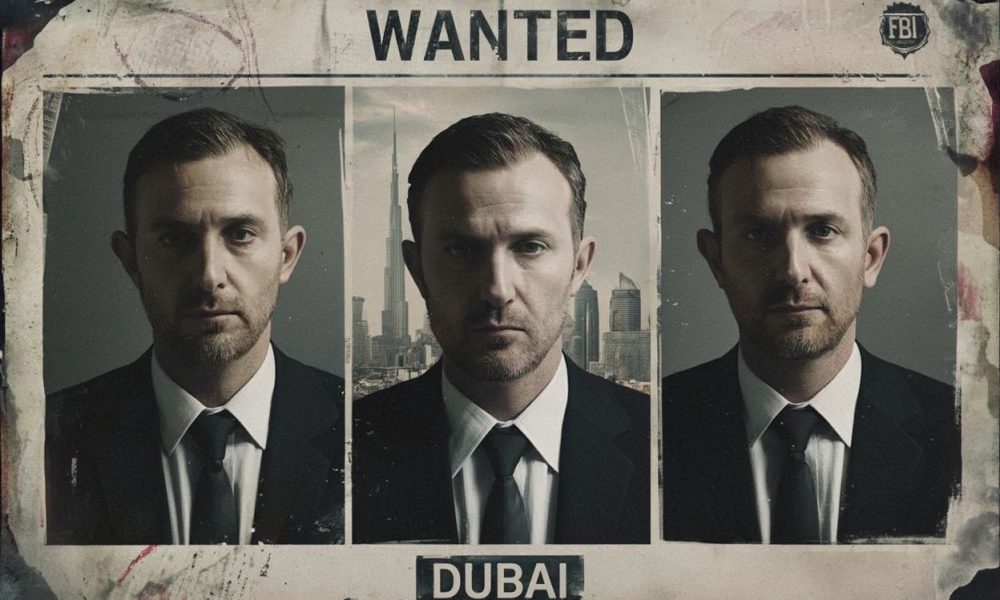
For years, Daniel Kinahan tried to convert his influence in boxing into the appearance of legitimacy, but the sport that helped polish his image ultimately became one of the most visible arenas where his rebranding effort collapsed.
WASHINGTON, DC, April 21, 2026.
Daniel Kinahan’s greatest public relations project was never a formal press campaign or a carefully staged interview strategy, but a long effort to make elite boxing treat him less as an alleged cartel leader and more as a credible international dealmaker with unusual access, unusual calm, and unusual reach.
That effort worked for longer than many critics expected because boxing, with its fluid networks of promoters, advisers, managers, broadcasters, financiers, and power brokers, has always rewarded the figure who can make difficult fights happen even when the background around that figure is ethically toxic.
The sport offered something crime could never buy on its own.
What boxing gave Kinahan was not simply money, because money was already available to a network authorities alleged was deeply involved in narcotics and money laundering, but something even more valuable, namely, a visible lane into mainstream respectability through televised events, championship negotiations, and elite athlete relationships.
In practical terms, the sport allowed him to move through a world of press conferences, contracts, and championship belts, where influence could be framed as expertise and where a man surrounded by serious allegations could still appear as a useful fixer rather than an existential liability.
That is why the boxing phase of the Kinahan story matters so much: it shows how modern organized-crime figures do not always seek legitimacy through politics or conventional business first, and may instead choose glamorous industries where relationships matter more than transparent governance.
MTK became the central vehicle for the rebrand.
Kinahan’s most important foothold in the sport came through MTK Global, the management company he co-founded after its earlier MGM branding, because the firm gave him a structure that looked corporate, international, and professional enough to place his name near fighters, negotiations, and event-making without requiring a formal public title on every occasion.
That corporate shell mattered because it made proximity look normal, allowing Kinahan to be discussed not as an underworld outsider hovering around the sport, but as someone woven into the daily business of matchmaking, career strategy, and the kind of commercial problem-solving that boxing often elevates into influence.
As MTK expanded internationally, the company helped create an atmosphere in which Daniel Kinahan could appear less like a controversial passenger attached to boxing and more like one of the people helping shape its commercial direction during a period when heavyweight boxing was again commanding global attention.
That was the essence of the rebranding strategy: he did not need every fan to admire him or every journalist to trust him, but rather needed enough promoters, fighters, and broadcasters to keep acting as though his presence was commercially useful and institutionally tolerable.
Tyson Fury made the image-management strategy look powerful.
Nothing demonstrated Kinahan’s success inside the sport more clearly than his public association with Tyson Fury, because an adviser who can credibly claim proximity to one of boxing’s biggest global stars immediately acquires a level of legitimacy that would be almost impossible to manufacture through ordinary business branding alone.
The relationship mattered beyond private influence because Fury publicly thanked Kinahan in 2020 for helping move a proposed Anthony Joshua fight agreement forward, a moment that showed just how far Kinahan’s rebranding effort had penetrated the sport’s upper tier.
Once a reigning heavyweight champion publicly presents a man as a meaningful dealmaker, the public sees not merely a name in the shadows, but a person whose role has become visible, normalized, and difficult for the industry to dismiss as rumor or background noise.
That public validation was central to the entire project because Kinahan was not simply trying to work in boxing quietly, but trying to use boxing’s glamour, celebrity, and media attention to recast himself as a businessman whose value lay in making things happen rather than in the allegations that followed him from Ireland and beyond.
Combat sports were useful because they blur access, ego, and commerce.
Boxing is especially vulnerable to this kind of reputational laundering because the sport has long tolerated intermediaries whose exact roles are often fluid, with advisers, consultants, fixers, and networkers operating in spaces where formal accountability is weaker than in more tightly regulated mainstream industries.
That looseness creates an environment where a man like Kinahan could build influence without needing a polished corporate pedigree, because what mattered inside the sport was whether he could bring fighters, money, and opportunities together faster than competitors and with fewer obstacles.
The very disorder of boxing, therefore, became part of the rebrand, because in a sport where back-channel negotiation is often celebrated rather than feared, the ability to broker major outcomes can obscure the much harder question of who exactly is being allowed into the room and why.
For years, that disorder worked in his favor, since even people who disliked the allegations around him still had to confront the reality that his name kept surfacing whenever major business in the heavyweight division seemed to be moving.
The illusion held because success kept arriving before scrutiny could fully catch up.
As long as the sport continued to produce useful outcomes involving figures connected to Kinahan, many participants had a practical incentive to look away, minimize risk, or tell themselves that boxing’s long history of controversial characters meant this was simply another uncomfortable but manageable relationship.
That is how reputational laundering often works at high levels: it does not require full public absolution; instead, it depends on enough people deciding that immediate commercial gain matters more than the long-term institutional damage caused by normalization.
Kinahan’s rebranding strategy relied on exactly that kind of tolerance, with the boxing world functioning as a stage on which usefulness repeatedly competed against alarm, and, for a significant period, usefulness won more often than critics expected.
The result was that an alleged organized-crime figure could appear within one of the world’s most visible combat sports ecosystems as a calm problem-solver, a high-level connector, and a man with the kind of access that others in boxing clearly wanted to preserve.
Washington shattered the arrangement in a single week.
That arrangement broke decisively in April 2022, when the U.S. Treasury sanctioned the Kinahan Organized Crime Group and described the network in severe terms, alleging major roles in cocaine trafficking, international money laundering, and violence, including murder.
The significance of that move for boxing was immediate because sanctions language does not merely wound a public image; it tells every promoter, broadcaster, sponsor, corporate partner, and service provider that continued contact has become a matter of compliance risk rather than public relations discomfort.
Once Washington acted, the sport could no longer treat Kinahan as merely controversial, because the United States had reframed the issue as a formal transnational organized crime problem with legal, financial, and diplomatic consequences far beyond boxing gossip.
That reframing is what made the crackdown so devastating to the rebrand, because image management can survive criticism for years, but it rarely survives a moment when governments transform a useful insider into a compliance hazard that others can no longer explain away.
MTK’s collapse exposed how dependent the brand had become on tolerated ambiguity.
The clearest proof came almost immediately when Reuters reported that MTK Global would close after the Kinahan sanctions, with the company saying it had faced unprecedented scrutiny and that leading promoters were severing ties.
That sequence mattered because it showed the company’s underlying weakness in stark terms, since MTK had looked durable while ambiguity protected it, yet once major commercial actors decided the risk was too high, the enterprise lost the network support that had allowed it to function across the sport.
The collapse was therefore more than a business failure, because it marked the moment when boxing itself admitted, through action rather than moral clarity, that the industry could not keep operating normally around a figure now publicly designated by Washington as part of a major criminal organization.
MTK’s disappearance also revealed how much of Kinahan’s legitimacy project had depended on institutional tolerance rather than institutional trust, because the sport did not destroy his image when allegations first circulated loudly, but only when continuing to indulge the ambiguity became too expensive.
The sanctions did not just target money, but the aura around the man.
One of the most effective aspects of the American intervention was that it attacked Kinahan’s status as much as his business environment, because a power broker is only as powerful as others’ willingness to answer his calls, attend his meetings, and publicly behave as though his involvement remains useful.
Sanctions, rewards, and resulting market panic stripped away that assumption by making every future association feel riskier, every quiet favor harder to justify, and every public appearance more likely to raise the question of why a sport already under scrutiny was still tolerating his presence.
That is the deeper reason the sport’s rebranding failed: the project had always depended on boxing continuing to treat him as a difficult but valuable insider, and once that calculation changed, the entire architecture of borrowed legitimacy began to collapse.
Even those who had benefited from his access had little room left to defend the relationship once governments, the media, and commercial partners were all speaking in a harsher, more coordinated language than before.
Boxing became a lesson in how criminal legitimacy is manufactured and then destroyed.
Kinahan’s years in boxing now look like a case study in how a controversial figure can use a glamorous but loosely governed sport to reposition himself socially, commercially, and psychologically, even while law enforcement continues to build a very different picture outside the ring.
The strategy was sophisticated because it did not ask the public to forget the allegations entirely, and instead asked the industry to behave as though utility, access, and deal-making skill were enough to offset them, which, for a time, proved disturbingly true.
That is why the boxing chapter still matters even after his later detention in Dubai, because it shows how legitimacy can be rented from sport for years when commercial appetite outruns institutional discipline.
For readers looking at the broader legal side of what happens after glamorous industries stop offering that kind of cover, this overview of extradition risk and cross-border surrender mechanics helps explain why distance, status, and elite associations become much weaker once multiple jurisdictions start aligning their enforcement pressure.
The same larger pattern appears in this broader analysis of shrinking safe havens and international mobility pressure, where the key lesson is that prestige sectors can delay reputational collapse without ever guaranteeing that a person’s underlying legal exposure has been meaningfully reduced.
The rebrand failed because boxing could polish the image, but it could not erase the file.
In the end, Daniel Kinahan’s boxing project failed not because combat sports refused to indulge him from the beginning, but because they indulged him until government action made indulgence commercially and politically untenable.
For years, the sport helped him look like a businessman with extraordinary reach, yet once sanctions stripped away the protective fog of usefulness, that carefully cultivated persona gave way to the harder public reality of a man authorities said belonged to a serious transnational criminal organization.
That is the real story of boxing’s dirty power broker, because the rebranding effort was never completely imaginary and in fact worked remarkably well for a time, but it was built on borrowed legitimacy that disappeared the moment the institutions around him decided the price of pretending had become too high.




